About This Episode:
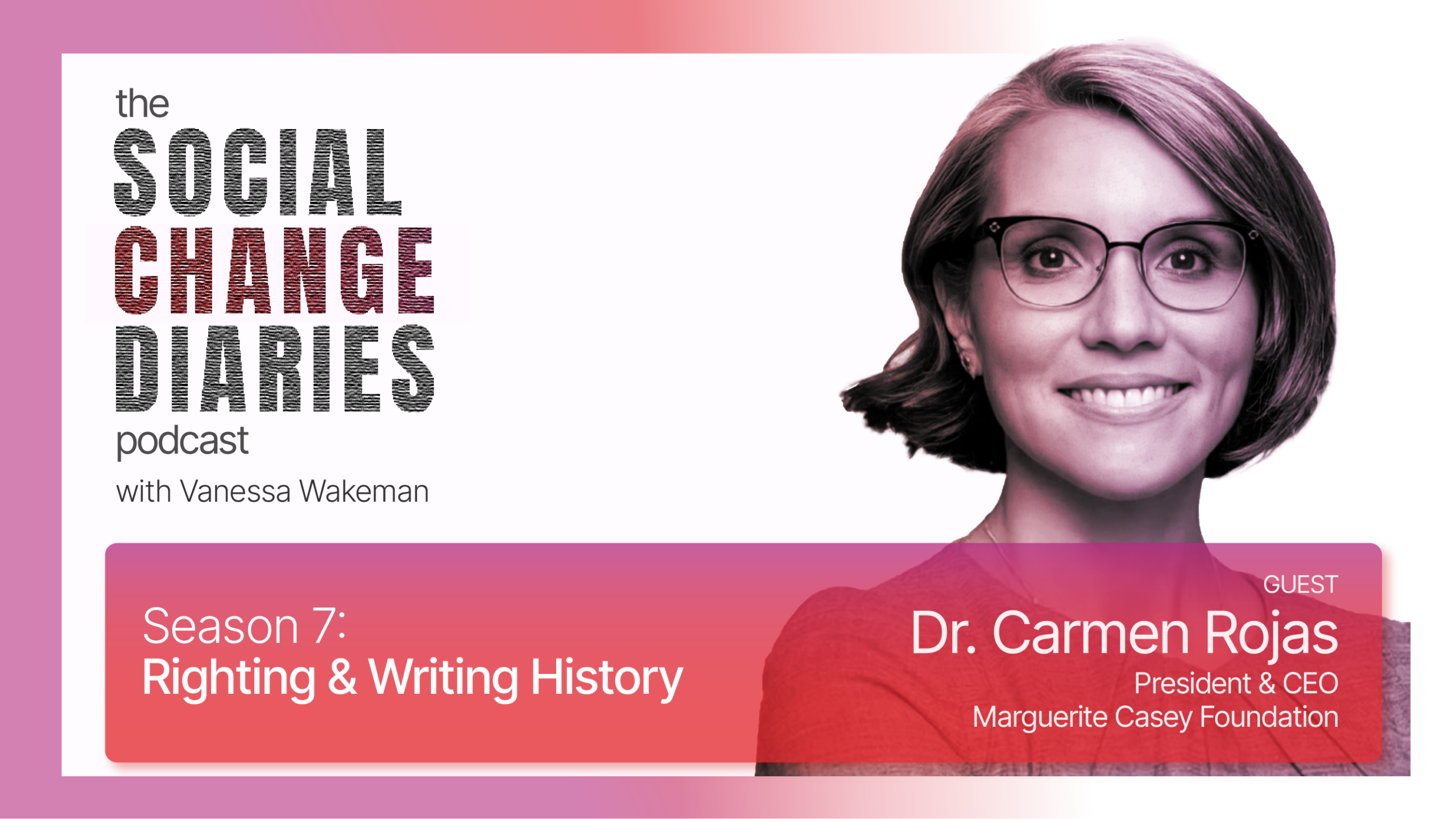
Dr. Rojas and Vanessa discuss how building a durable democracy that improves the lives of people includes investing in the shared humanity elevated through community power, advancing racial justice as a foundational underpinning of democracy and economic liberation, and ensuring that philanthropic resources are 100% aligned with the urgency of the challenges communities face. They also discuss the notion that “we the people” means WE are the people and the transformative power of that perspective.
About Carmen Rojas:
Dr. Carmen Rojas is the president and CEO of Marguerite Casey Foundation (MCF). Under her leadership, which started in 2020, MCF launched the prestigious Freedom Scholar award and has granted more than $330 million in funding to dozens of organizations doing the hard work of shifting power to those people who have long been excluded from having it. Prior to MCF, Dr. Rojas was the cofounder and CEO of the Workers Lab, an innovation lab that partners with workers to develop new ideas that help them succeed and flourish.
In her words…
“Government remains the most powerful vehicle we have to improve people’s lives or destroy them. What we’re living through right now is an example of that.”
“I see philanthropy’s role as planting seeds in people’s imaginations about what’s possible.”
“If you keep saying our communities are in crisis but continue funding at 5%, there’s a disconnect. You’re demonstrating conflicting commitments.”
“I want the record to show that we fought. That the Marguerite Casey Foundation, as an institution, and I, as its leader, along with our board and staff, stood shoulder to shoulder with our grantees and the communities they were created to serve. That we stood with them during the hardest of times.”
“For us, it’s about creating as many spaces as possible for people to build relationships with one another, bear witness to each other’s pain, and, more importantly, become protagonists in each other’s pursuit of power.”
“Our economic liberation is contingent on racial justice. It’s not separate from it. Our democratic future is contingent on racial justice, too. Racial justice and democracy aren’t separate from each other.”
Transcript
Vanessa Wakeman: Welcome to the Social Change Diaries. I’m your host, Vanessa Wakeman. This is our final episode of the season. I don’t want the season to end, but here we are, and we’re ending just as strong as we started.
Our guest today is Dr. Carmen Rojas, president and CEO of the Marguerite Casey Foundation. Since stepping into the role in 2020, she has led the foundation in launching the prestigious Freedom Scholar award and granting more than $330 million to dozens of organizations working to shift power to people who have long been excluded from it.
Before joining the Marguerite Casey Foundation, Dr. Rojas co-founded and served as CEO of the Workers Lab, an innovation lab that partners with workers to develop new ideas that help them succeed and thrive.
Welcome, Carmen!
Carmen Rojas: Thank you so much for having me, Vanessa.
Vanessa Wakeman: I want to put a little pressure on this conversation because it’s our final interview of the season. I’m hoping our discussion leaves listeners with a lot to think about, consider, and work toward. I also hope it helps them reframe some of what’s happening in the world and, ultimately, gives them a sense of hope. So, no pressure, but there’s a lot riding on this conversation!
Carmen Rojas: I’m ready to deliver.
Vanessa Wakeman: Thank you, thank you. I want to start by talking about the foundation’s mission, which is explicitly focused on shifting the balance of power toward communities that have historically been excluded from shaping society. What does that look like in today’s climate?
Carmen Rojas: Our North Star at the Marguerite Casey Foundation is to fund organizations, leaders, and initiatives that are building power to transform government so that it delivers for working people. In very concrete terms, that means making sure everyone has a decent home to live in, access to great schools and quality healthcare, clean air and water, and all the things people need to live a good life. The government should be providing those things for people.
But as you alluded to, Vanessa, these organizations and communities are under serious attack right now. This administration has severely cut social safety net programs, pursued aggressive and often violent immigration enforcement, and deployed armed forces to patrol our streets. All of this has created a climate of enforcement and fear that has silenced many organizations fighting for racial and economic justice.
For us, our mandate hasn’t changed because of this political moment. If anything, we’ve stepped more fully into it.
For example, in Maine, after ICE killed a young father, we were able to quickly get resources to organizations on the ground that were supporting his family and other immigrant families in the community.
But I would be remiss if I focused only on how we’re responding to this moment without also talking about the future we want to build. We’re supporting organizations that are working to create a durable democratic future.
One example I love to talk about is the African American Roundtable in Milwaukee, Wisconsin. The group came together to organize with their neighbors and demand a greater say in how their tax dollars are spent. In the aftermath of 2020, they began asking themselves, “Who gets to decide how our tax dollars are being used?”
This year, they won $600,000 from the city of Milwaukee to implement participatory budgeting, giving their neighbors a meaningful role in deciding how public resources are allocated.
For us, the work is about both protecting communities that are clearly under attack in this moment and planting the seeds for a future in which people feel and know that their government is working to make their lives better.
Vanessa Wakeman: So, it sounds like you’re identifying emerging opportunities as things unfold. I would imagine that requires having strong relationships with organizations, so they’re communicating with you when they see things happening, and you can think together about how to respond. That means being proactive and investing in opportunities without knowing exactly what the outcomes will be, while also being able to react when something happens.
You mentioned the opportunity to build a durable democratic future that emerged after 2020. Are there similar opportunities you’re seeing now? Maybe there are things you hadn’t previously anticipated needing to plan for, or areas you’re considering investing in because you’re seeing recurring issues or emerging patterns. Are there any opportunities coming to mind?
Carmen Rojas: Mm. Gosh, you know, we’re here talking about communications and how it shapes our lives at a time when so much of the information we consume is controlled by a handful of people whose interests don’t necessarily align with those of the broader public. I’ve been thinking a lot about that, as well as about real examples of government delivering for people and how we might support those efforts.
Fundamentally, I’m thinking about how we can support both the protection of our democratic systems and the practices that keep democracy alive.
What I love about the African American Roundtable example is that it was a group of everyday people who were frustrated that they didn’t have a say in how their tax dollars were being spent. Instead of blaming immigrants or other communities that this administration has aggressively targeted, they said, “We want to have power and a voice in how our resources are used.”
They came together with their neighbors to build the power necessary to decide how public resources, their resources, were being used to shape their lives.
Vanessa Wakeman: Yeah, that’s a powerful example and a reminder that we, the people, are the people, right? It’s us.
One thing I’ve been thinking about in my conversations with our clients, particularly foundation clients, and with foundations more broadly, is the growing number of conversations about field building. How do we work together to elevate issues? There are great things happening in different communities and cities, and we need to think about how to build a community of practice where we can share these examples and communicate about them with different audiences.
Through a communications lens, I’m seeing two things happening. First, there’s so much disinformation that people don’t know what to believe or what they should support. I think people are feeling afraid, and in some cases, they feel like it’s over.
So, how do we hold the line and build narrative resilience so people understand that we have a robust infrastructure of organizations doing this work?
And to your point about nurturing that process, how do we make sure philanthropy is thinking about protecting democracy as an opportunity to build something better? When we look at the organization you just mentioned, for example, what they’re doing is better than what we’re used to. How do we elevate that idea and show people that we can do better? What does that look like for you all?
Carmen Rojas: Sort of, yeah. You know, we can do better. I want to respond to something you said earlier about misinformation.
We sponsor the National Book Awards, and one of this year’s nonfiction finalists is an amazing book called Let the Poets Govern. Kaveh Akbar opens the book with the line, “Language is what governs us.”
I feel like we’ve been fast and loose as a society, not only with the language that governs us, but also with how language shapes the way we see ourselves and our relationships with one another.
For me, this is especially powerful when I think about the role of government. The reason we’re so committed as an organization to government delivering for people is that we know there’s no institution more capable of shaping people’s lives. Government remains the most powerful vehicle we have to improve people’s lives or destroy them. What we’re living through right now is an example of that.
And for me, I want something better. To get to your question, I don’t think the current system has worked. We got here because a number of people made decisions that kept opportunity, freedom, and the ability to live a good, decent life available only to a small number of people.
Meanwhile, 70% of Americans in the richest country in the world don’t have $1,000 in savings to cover an emergency.
When I think about imagining something so much better, I think we have a rich history to draw from. Consider the abolitionists. What an extraordinary thing to imagine: for hundreds of years, this country’s economy was organized around slavery, and yet a group of people imagined something radically different.
Or consider the New Deal and the idea that government could provide the workplace protections and livelihoods people needed, along with Social Security. There was a time when our elders were left to die without a safety net. People imagined and dreamed of something so much more.
Over time, though, the language surrounding government became synonymous with inefficiency and incompetence. And I’ll say that’s everybody’s fault. It’s all of our fault. A lot of us, and I don’t know if you can cuss on your podcast, but I’m a cusser, were just like, “The government ain’t shit. It does nothing to make my life better.”
I think too many of us have internalized that cynicism, and it’s been to the detriment of the majority of us.
I need to say this again: government remains the most powerful vehicle we have to improve people’s lives. It distributes money, creates policy, and builds things.
In this moment, I worry that as people seek to return to a government that was atrophied, weak, and small, we’ll lose the opportunity to imagine a government that can deliver for all of us, as it has in the past and could do again in the future.
Vanessa Wakeman: That was a wonderful reminder of who we are and what we’re capable of.
I want to touch first on what you said about language because I do think it’s incredibly important. Language can be used in powerful ways, both positive and harmful. It can be intentionally used to shape perceptions, influence behavior, and affect how people think about things.
At our agency, we’ve been almost relentless in reminding people to think about how they’re telling stories, the language they’re using, and the narratives they’re reinforcing. We’re constantly asking people to consider the counter-narratives, too.
Building on what you said about government, I agree that many people don’t have a lot of positive things to say about it right now, given the position we’re in. But there’s an opportunity to restore government to what it can be. That takes citizens being actively involved in shaping it.
If government is the most powerful institution we have, where does philanthropy fit in?
I’ve talked before about the interdependence between government, philanthropy, and the private sector. At any given moment, one of those sectors may take the lead depending on what’s needed.
I feel like a lot of people are looking to philanthropy and asking, “Are you going to save us?” So, is philanthropy going to save us? What do you see as its role in this moment?
Carmen Rojas: I see philanthropy’s role as planting seeds in people’s imaginations about what’s possible. I use the African American Roundtable as an example because that kind of work is possible everywhere.
We’re seeing it happen in New York City, too. The mayor is pulling up an Excel spreadsheet and saying, “Here’s what the city’s budget looks like. These are the choices I’m making with the tax dollars you pay to govern the city. These are the trade-offs we have to make.”
Far too often, we’ve treated the people most affected by government failures as the least capable of informing conversations about how public resources should be used.
I think the best role philanthropy can play is creating that space for possibility. And, I mean, there are certain realities. We don’t have enough money to solve everything, so philanthropy isn’t going to step in and do it all. We’re also not democratic institutions, right?
Vanessa Wakeman: Right. Right.
Carmen Rojas: For all the conversations about the good that charity can do, people don’t necessarily get to decide. Everyday people affected by the decisions of major institutions don’t get a say when a big donor comes in and says, “You know what? We’re going to shut down public schools and only have charter schools. School choice is the answer.”
People don’t get to decide those things. Philanthropy isn’t inherently democratic.
So I think, at our best, we can point to clear examples of what a multiracial democracy looks like in practice and what a just economy looks like in practice.
Vanessa Wakeman: The point that philanthropy isn’t inherently democratic is so important, and I don’t think we think about it enough. There are a lot of assumptions we make about philanthropy. So, thank you for raising that.
If historians were to look back at this period in philanthropy, what would you want the record to show?
Carmen Rojas: I want the record to show that we fought. That the Marguerite Casey Foundation, as an institution, and I, as its leader, along with our board and staff, stood shoulder to shoulder with our grantees and the communities they were created to serve. That we stood with them during the hardest of times.
I hope it will show that we were unafraid and bold, that we were willing to step into the fray and be at the front of the fight, knowing we could absorb a blow.
I also hope we’re modeling a few things as an institution. One is aligning our resources. One hundred percent of our resources should be aligned with our mission. Another is giving out more money.
Over the last three years, I’ve been in so many conversations where people keep using the language of crisis but continue funding in ways that reflect fear. It’s disturbing. There’s a mismatch, Vanessa. And I love this line: “Language is what governs us.”
If you keep saying our communities are in crisis but continue funding at 5%, there’s a disconnect. You’re demonstrating conflicting commitments.
I hope that our increased payout last year, along with our increased payout over the next 10 years, will demonstrate a clear institutional commitment to aligning our resources with the needs of communities that are struggling. And, once again, I hope we’re planting seeds in people’s minds about the possible future we could be living in.
Vanessa Wakeman: So, that’s what you want the record to show. What do you think history will be most critical of? When I look back at history, I sometimes find myself asking, “Why did they do that? Why didn’t they do something differently?” What do you think history will be most critical of when it looks back at this moment?
Carmen Rojas: Oh, gosh. You know, the thing is, the internet is savage, Vanessa. I’m so glad I’m Gen X and had a pager as a teenager because it really is savage.
And one of the ways it’s savage is that, in 2020, institutions made real commitments to loving Black people and supporting Black freedom. But by 2026, you can’t even say the word “Black” without people labeling it DEI and threatening to withhold funding.
That’s where we are in history today. We’re living through a moment when we can look back at institutions and their leaders who were once proud of the protesters who reshaped conversations about criminal justice and policing in this country. Today, those same organizations can’t even get a call with those funders.
I remember the number of people who became converts in 2020, and even before that, in 2016 and 2017. I was in conversations with leaders who would talk about the march across the Edmund Pettus Bridge and say, “I would have been on that bridge.”
And honestly, I would think, that sounds really scary. I don’t know if I would have been there.
But people would say with their whole chest, “I would have been there. I would have stood with Dr. King,” forgetting that, at the time, Dr. King was one of the least popular people in this country.
He wasn’t the figure we imagine him to be today. In that moment, he was questioning capitalism. He was talking about ending war and violence against people. He was advocating for dignified work.
He was also able to connect what people thought of as a regional issue, confined to the South, to what was happening in places like Chicago and other parts of the North. He was saying, “Actually, we thought that was messed up down there. It’s also messed up here for Black people.” He was making those connections.
And I look back at those conversations from 2016, 2017, and 2020, and at what people were saying. Now we’re seeing organizations change grant agreements, subject themselves to legal reviews over charitable purpose, and face investigations from foundations that are scrutinizing their social media profiles. These are the same organizations those foundations once invited to speak to their boards.
The dissonance is enormous. I don’t think our institutions will be looked upon kindly, either in the near future or in the distant future.
And if you run a nonprofit organization in this country, you’re already experiencing this. You’re looking back at conversations you had just a little while ago, remembering when someone couldn’t wait to have you come speak to their staff, only to find yourself being pushed to voicemail, if anyone responds at all.
Vanessa Wakeman: Yeah. I think it’s been a very painful experience for organizations because, in many ways, their reality was altered. We thought we had finally reached a moment where we’d found the keys to the secret door, where we could have these conversations openly and feel seen. And then, for that door to shut again, is traumatizing.
I think it’s a difficult hurdle to overcome, and history will remember it. The people who have been impacted by it will certainly remember it, too.
Carmen Rojas: Totally.
Vanessa Wakeman: You had an interview with the Associated Press earlier this year, and you said something I thought was really interesting: “Philanthropy should use the full weight of its resources to advance its mission.”
Speaking on behalf of all the organizations I know, I can say the response is, “Yes, please!”
So, what does using the full weight of those resources look like, and how does that apply at the Marguerite Casey Foundation?
Carmen Rojas: Oftentimes, when people think about foundations, they focus on our charitable giving, which is the 5%. But people don’t talk about the other 95%.
Historically, foundations have given 5% of their assets to nonprofit organizations in the form of grants. The other 95% operates, euphemistically, in the background to help generate the returns that make those grants possible.
As an institution, that didn’t make sense to us. We wanted to devote as much time and energy to the 95%, including talking about what we’re invested in, as we do to the 5%.
We’ve challenged conventional philanthropic wisdom by saying that all our resources, 100% of the capital we steward, should be working toward our mission.
One of the clearest examples is the one I shared earlier. We supported organizations in Maine after ICE killed a father. Imagine if we had made those grants while simultaneously investing in companies like Palantir or Meta that profit from surveillance, the killing, incarceration, detention, and often illegal detention and deportation of our neighbors.
We’ve made some very deliberate decisions about how our endowment is invested. We don’t invest in companies involved in surveillance, weapons manufacturing, detention centers, predatory lending, or fossil fuels because we believe these industries often harm the very communities we were created to serve.
So, when I think about using the full weight of our resources, it means aligning our actions by ensuring our grantmaking and investments work toward the same mission. It also means making our commitments on the investment side just as visible as our commitments to grantmaking.
Vanessa Wakeman: And has any of that been challenging to implement?
Carmen Rojas: Not at all. I think what’s interesting about conversations around divestment is how complicated institutions make it seem to invest in line with their principles.
We’re really fortunate to have an amazing Vice President of Investment Operations, Dan Gould, who has led this work for the foundation. Our board chair is also an asset manager who has helped demystify the world of endowment investments, both for us and for our peers.
Vanessa Wakeman: Got it. Thank you.
On your website, you talk about defending civil society as central to your mission. What does that actually look like, and what does it mean in this moment? Should more organizations consider defending civil society a core tenet of their missions?
Carmen Rojas: At our core as an institution, we want to support everyday people in coming together and feeling that they have greater power, greater agency, and a greater say in how they get to live their lives.
I really love the saying, “It’s hard to hate people up close.” The amazing thing about community organizing is that it brings people together. It allows people to sit in a room and, at first, commiserate. Why is their rent so high? Why are they working 60 hours a week and still struggling to make ends meet?
Then something magical happens. People move from feeling disempowered to recognizing that they’re not alone. They realize that, by building relationships with one another, they can have a meaningful say in the institutions that shape their lives.
For us, it’s about creating as many spaces as possible for people to build relationships with one another, bear witness to each other’s pain, and, more importantly, become protagonists in each other’s pursuit of power. It’s about giving people the opportunity to shape a future worth living for themselves, their neighbors, and their families.
One thing I’m always reminded of, both by history and by what I see around the world, is that with or without philanthropic resources, people will come together to fight for better lives for themselves, their neighbors, and each other. They’ll fight for a better life for all of us.
At our best, philanthropy can be the wind in their sails, helping make it possible for people to come together and build the future we want.
Vanessa Wakeman: I love that, and it’s the perfect lead-in to my next question.
While we’re collectively trying to right the ship in this moment, let’s say we don’t. If democratic institutions continue to erode over the next few years, what happens?
I know you mentioned earlier that philanthropy doesn’t have enough money to fill in all the gaps, and I completely agree. I’ve been doing some math in my head lately, and the reality is that we just don’t have enough money.
So, what changes do you think are necessary for philanthropy to continue playing a valuable role if we aren’t able to course-correct? Let’s say we get to 2028 or 2030 and things haven’t turned around. What does philanthropy need to do differently?
Carmen Rojas: Yeah. I think we have to be able to walk and chew gum at the same time. On one hand, I don’t think we can abandon the very real need to protect democratic institutions and safeguard what we’ve long known to be democratic practices, like the right to vote and the right to protest. I think we have to be able to stand up and, as institutions, support the people and organizations that are working to safeguard these institutions.
But we also have to be able to nourish the practices of democracy. Too many institutions in philanthropy have underinvested in these practices because they’ve thought that either we invest in the practices or we invest in the institutions. And I believe we have to meaningfully do both.
In order for everyday people to believe these institutions are worth protecting, they have to have faith in the practices, too. For us at the Marguerite Casey Foundation, the best way to build these durable practices is by supporting organizations that bring people together every day to make decisions about their lives. That happens through community organizing, popular education, and the kind of work that helps people see and be with each other during their hardest times, in service of a brighter and better future.
I think it’s hard. Again, the things that come to mind, Vanessa, are that the vast majority of people in this country are struggling, while the richest people in our nation are looking down on that struggle. They’re saying, “We don’t understand how you could vote this way because eggs cost a lot of money or because gas costs a lot of money.”
I feel like we’re in a moment when our most powerful institutions are so far removed from the lived reality of the majority of people in this country. If we aren’t able to bridge that gap and acknowledge people’s pain, we’re going to have a problem.
When I was growing up, one of my favorite breakfasts was eggs with tortillas. It was scrambled eggs with corn tortillas, all mixed together. My mom worked, my dad worked, and my brothers worked. It was the fastest, healthiest thing they could make for me. It was also the most affordable thing they could put on a plate for me.
When we look down on people’s economic pain, I feel like we create openings for nefarious forces and misinformation, for people who want to take that pain and harness it for harm.
We need to be able to fill that gap by helping people meet their day-to-day needs and helping that become the fuel for imagining a possible future.
Vanessa Wakeman: This is my last question for you. We talked a little bit earlier about communications and language, and you just alluded to some of that in your last statement.
Is there a particular narrative you’re hearing, or one that comes to mind regularly, that you feel is especially harmful in this moment? It could be related to specific social issues, philanthropy, the nonprofit sector, or anything else. Is there a narrative that makes you think, “We need to invest some time and energy in figuring out how to counter this or reframe it”?
Carmen Rojas: Yeah. Gosh, so many, Vanessa. So many.
Vanessa Wakeman: Which ones are most annoying and frustrating to you?
Carmen Rojas: You know, as a Latina, I’ve been thinking a lot about the way people talked about Latinos after the last election and the sense of betrayal some people expressed. They were asking, “How could Latinos have voted for Trump?”
The issue of eggs keeps coming up for me. I’ve been in a lot of fancy conversations where people say, “It wasn’t the eggs. It was racism.” And I’m kind of like, well, maybe it was a little bit of both. Let’s have that honest conversation. But the eggs actually matter.
This is especially front of mind for me because a report came out last week. I grew up in California, and I’m a proud Californian.
Vanessa Wakeman: Right. Yes.
Carmen Rojas: And California is a place where Latinos make up 40% of the electorate. In California, 40% of Latinos have not been contacted by absolutely anybody about the upcoming elections, whether through partisan or nonpartisan outreach. Across the country, 60% of Latinos have not been contacted by anybody about the upcoming elections.
Sixty percent of one of the fastest-growing groups of people in this country have had absolutely no contact from anyone about these upcoming elections.
For me, I go back to that last example. When space is created, nefarious forces will fill it. And if we keep creating that space without offering a different vision of a possible future for all of us, I worry for everyone. I worry. I really, really worry.
I’ll share one more thing, especially now that I have this fancy Yeti microphone. Vanessa knows it’s my first time using it, and I’m going to be unstoppable now!
The other issue is racial justice, and this feeling that, as a nation, we have to choose between conversations about economic opportunity and racial justice. We’re failing to recognize that the fabric of our nation weaves these things together. Our economic liberation is contingent on racial justice. It’s not separate from it.
Our democratic future is contingent on racial justice, too. Racial justice and democracy aren’t separate from each other.
My real hope is that we can fill these spaces as quickly as possible, both by offering a vision for the future and by having the ambition to build the future we know this country is capable of delivering for everybody who lives here.
Vanessa Wakeman: If I wanted to be greedy and take up more of your time, I would ask, does this country really know? Do they really know?
Carmen Rojas: Yeah, be greedy, be greedy. No, but who is “they”? It’s we, right? Like you started with this, Vanessa: “We the people.” And so I feel like one of the things, you know, as the kid of immigrants, I’ve talked about this as a kid of immigrants. My dad’s from Venezuela, and my mom is from Nicaragua, two countries that have experienced, you know, contemporary social revolutions that have quickly turned into autocratic nations in my lifetime. Not even in my lifetime, but in the last, you know, yeah, in my lifetime.
I think a lot about people saying “them,” like “they.” And I think at some point, we have to be clear about the “we” and the “us.”
And in 2016, I just imagined going somewhere else. I was like, “This ain’t shit. I don’t really like it here. It’s not for me.” And then I remembered how amazing this place has been. Not evenly or equally, not fairly or transparently, but for me, how amazing it has been.
My mom was 16 when she came to San Francisco with a middle school education. She got a job working at a bank at a time when banks gave entry-level employees no-interest loans to buy their first homes. My dad immigrated when he was, like, 19 or 20. He was the youngest of 10 kids from an island off the coast of Venezuela. He’s a fisherman and got a job as a teamster, as a truck driver.
And imagine that my parents left these places to come here to create a kid who is me, who gets to be here talking to you, dreaming and imagining a possible future.
And so then I go back to the Edmund Pettus example, the abolitionist example. You know, this country has not always been fair. It has not always been for all of us. Our founders never imagined a Vanessa or a Carmen being in a conversation, dreaming of a future. And that does not mean that it’s not possible.
And I refuse to give it to them. I refuse to give it to them.
Vanessa Wakeman: That is 100% legit, and I agree and cosign. I think for me, it’s like, when we think about the power dynamics, I do feel the us and them. So I think that we the people, we do have the power, but I don’t think we fully know it or have fully realized it. And so I think that’s the tension that needs to be resolved.
Carmen Rojas: Yeah. Yeah. Imagine, though. The woman who founded the African American Roundtable in Wisconsin was a news broadcaster during 2016, 2017, and 2018, and then she wanted to do more. She was like, “I want to give back to my community,” and started working at a nonprofit organization in an entry-level job.
And then 2018, 2019, 2020 happened. She was like, “Gosh, all these people are talking about where these dollars are going, you know, defund the police. So many people are saying this, and I want to do that, but I also want to know where all of these other dollars are going. Who gets to decide that?”
She did this miraculous thing, which is she became the “we,” and then she made a space.
Tenants in Kansas City, you know, the Kansas City Tenants Union, they come together in some of the worst housing conditions you could imagine. Like, you can’t… This feels intergalactic. It feels like something from a past time, the housing conditions today in Kansas City.
Tenants came together, and they were like, “Enough is enough. The rent’s too damn high. We pay rent. We deserve to have dignified housing.” And they not only fought their landlords and won, but they also fought and won to get the first social housing bond in Kansas City history. So the city of Kansas City now has to build social housing for working people in their city.
Everyday people who are, you know… We imagine it’s impossible. Imagine being an undocumented person in this nation.
Vanessa Wakeman: There’s examples, yeah.
Carmen Rojas: Imagine being, you know, I think about people in Tennessee right now who are fighting the expansion of one of the nation’s largest data centers, which was not democratically voted for or supported. The people are fighting every day, across race and across class. They’re saying, “Enough is enough. You billionaires have lived enough. You’ve stolen enough from me, have stolen enough of my life, have stolen enough of my future. I want more and better.”
I feel like if the people of Memphis, the people of Kansas City, the people of Milwaukee can do it, Vanessa, you and I have to be able to do it too.
Vanessa Wakeman: Fair enough. So I think our T-shirt is “I Am the We.” It’ll be in stores next month. Look out for our merch drop with Vanessa and Carmen.
Carmen Rojas: I am the way! I am the way!
Vanessa Wakeman: Carmen, thank you so much for joining me. We appreciate this conversation.
Carmen Rojas: Mm, thank you so much, Vanessa.
Vanessa Wakeman: I loved Carmen’s framing in today’s conversation, and it feels like the perfect way to wrap up this topic. This season’s theme, Righting and Writing History, focused on philanthropy’s role in protecting democracy. Carmen took that a step further. When I casually commented that “we the people” is really all of us, she provided a powerful example of what that looks like in action by describing the work of the African American Roundtable and reminding us of all the ways that we the people do, indeed, have power. I hope everyone walks away from this conversation feeling a little more hopeful about what is possible.
This show explores the intersection of communications and social change, and Carmen and the other guests this season highlighted just how important communications is in the sector and how it supports meaning-making for the public. With so much disinformation and harmful counter-narratives, we need to use communications to hold the line, ground stories in facts and emotion, and make sure our narratives are resilient and able to withstand, adapt to, and respond to counter-narratives. We also need to be responsible for the language we use. All of this contributes to the strength of our democracy.
I want to thank all of our guests this season and, of course, all of our listeners. Please continue to send me your comments and questions. While this is our final episode of the year, we will be back in January with Season 8.
And while Carmen and I do not have any merch coming out, I hope we all remember that we are “we the people.”
See you in January!