The annual Edelman Trust Barometer has just been released, and although it is not surprising, the report emphasizes the global shift toward more insular thinking when it comes to trust. Across twenty-eight countries and almost 34,000 respondents, there has been a substantial decrease in respondents’ willingness to trust people who are different from them.
This shows up in a number of ways in the data, and there are useful insights for nonprofit communicators to take note of. Below, we share some of the most compelling points from a review of the findings, along with our recommendations.
1. Trust is mitigated by income at a global level
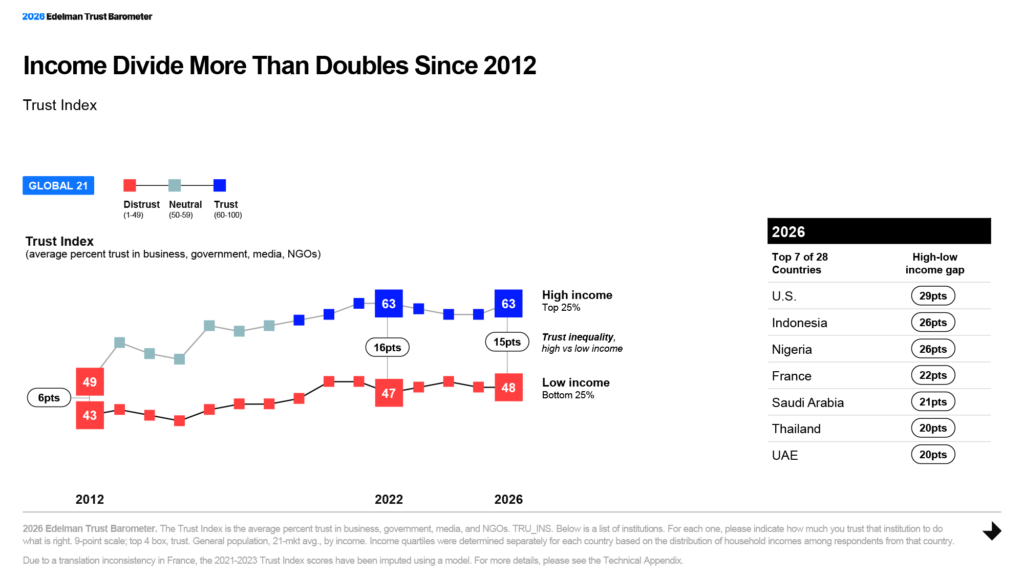
One of the long-standing outcomes of recent Edelman Trust findings is that people who fall into the lowest income categories of their given country, and those who fall into the highest income categories, have significantly different levels of overall trust. The U.S. has the highest recorded trust disparity across income levels of any country—twenty-nine points on average for the difference between people in the lowest 25% income and the highest 25% income.
2026 Edelman Trust Barometer Global Report, Trust Amidst Insularity (7)
This is distinct from how income disparity is usually talked about in the U.S. since the 2008 financial crisis, regularly pitting the 1% against the “rest,” and shows that income impacts levels of trust across large swaths of the population.
Take Action: Your organization can build on this knowledge by thinking through what assumptions may be embedded in your public relations with different audiences. Are you using the same language to communicate to both prospective program participants and prospective funders? What about prospective supporters in different funding mechanisms—Giving Tuesday as opposed to fundraising galas?
You can strengthen your communications to all audiences by thinking strategically about what assumptions you have made regarding levels of trust among those audiences, and tweaking your messaging to recognize that likely reality. We recommend testing adjusted messaging and taking note of response rates, in order to gradually see if you notice a difference based on your changes. Gathering this kind of information can help to position your future public relations efforts more confidently.
2. Insularity has increased
70% of US respondents indicated that they are “generally hesitant or unwilling to trust someone who”:
- “Lives by different core values than me.”
- “Believes different facts and trusts different sources than I do.”
- “Wants to address societal problems differently than I do.”
- “Has a different culture, background, or lifestyle than mine.”
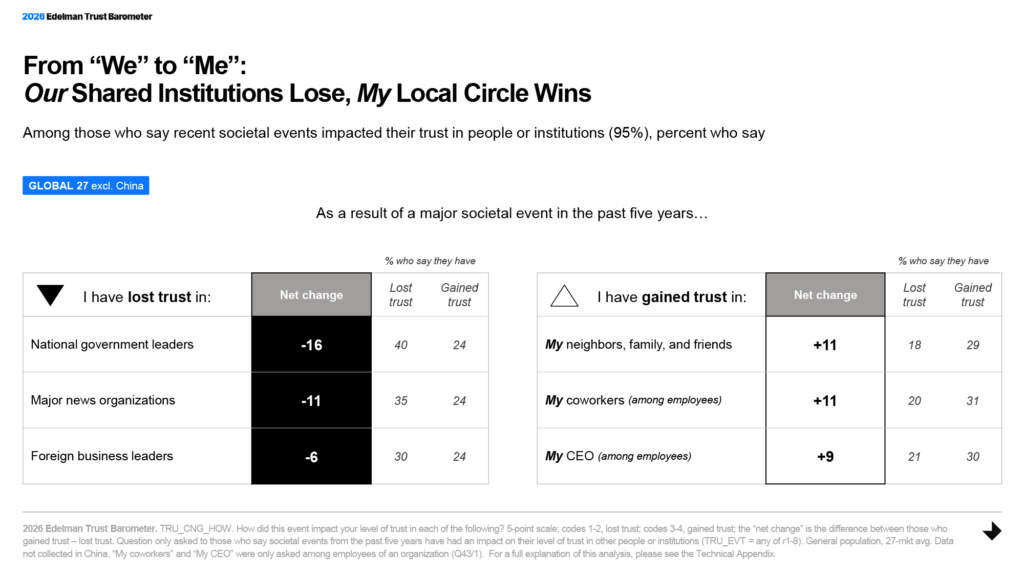
This is a strong indicator of an increasingly closed-minded and limited mindset. However, this insularity is also considered a problem by many. Insularity is also reflected in the fact that, as trust in larger entities decreases, trust in more local relationships has increased. The data shows that people across the world have lost trust in national governments, major news organizations, and foreign business leaders, but gained trust in “my neighbors, family, and friends,” “my coworkers,” and “my CEO.”
2026 Edelman Trust Barometer Global Report, Trust Amidst Insularity (15)
Take Action: Combined, these data indicate that insularity can be more effectively addressed through personal relationships. Increased social equity depends on a willingness of populations to be open to and trusting of people who are different from themselves. The best approach for nonprofit organizations to take is through a communications strategy that relies on the connections people have with those they are already close with.
3. Organizations should act—intentionally—as brokers of trust
The Edelman report also shares recommendations about how NGOs should help to broker trust:
- Fostering understanding among distrusting groups.
- Establishing local community mediation programs.
We agree that these are important types of work for some organizations that are focused on dialogue across difference or conflict mediation. However, we recognize that this is not the mission of many of those in our network.
For organizations working to foster increased equity, the most effective communications strategies today aim to influence behavior and attitudes of what we might call the “movable middle,” rather than focusing on explaining differences or mending community relationships. Also, given that many organizations include people who have lived experience with the issues they are working to solve, this recommendation can risk burdening people with the task of explaining themselves to those who are hostile to them.
However, data on those who already have high levels of trust in others who are different from them indicate two important themes that can be more helpful to a wide range of nonprofits. Respondents with high levels of trust in others who are different than them—those who Edelman identifies as having an open mindset—say that:
- Acknowledgement and acceptance of differences is important, without trying to change someone.
- Helping and defending someone when they have been criticized has played a role in fostering more open trust of others across differences.
This points to the value of using overt language about differences—whether that is race-conscious communications, those that affirm a range of gender identities, or simply recognizing and valuing the greater outcomes that result from a diverse group of people contributing to an effort. The second point highlights the value of organizations providing support for communities to actively counter hateful rhetoric and directly address bigoted narratives, whether in public discourse or interpersonal communications.
No matter what direction you decide to take, trust should be a factor that is incorporated into your public relations strategy.
If your organization could benefit from further insight on how to translate trust into a concrete communications plan tailored to your audiences, reach out for a confidential, exploratory conversation.