About This Episode:
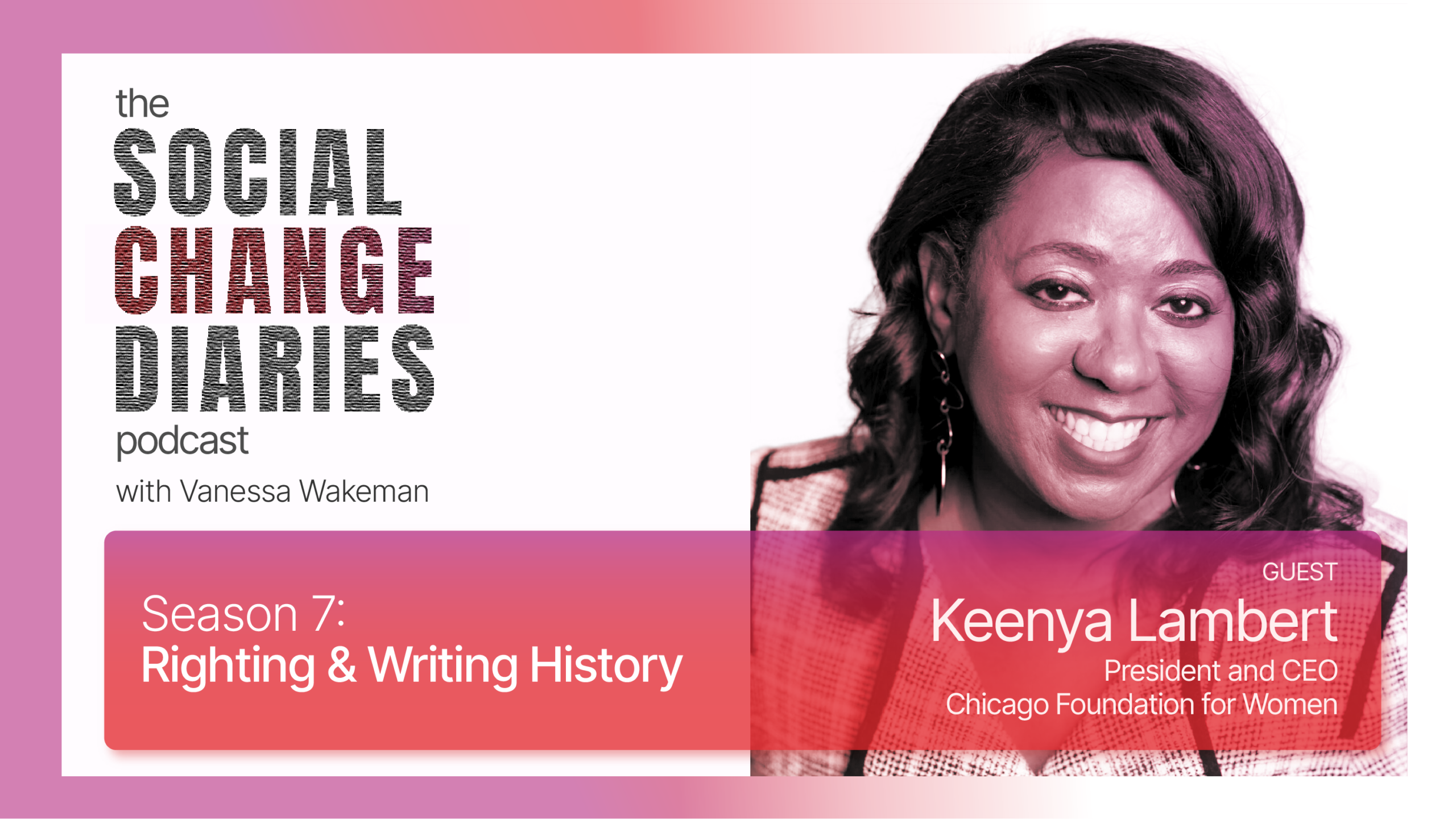
In this week’s episode of the Social Change Diaries, we discuss why movements are the foundation of social change work, what can happen when we refuse to wait for someone else to make the change, and what it looks like to apply these lessons in our own institutions. With our guest, Keenya Lambert, President and CEO at the Chicago Foundation for Women, Vanessa examines the role of movements in orienting foundation impact and the possibilities this presents for the democracy we are continuing to build today.
About Keenya Lambert:
Keenya is a Chicago native with 23 years of successful nonprofit experience in fundraising, advocacy, direct service, and executive leadership. She was part of Leadership Greater Chicago’s (LGC) 2025 cohort of The Daniel Burnham Fellowship and was recently recognized by Crain’s Chicago Business as part of its 2026 Who’s Who in Chicago Business list. As the President and CEO of Chicago Foundation for Women (CFW), Keenya has increased the Foundation’s assets, solidified CFW’s strategic direction, and strengthened partnerships throughout the state.
As the Chief Development Officer for Nourishing Hope, she exceeded revenue goals, earned the inaugural $1M Northern Trust Award, and managed 6,700 volunteers to provide millions of meals annually. Prior to that, Keenya led the development operations for the Shriver Center where she completed fundraising campaigns to advance laws and policies for people experiencing poverty.
In her words…
“History teaches us that community organizing leads to movements. Movement building and movements, they go beyond just one generation. It’s interconnected. Movement building is intergenerational. It’s for the long game.”
“If we really want lasting change, it requires deep investment.”
“What is needed right now is funding organizations and providing capital to them to create a sustainable infrastructure to address the key issues of our communities. Sometimes that doesn’t happen in three to five years.”
“If we want to see democracy move forward, we have to resource it. And in this context, that is interconnected with community organizing. Democracy is the community organizing piece that happens in the work of nonprofits.”
“I believe that women will lead the movement to create wealth for other women. It has not only been my personal experience in my career, but also in my personal life. If we are going to be the people that lead the movement to create wealth for other women, we have to think about the policies that we put into place.”
Transcript
Vanessa Wakeman: Hello, and welcome to the Social Change Diaries. I am your host, Vanessa Wakeman. We are in season seven, and we are discussing Righting and Writing History, with some of philanthropy’s most influential leaders trying to interrogate this idea of philanthropy’s role in protecting our democracy. And today I have a treat. I am joined by Keenya Lambert of the Chicago Foundation for Women. Keenya is a Chicago native with 23 years of successful nonprofit experience in fundraising, advocacy, direct service, and executive leadership. She was recently recognized by Crain’s Chicago Business as part of its 2026 Who’s Who in Chicago Business list. At Chicago Foundation for Women (CFW), Keenya has increased the Foundation’s assets, solidified CFW’s strategic direction, and strengthened partnerships throughout the state.
I wanted to speak to Keenya because I think having the perspective of an organization focused on women is really important when we’re thinking about this idea of democracy and rights and how we should be forging a path forward. And so Keenya, welcome to the Social Change Diaries.
Keenya Lambert: Thank you so much, Vanessa. I am so delighted to be here and represent the Chicago Foundation for Women. Thank you.
Vanessa Wakeman: Thank you. I’m going to jump right in. Wakeman is celebrating its 23rd anniversary on July 3rd. Thank you, thank you, thank you. I’m trying to think about what the gift is for a 23rd anniversary. I also know that the Chicago Foundation for Women is celebrating its 40th anniversary, and that’s such an important milestone, particularly when we think about the rights of women, right? And when we think about how long we’ve had rights like voting, access to credit, and so much more, it’s an incredible milestone. I’d love for you to help frame that for me. When you think about the history of philanthropy and its role in advancing women’s rights, what do you take away from that history that helps you think through the challenges the social change sector—and really our democracy—are facing today?
Keenya Lambert: Wonderful question. And again, congratulations on your 23rd anniversary this Friday. The Chicago Foundation for Women has been in existence for 40 years. We were founded by four courageous women—four individuals who decided they weren’t going to wait for permission to take action. When I think about your question, two things come to mind. First, they refused to wait. Second, they understood that this is the long game.
I’ll start with that first point. Oftentimes, women see a need, whether it’s within our families or our communities, and we’re able to use our collective power to bring people together and take action. We do that really well. When we think about our faith-based institutions, our communities, the clubs and associations we’re part of, the workforce, or democracy itself, women bring people together and make sure people have a seat at the table.
Our founders didn’t wait to take action. They recognized that there weren’t many women leading foundations at the time. In 1985, it was rare to see a woman leading a foundation, so they decided to create a foundation focused exclusively on the rights of women, girls, and gender-expansive individuals. This was just a decade after women gained greater financial independence, including access to credit in their own names. It was also part of a broader global movement that was taking shape at the time. The Chicago Foundation for Women was one of six foundations doing something different—responding to a need by creating a philanthropic institution dedicated to advancing gender equity.
What was happening throughout the country was that there needed to be a focus on women. While other foundations were providing capital to programs that were advancing individuals, girls, women, and families, they were not exclusively focused on that work. Our founders decided to do exactly that—they took action. And that’s the takeaway.
They were revolutionary, like many others in our movement who recognized a need and stepped forward to address it. The second thing is that I see this as an opportunity for the long game. We talk about that often, whether it’s in philanthropy, sports, or strategy meetings, but it really is the long game. It’s intergenerational.
History teaches us that community organizing leads to movements, and movement building extends beyond one generation. It’s interconnected. That’s why we’re seeing, even from a Black perspective, the civil rights movement and within our own families, individuals who lived through that movement now witnessing the erosion of some of the progress that was made during that time. We’re only one or two generations removed from those experiences.
We know that movement building is intergenerational, and because of that, it requires a long-term commitment. Honestly, I think that if we want lasting change, it requires deep investment. In philanthropy, oftentimes the strategy might be to fund organizations for three to five years and call it a day. I don’t know how many problems actually get solved in three to five years—that’s just my personal opinion.
When we think about the issues that impact our communities, we know that meaningful change takes time. We can even look at democracy, political strategy, and campaigns—it doesn’t happen overnight. What we’re experiencing right now did not happen overnight. It was years, and some would argue even decades, in the making.
I believe we have to think about funding organizations and providing the capital they need to build sustainable infrastructure to address the key issues facing our communities. That is what is required for lasting change and lasting impact. Sometimes that doesn’t happen in three to five years; it may happen over a longer period of time.
That is why, at Chicago Foundation for Women, our current portfolio includes organizations we’ve funded for less than five years, five to ten years, ten to twenty years, and some for more than twenty years. Our goal is to think about how we can support individuals and partner with the leaders in our communities who are doing work that benefits all of us. We are beneficiaries of the work of the leaders we invest in. So how can we think about the investments we make and develop a long-term strategy?
Vanessa Wakeman: Thank you for sharing that. As you were speaking, I was reminded of some of my thinking from a decade ago that I’ve since shifted on, but I think is still relevant and important to this conversation.
When we talk about social issues, the framing—particularly when we’re thinking about investment—is often: How do we solve this problem? And so, we are frequently giving nonprofits the responsibility, the burden, if you will, of saying, “You need to solve the problem.”
But as we have become, I guess, more sophisticated in some ways, but also more realistic in understanding where many of these issues stem from, we recognize that there are larger systems at play. There is patriarchy, there is racism, there is white supremacy—there are all of these factors that influence how communities are treated, how they are served, and what they have access to.
So, in some ways, I think part of the question is: Are we being realistic in the burden or the expectations that we are placing on nonprofits, while also understanding the external factors that either create the barriers—the boulders, if you will—that prevent them from advancing, improving, and accelerating progress, or that can open the floodgates and cause more harm?
When we’re talking about democracy and the investment in organizations, I really appreciate the foundation’s commitment to longer-term investment and, as you said, making sure that people understand that sometimes change is multi-generational.
As you’re thinking about your work and your strategic vision, is there a place where you see that there are other factors or other areas we need to be addressing beyond funding nonprofits if we truly want to realize and protect democracy?
Keenya Lambert: Wow. Incredible question. I will try my best to answer it. My first response is that I think nonprofits can sometimes become performative, right? They exist within communities that are asking them to provide X, Y, and Z outcomes within a certain period of time, but nonprofits are not always given the ability or space to say, “This problem did not happen overnight, so the solution is not going to happen overnight.” And because of that, we become performative.
The reason I say “we” is not only because of my career in fundraising, but because I sit in a unique position as both a fundraiser and a funder. My proximity to both nonprofit leaders and other funders gives me and my team the ability to say the things that sometimes nonprofit leaders aren’t able to say—or perhaps they do say them, but they aren’t taken seriously. I actually think it’s more of the latter.
I bring that up because the performative nature of the sector prevents us from having the honest conversations needed about what it takes to provide organizations with the capital and resources they need to create lasting impact in their communities.
I’ll share one example. I don’t think we’re resourcing organizations well, and as a result, we’re building on a faulty system. We see that the largest organizations are often led by white men, mid-sized to large organizations are often led by white women, and the smallest, hyperlocal organizations are frequently led by women of color and BIPOC women. The same challenges that white women face in leadership are often amplified for BIPOC women.
For us to move forward, we have to acknowledge that reality. We have to put it on the table, talk about it, and do something about it. Bringing more transparency into conversations about how we deploy resources and who we deploy resources to matters if we want to see true results.
If we want to see democracy move forward, we have to resource it. In this context, I use my definition of democracy, which is interconnected with community organizing. To me, democracy is the community organizing work that happens through nonprofits.
At the Chicago Foundation for Women, we’re trying to fund the entire ecosystem—from community organizing and advocacy to direct services, while also creating spaces for learning and building learning communities. It’s important to think about the entire ecosystem.
So, to answer your question, my first reaction is that we’re not resourcing these organizations adequately to begin with. Then, those organizations are being pushed into a space where they become performative because we’re not creating the conditions for transparency and honest conversations.
The real conversation is: “In order for us to do this work, it will take X, Y, and Z investment over a certain period of time.” I’ll share a story from another organization I worked with. I was working at an organization focused on addressing food insecurity, and we received an opportunity to apply for a seven-figure grant—a million-dollar grant. This was a new opportunity for the funder, and only 10 organizations were invited to apply. A few organizations opted out because they didn’t have the capacity or infrastructure, which is a whole other conversation about the challenges facing nonprofits.
We applied. Because I had the infrastructure in place with my team, I told them to continue doing the work they were doing while the CEO and I focused on this new opportunity. When we engaged with the funder, we said, “Listen, we’re going to pull back the curtain. This is where we are, this is what we need, and this is what will allow us to grow.”
We had experienced significant growth during the pandemic. People were investing in human services because of the immediate needs coming out of COVID-19, but we also knew we needed to create sustainable growth. To do that, we needed support for infrastructure projects, capital projects, and long-term investments. We were able to have an honest conversation about what wasn’t working and what we needed.
Those conversations don’t happen often.
Long story short, the organization, Nourishing Hope, was awarded the million-dollar grant—a three-year grant that they continue to have today. It was transformational. And it came in addition to continued funding from other donors. Oftentimes, we assume donors won’t give after an organization receives a large gift, but they actually will because they can see that you have the capacity to manage significant investments.
I want to see more of those moments happen with the organizations we fund, particularly those that are hyperlocal. Many of the organizations we support are under a million dollars, Vanessa. Ninety-two percent of our grants go to organizations led by women, and 72% go to BIPOC-led organizations. And it’s not because we’re being prescriptive and saying, “This is what we’re going to do.” It’s because those are the individuals leading organizations in their communities.
They’re not only addressing community challenges—they are of the community. I’ll stop there. I’ve said a lot.
Vanessa Wakeman: No, no, thank you. And first, thank you for zeroing in and putting your attention and resources behind those organizations. Over our almost 23 years of existence, I’ve had so many conversations with Black and brown women leading organizations who are carrying the weight of never having a place where they can be fully funded, fully resourced, and have the infrastructure they need.
It’s always a climb, and that is true even for organizations led by women. So I’m grateful that your organization exists to support those who are doing such important work in communities and who need that lifeline of financial support.
As you were talking about organizations and this idea of being performative, and asking, “Do we really want to have this conversation?” something came to mind. I actually chuckled because I thought about 2020, when everywhere you went there was a conversation about privilege and how people were responding through the lens of their privilege.
And I’m thinking now, wait a minute—does democracy have a privilege vest on? Does democracy look a certain way to people based on the privilege they have and based on what they have access to in this world?
When we’re talking about how we protect and preserve democracy, some people can’t even fathom that there are issues because they are not living the same experiences as others. And so I just wanted to name that as you were sharing this perspective. Thank you for painting that picture for me.
I want to shift a little bit to the idea of narrative because I feel like gender equity is so aggressively targeted through narratives. Who gets the right to make decisions about a woman’s body? Why aren’t women expected to be a certain way? We see these conversations around the “trad wife” versus “non-trad wife” dynamic, and there are all of these competing narratives about who we are and who we should be.
And most often, it’s like, can we be at the head of the table? Can we be the only people at the table having these conversations? But in our country right now, with all of the aggression and the narratives that are sadly shaping and influencing even the beliefs of women about what rights we should have access to, what roles we can play, and who we can become—how does the foundation maintain narrative integrity in this kind of environment?
Because it’s really designed to distort it. It’s designed to make young women question: Maybe I don’t want to pursue my dream of becoming the first president, an astronaut, a teacher, or whatever it is. Maybe that’s not what I should be doing.
As I watch some of the interviews online of women who are now taking a more conservative approach—and I’m not knocking that—I do think those narratives are playing a role in how people are envisioning where women belong in the world.
What does the foundation do to maintain a level of narrative integrity, not only for the organization itself but also for the organizations you work with?
Keenya Lambert: Hmm. Such a fascinating question, especially in these times. I have two responses. My first reaction is that our foundation, because there are so many attacks happening right now—on names, on DEI, and of course on women—is in that category of being targeted.
I think about this often, and I share with my staff that we don’t have the privilege of renaming who we are or softening what we do because of any type of political shift. It is not a trend for us. It is really embedded in the fiber of our DNA.
Although we have gone through our strategic planning process and will be launching a rebrand, a new website, and other updates, we are not shifting away from our name or our purpose. Our goal is to strengthen the conditions for women, girls, and gender-expansive people so that they can live lives of safety, dignity, and choice. And we cannot change our name in order to do that.
The second thing I think about is that language is really driven by action. For our foundation, what we do is what we do. How we do it is how we do it. And how we say it is how we say it. Our responsibility is to make our work clear and accessible so that people understand what we do without relying on jargon.
I think that’s more of the concern—not that we need to “massage” our language around gender or gender equity because of the current environment. We don’t. If people visit our website, they will see our updated strategic plan, our history, our mission, vision, values, and our gender equity framework.
Our gender equity framework invites all people to be part of this work, including men, and it calls out the fact that we cannot achieve gender equity without them. It also recognizes that equity is based on what people need; it is not a one-size-fits-all approach. It acknowledges the lived experiences of women, girls, and gender-expansive individuals.
For us, our language is rooted in the belief that we cannot advance this work without allies working alongside us. Our language reflects what we do. If you attend our 1,000-person luncheon every year, you will see our male allies in the room. We have men on our board. All of that is a reflection of our values and our approach.
One of our longtime supporters shared that her late husband was one of the greatest feminists she ever knew. To me, that’s a beautiful testament to how male allies can advocate for and advance gender equity—for their wives, their daughters, their friends, their colleagues, and for nonbinary individuals as well.
So my first reaction is really those two things: One, we don’t have the privilege of renaming ourselves. And two, our language is driven by our actions. It is driven by the work we do and our belief in building collective power and strengthening partnerships.
We see that through our six giving circles and councils, where individuals from the community come together to pool their resources each year and provide grants to organizations in their communities—whether that’s on the South Side, West Side, North Side, or North Shore. It’s powerful to see.
Our language is driven by our action. That’s the lane we’re in. This is what we do. What you see is what you get.
Vanessa Wakeman: Yes, yes, yes. Well, I will be timing one of my 2027 trips to align with the 1,000-person luncheon so I can be in the room for that. So I’m inviting myself for October 20th. Actually, I need to check the date, but yes, I will be at one of these events.
I’m also trying to connect the dots in my head to democracy so that I’m not totally digressing on this podcast and in these questions. But one of the things that, as an observer, outsider, and onlooker, I am most proud to know exists within the foundation is the program that focuses on violence against women—the epidemic of harm that women experience. Forgive me for not remembering the exact name of the program, but what’s the name of it?
Keenya Lambert: Freedom from violence is the portfolio, and then we have a sub-portfolio focused on missing and murdered Black and brown women and girls.
Vanessa Wakeman: Yes, yes. That particular piece of work really stands out to me. We started back in—gosh, I want to say 2017—a free training called the Narrative Justice Project, where we worked with communities, primarily communities of color, to train them on how to work with the media if there was an act of violence or harm in their community.
What prompted me to start this was there was a period, a summer, where over 100 young girls went missing in D.C., and it really never made it into the media. As I started investigating—asking, “Where else is this happening?”—I also learned about the high number of Indigenous women who are murdered every year, and we never see those stories on television.
As we’re thinking about this idea of democracy, we’re a country that is often talking about missiles, foreign countries, and how we protect our nation. But are we protecting the women in our own country? And why aren’t we talking about these things?
Knowing that this work exists, and knowing that you’re working with organizations that are helping to keep their communities safe, I’m wondering: Do you see an opportunity to create language around this? I know that’s not necessarily the role of the foundation, so I don’t want to add additional responsibilities or requests, but do you see an opportunity to help shape the conversation?
I don’t see enough conversation happening at a scale where people understand that this is an epidemic—that women are being disappeared. What do you think is required? What is the shift that needs to happen as a funder, as you think about the programs and organizations you are supporting because they are doing this work?
What would it take for more funders and organizations to invest in this? What do they need to understand? Are there things we need to be talking about? Is it discomfort? Is it that people aren’t ready to have the conversation? What is it? Because you’re in it.
Keenya Lambert: Yeah, amazing questions. Thank you so much, Vanessa. I’m loving this conversation. The first thing I think about is: What is the urgency of the day? Philanthropy often follows that urgency, right?
And I understand the need for shifts and responsiveness. At Chicago Foundation for Women, our Rapid Response Fund typically runs two to three cycles a year. In closing out this fiscal year, we did three. So I understand the importance of being responsive.
But again, going back to our earlier conversation about the long game, we also have to make sure there is a long-term strategy to address issues that some would say are perennial—issues that require sustained capital and investment over time.
When I think about the shifts I’ve seen on both sides, philanthropy often directs resources toward what feels urgent in that particular moment. And I think missing and murdered women and girls are talked about far less than domestic violence. If we think about how we are already not investing enough in domestic violence, there is an additional layer underneath that: missing and murdered women and girls.
We saw a shift a few months ago—I believe there was a great segment on our local NPR station—about changes in funding. COVID relief dollars dried up, and additional resources that had gone toward organizations focused on freedom from violence, including domestic violence organizations that support survivors through shelters and other services, began to disappear. Advocates were seeking more resources to continue this critical work.
And again, that’s domestic violence work. When we think about missing and murdered women and girls, that is something that is often even more overlooked. It impacts communities deeply, but when we think about the visibility and immediate impact of domestic violence, we see it, we feel it, and we are often more directly aware of it. I don’t have the numbers in front of me right now, but I imagine the impact is different in scale and visibility.
The reality is that both areas are not receiving the funding they need. That is the common thread.
The key issue is that if we approach these challenges with a long-term strategy, we can fund what needs to be funded in the moment—the rapid response, the immediate needs, the democracy work—but we also have to think about the broader ecosystem. To me, democracy is also community organizing.
We support organizations within this portfolio whose community organizing brings attention and awareness to the fact that so many missing and murdered Black and brown women and girls go unrecognized and unspoken about. That is another critical strategy. We also fund organizations that work with law enforcement, organizations focused on research, and groups working across different parts of the ecosystem.
When we talk about the ecosystem, we have to think about every aspect that impacts how we deploy capital in ways that address the issue and create lasting impact—so that these women and girls are found and so that we can bring greater attention to these stories.
I think philanthropy needs to continue shifting. In my opinion, it’s not just about saying, “Our foundation focuses on education,” or “Our foundation focuses on one specific area.” That may be the strategic vision of a particular foundation, and that’s important. But when we think about the challenges communities face, everything is interconnected.
Education is connected to economics, housing, food insecurity, and so many other factors. That’s one of the reasons the Chicago Foundation for Women has four focus areas. They are intentionally broad because we are looking at the whole person and recognizing that these issues are interconnected.
You cannot address someone’s economic situation if they are also experiencing domestic violence. These challenges do not exist in isolation.
Our focus areas—freedom from violence, health access, reproductive justice, and economic mobility and security—reflect the issues that women, girls, and gender-expansive people experience.
Vanessa Wakeman: Yeah, and I think adding to what you said—or maybe just sharing my own framing, because I’m always processing things through the communications lens, and that’s part of who I am—I feel like we need to identify a narrative and make it resilient.
I think we need to focus on narrative resilience in a way that elevates this idea of missing and murdered women and girls. Because the fact that there is an entire portfolio dedicated to this is shocking, right? Why is this a social issue that exists? Why is this happening, and why aren’t we doing more about it?
Years ago, when I was in corporate America, the taboo topics were race, religion, and politics. And I feel like the discomfort people have around violence against women, domestic violence overall, and the issue of missing and murdered women and girls is something we need to address by asking: How do we elevate that narrative?
So yes, when I come to Chicago for the luncheon and we have tea, we’re going to talk about this first. I have a whole agenda for us.
Keenya Lambert: Yes. Absolutely. Listen, I’m already ahead of you.
Vanessa Wakeman: All right, I know we are almost out of time, so I’m going to try to squeeze in another question—maybe two. But I want to focus on our theme of Righting and Writing History.
When I think about “righting” history with an R, we’re talking about correction. When you think about the work of correcting history, what parts of that history are you drawing on? And where do you see opportunities for the foundation to make the greatest impact toward correction and change?
So much of what you’ve already shared with us reflects that work, but are there moments where you think, “Not on my watch,” or “We have an opportunity to do something differently here”? What is inspiring you—or even infuriating you—that is driving you to create impact?
Keenya Lambert: Yes. Okay. So I’ve been waiting for this question because I love it so much, and it’s actually what’s inspiring me in this moment. I think it’s twofold. When we think about internal investments within our foundation—the people who are on my team—and then externally, I think about the capital that we deploy in our communities and the support network that we provide for our grantees.
First, I want to lead with a statement that I’ve shared before, and I just want to double down on it. I was on a panel a few weeks ago where I shared that I believe women will lead the movement to create wealth for other women. I believe that at my core. I get chills when I think about it because it has not only been my personal experience throughout my career, but also in my personal life.
I want to talk about the internal piece first because other nonprofit leaders are dealing with many of the same challenges. If we are going to be the people who lead the movement to create wealth for other women, we have to think about the policies we have in place that either allow—or do not allow—women to fully live out their lives, both at work and within their communities.
And so, part of this passion I have around righting history is recognizing that we need women in leadership. As women continue to ascend into leadership roles, I envision there will be a shift in workplace culture—one that creates more space for women to live and work in ways that support their full lives.
I’ll give you some examples. We have a hybrid environment. My staff works three days a week in the office and two days remotely. That was the work culture when I arrived, and it remains the work culture today. It will continue to be the work culture because, as president and CEO, that’s not changing. There is only one entity that can veto me, and at the end of the day, if that ever shifts, then you lose me.
I believe strongly that we need to give people the space to have flexible lifestyles. That’s one piece of it. I also think about the salaries we provide and the benefits we offer. There is often a misconception that because you work in the nonprofit sector, you are doing meaningful work—which you are—but that you should not necessarily be paid what you deserve. That is unacceptable for multiple reasons.
Women are already paid less. No matter the degree they hold—we receive the most degrees—and at every education level, men are making more. At every education level, they are making more.
So now we’re saying that an industry largely made up of women is going to pay women even less than the wage gap they already experience? Not on my watch.
That includes thinking about our internal culture and our benefits, including things like sick time. For us, we allow sick time to roll over, and there is no limit. Some organizations have made similar decisions, and some have not. When I arrived, this organization did not allow sick time to roll over. I believe that needs to change because short-term and long-term disability only support the employee.
But what happens when a family member gets sick? Oftentimes, women are the caregivers for their families and communities. They are the ones who have to take time off.
Vanessa Wakeman: The care game for us.
Keenya Lambert: Right. So that sick time allows them to continue working while also caring for their loved ones. Not everyone on my staff has entered parenthood, but I will say that most of my staff are part of the care economy.
So when we think about our philosophy—even around the care economy—we have to think about the internal practices we create, as well as the external practices we prioritize.
Externally, that means making sure we are investing in organizations that traditionally receive less funding. Smaller foundations and nonprofits need other foundations, like CFW and others, that are willing to support them when they are in their earliest stages—when their organizational budgets are $300,000 or less.
At CFW, we want to do the opposite of what philanthropy has historically done. We want to double down on growing and developing hyperlocal organizations—not only by deploying capital, but also by providing the capacity-building support to match that investment.
One example is our program called The Breathing Room, which creates space for CEOs and senior leaders to connect with one another through peer learning and peer support. It also provides capacity-building support for infrastructure projects. That goes beyond the grant dollars themselves; it’s about creating sustainable infrastructure so nonprofits can continue carrying out the work that benefits all of us.
When we think about the policies that have been passed—even in our own state—such as minimum wage increases or protections that allow employees experiencing domestic violence situations to take time away from work without fear of losing their jobs, those changes impact everyone.
Because the reality is that domestic violence does not only impact people experiencing poverty. It impacts people across all communities.
Those are the two things that come to mind when I think about what excites me: our internal practices and making sure that what we practice, what we say, and what we advocate for externally are also reflected in how we operate internally.
I’ll stop there.
Vanessa Wakeman: Thank you for that. As you were speaking, I was thinking about when you first started the conversation by saying that these four women didn’t wait for permission. I think you have fully embraced that same spirit—you are not waiting for permission. So, brava for embodying the vision of your founders while also creating a new way of life for women.
You are recognizing that women often carry the invisible labor of caregiving. When we talk about equity, and even when we talk about democracy, the ability to fully exercise your rights requires that you are not constantly carrying those additional burdens or worrying about those responsibilities.
I think that is such a brilliant gift that your staff receives. And I will absolutely be sending anyone who asks me, “What companies or organizations would you recommend?” to learn more about the Chicago Foundation for Women. So, yes, yes, yes.
Okay, I would like to squeeze in one more quick question, if I may.
What is the work that you would say CFW is advancing today that may not be completed or fully realized within your lifetime, but is still important enough to continue advancing—even knowing you may not see the final outcome?
I can’t wait to hear this answer.
Keenya Lambert: Thank you. My goodness. Again, my hope is that we continue to recognize that this is the long game: pay equity, more women in leadership, and more women making transformative gifts to women’s funds and organizations.
Our sister foundations across the country are doing incredible work. Gloria Perez, the leader of the Women’s Foundation of Minnesota, is absolutely amazing. They were able to deploy $13.2 million in a matter of 15 months based on all that was happening in Minnesota, while they typically give away about $5 million annually.
I think about this moment of wealth transfer and the opportunity for women to trust in and believe in the infrastructure we have built—and continue to build—so that women’s funds can be longstanding institutions with lasting impact.
That means creating a future where there is pay equity, where our families are safe, where our communities are safe, and where we have the ability to unleash resources without restraint.
I think philanthropy is still struggling with that. Through trust-based philanthropy, which also includes accountability, I believe there is still an opportunity to unleash those resources—especially in this moment.
We also have to be comfortable with the fact that sometimes things will go our way and sometimes they will not. But we have to keep investing. We cannot stop.
I have a running list of opportunities, but I’ll stop there. I just see so many possibilities beyond my lifetime, and I believe that the work I’m doing today is helping create the infrastructure for generations to come.
Vanessa Wakeman: I’m going to plus one that—I agree. I think what you are doing and the way you are thinking about this work is beautiful and refreshing, and I hope others follow suit.
I want to thank you so much for your time today, for your thoughtful responses to my questions, and for sharing your perspective. I think this conversation is incredibly valuable in this moment and beyond.
When we think about the future of women and girls, I am grateful to have you as one of the leaders thinking about the long-term game. Thank you so much, Keenya.
Keenya Lambert: Thank you. Thank you so much for the invitation.
Vanessa Wakeman: Well, another great conversation in the bag. As I think about the discussions I regularly have with nonprofits, the thing that really stood out to me in this conversation is Keenya’s perspective on long-term investment and thinking about the long game.
We know nonprofits are often attempting to address issues that have festered and metastasized over extended periods of time, or they are working to solve emerging issues before they become widespread. That requires infrastructure, it requires investment, and it requires time.
One thing I would love to add to this is the importance of having the spaciousness over time to try new approaches. Bringing all of this back to the topic of democracy and philanthropy’s role in protecting it: preserving what we have will absolutely demand infrastructure, investment, and time.
To build something even better, we need to think about where we can innovate, the role of community power-building, and how we stay rooted in our individual and collective power to create change. So yes to the long game, and absolutely yes to long-term investment—which I know is something so many organizations are often advocating for.
Thank you all for tuning in. Please continue sharing your questions and comments; we appreciate all of your feedback. Be sure to follow the show on our website, thewakemanagency.com, Apple, Spotify, or wherever you listen so you never miss an episode. We are dropping new episodes on Tuesdays, so be sure to tune in next week.
See you all then!