About This Episode:
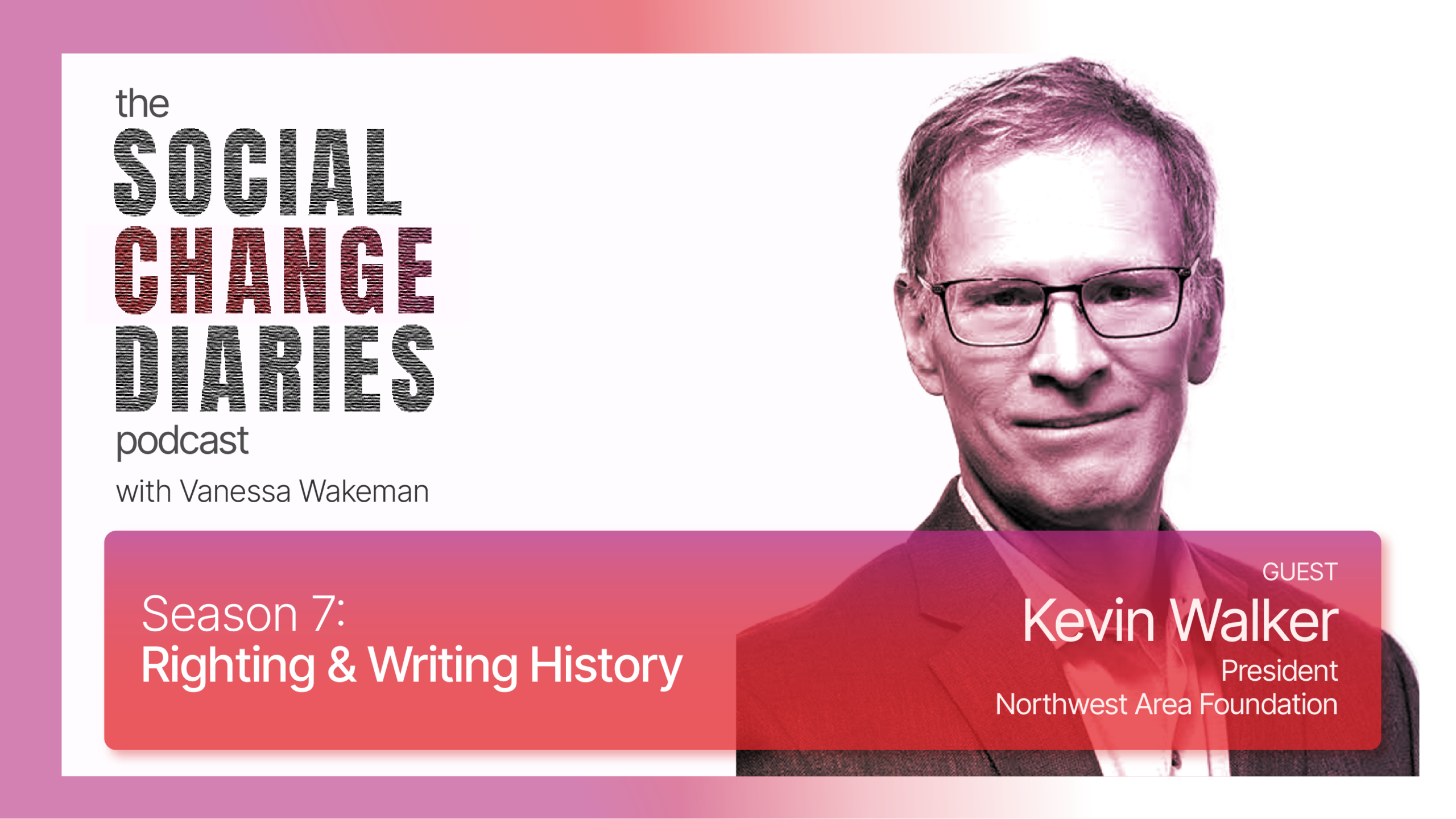
In this discussion, Vanessa sits down with Kevin Walker, President of Northwest Area Foundation. Their conversation explores lessons learned in periods of crisis, and how foundations can contribute to a strong democracy. Examining the importance of foundations supporting grantee partners as a bulwark protecting the society we value, they talk about how the past must inform our present to build a durable and more equitable future.
About Kevin Walker:
Kevin Walker leads the Northwest Area Foundation’s efforts to advance racial, social, and economic justice across eight states and 76 Native nations, including a longstanding commitment to Native-led organizations. Previously with the Charles Stewart Mott Foundation, he serves on the BoardSource board and is a recognized leader in philanthropy, equity, and nonprofit governance.
In his words…
“How do we support grantee partners’ participation in our democracy now at this very hot moment?”
“I think that we foundations are in a stronger position to continue to speak the truth as we understand it and to continue to speak from our values and from our mission and from our purpose in the world. The effect that can have on the ecosystem is very important. We should be thinking about how can I serve the broader ecosystem.”
“An elder in philanthropy recently shared, ‘We need to protect and fight for the democracy that we have so we can build the democracy that we need.’ The way I see it, democracy is a journey, rather than a destination. The erosion of truth-telling is a huge threat, and we have got to work through that.”
“We have leaned into our existing relationships and sought out lots of new relationships, particularly with immigrant and refugee-serving organizations. One of the current ways that our society is under threat is the hysteria around immigrants and the abandonment of refugees. The record will show that we went there and we supported organizations pushing back against that tide.”
“The enterprise that our wealth comes from is rooted in this land where Native people were systematically dispossessed. So the wealth that we steward, if you’re being honest, you can’t separate it from the situation of Native American communities today.”
Transcript
Vanessa Wakeman: Hello and welcome to the Social Change Diaries. I am your host, Vanessa Wakeman, and on this episode, I am joined by Kevin Walker, CEO of Northwest Area Foundation. Kevin leads the foundation’s efforts to advance racial, social, and economic justice across eight states and 76 Native nations, including a long-standing commitment to Native led organizations. Previously, with the Charles Stewart Mott Foundation. He serves on the Board Source Board and is a recognized leader in philanthropy, equity, and nonprofit governance. In addition to all of those great things, Wakeman Agency has the pleasure of calling Northwest Area Foundation and Kevin a client, and so excited to be in this conversation with him today. Welcome, Kevin.
Kevin Walker: Thank you very much, Vanessa. I’m excited too. I really appreciate the invitation to join you on the podcast, and I’m looking forward to the conversation.
Vanessa Wakeman: Wonderful. So, I feel like this is my chance to ask all the questions that come up as I am engaging with Northwest Area Foundation and speaking with your team and just understanding the work. But I think I’m gonna start off in a place grounded more in you and just your experience at Northwest Area Foundation. You have been at the helm of the organization during four major crises in our country, so pat yourself on the back for being able to withstand that. You started in 2008, which was the Great Recession, and then in 2020, with the pandemic and the murder of George Floyd, which led to an alleged racial reckoning, and today, we are currently in a crisis, right?
In my opinion, each of these in different ways highlights the fragility of our systems and the distance between what we believe democracy to be and how it actually exists in our country. And looking at your organization and how you’ve navigated these crises and what’s at stake today, how much of your work is about righting, correcting history versus writing and authoring history? I think that those two things are absolutely reflected in your work. And so, how do you see that based on these crises and where we are today?
Kevin Walker: Well, to start there, Vanessa, I think that for us those two concepts of writing history as in, you know, repairing injustice, and writing history as in making new things happen or helping others bring new possibilities to life, those two are intricately connected for us. I think a lot of people in philanthropy, certainly, I resonate with that idea we associate with Martin Luther King, that the arc of the moral universe is long, but it bends toward justice. We are trying to contribute to bending that arc toward justice. But to view the world that way, you have to understand that the beginning of that arc is injustice. And so for us, the two things are really inextricable. For more than 25 years, we positioned ourselves as an anti-poverty funder. And during my tenure, we became more and more aware that poverty is actually a symptom.
Poverty is a symptom of various injustices, what we think of today as racial, social, and economic injustice. We have evolved during the 18 years that I’ve been in the work here at Northwest Area Foundation to a broader frame, not just about poverty and prosperity, but to advancing justice, bending the arc of the moral universe toward justice, as King liked to say. And so when I think about the crises of this era, the ones that you noted. I mean, I’ll tick through all four of them. My main memory of the financial crisis of ‘08 is gratitude that the Northwest Area Foundation board didn’t fire me because when they hired me, our assets were about $500 million. And by the ensuing fall, we were down closer to $300 million. Now, obviously those are big dollar amounts for us normal folk, right? That’s real money. But yeah, no, we lost almost between 30% and 40% of the value of our asset base during that crisis.
Vanessa Wakeman: Jesus.
Kevin Walker: And they didn’t fire me mercifully because they actually hadn’t hired me because of my asset management expertise. They hired me because I come from the program side of foundation work. I’ve, for many, many years, tried to put philanthropic resources to work, helping communities rise out of poverty and thrive on their own terms. That’s what I’ve been about for a long time. That’s why I was here; that’s why I am here. So yeah, I’m glad I personally survived, and our asset base did rally. And so the next crisis in your list of crises, I suppose, was the pandemic during which George Floyd was murdered a few miles from where I’m sitting right now. Our offices are in St. Paul, Minnesota, and what would I say about those two crises? I think, as you said, they revealed the fragility of our systems; they revealed really vividly some of the baked-in injustices in our society. So, you know, if you think in terms of the old-fashioned framing of the haves and the have-nots, when the pandemic hit, who got hit the hardest? The people who were the most in need to begin with, the people whose connections to the things that they need to survive were the most fragile.
Vanessa Wakeman: Mm-hmm.
Kevin Walker: And the workers who were most at risk were those who did not have the luxury, like I did, to work from home for whatever that was, two years. It’s all a bit of a blur, right? So first responders, essential workers who had to be in place. That crisis revealed an awful lot about the ways in which economic injustice and inequality are baked into the way we live these days. George Floyd’s murder shook everything.
Vanessa Wakeman: Right.
Kevin Walker: Everybody’s attention, and as you said, there was an alleged racial reckoning in the aftermath. And I think that the first urge or that philanthropy expressed was very positive. That is, suddenly everybody was paying attention to racial justice and racial injustice, and trying to show the world that they had a take on that and they had something to say and that they could put their money where their mouth now was. Northwest Area Foundation was lucky in that we were already there.
They had an analysis around the role that racism plays in our country and in our region. We were already putting something like four, three out of every four grant dollars in the hands of people of color-led organizations because that’s how our mission expressed itself in strategy. So we didn’t have to scramble and try to figure out what do we think about this. We already knew what we thought about it. And I was pleased to see so many of us in philanthropy make new commitments.
And then, like everybody in the sector who’s been paying attention, I have been dismayed to see the backtracking from that. What seemed really important to folks in 2020 and 2021 grew less important apparently immediately after that. We at Northwest Area Foundation have stayed the course. We are still committed to racial justice in many ways, and we put our dollars where our mouth is. And I continue to encourage my friends and peers in philanthropy.
To do the same and to be undaunted by some of the headwinds of the current era, which is the fourth crisis that you mentioned. So we are in the club in the current era of funders who have not changed our stripes. We have not scrubbed our website. We have not pretended we no longer care about racial justice and racial equity. We are what we are. Our mission statement says that we are about advancing social, racial, and economic justice and that we support change makers who are trying to push in that direction. When that’s your mission, where are you gonna hide? You know, so I am proud to be in that circle of foundations who have been saying we still are who we are. And I am, in terms of the way our sector has responded, you know, there are a number of sectors in our society who showed an awful lot of cowardice or at least, I don’t know, a lack of gumption. I’m thinking of some of the universities, the law firms, the corporate sector. There are more than 300 of us foundation CEOs who have linked arms to say, no, we are going to unite in advance, and we are going to stand firm for our values and for the freedom to give in alignment with your values and your purpose. And I’m very proud and happy to be a part of that effort. I have not been a leader of it. I have been a follower and an admirer of the folks who have been leading that charge within philanthropy.
Vanessa Wakeman: Right.
Kevin Walker: I do think so far we’ve done a better job of keeping our feet underneath us in the current era, in the fourth crisis, as you would say.
Vanessa Wakeman: Kevin, thank you for sharing that. I have two questions. First, I want to start by thinking about the 300 organizations—your colleagues—who are standing behind their intention and mission. In many ways, thinking about our theme of “righting and writing history,” there is authorship in that. It’s a way of saying, regardless of the risk, regardless of the threats or vulnerabilities, we are going to continue the work we set out to do.
So, in thinking about the responsibility of philanthropy in protecting democracy, or its relationship with it, and the ways we understand history being made in real time, and what future generations will see or experience, as well as the consequences or opportunities that come from today’s decisions, I think there is something really important for us to sit with.
What does it mean for 300 foundations to be aligned around a shared value set about the responsibility of philanthropy, the way it supports organizations, and the implications of that across different socioeconomic levels, including the people in community with the nonprofits you serve?
I think what I want to note for our audience is that, in a more subtle way—one that we’re probably not hearing about day to day—foundations are writing history simply by coming together around this common goal. And going back to what you said about not changing your stripes, staying authentic, and not allowing threats to shift how you show up in the work—how you talk about it on your website, how you engage with grantee partners—what do you say to organizations that are concerned and have removed information from their websites or decided to go silent?
I know it’s difficult to make a blanket recommendation because every organization has nuance, but what do you say to those who believe that silence, and hopefully becoming invisible, will make things easier or safer? What do you say to encourage them to consider the ways their role and actions still have an impact on the broader ecosystem?
Kevin Walker: I think it depends a lot on what organizations we’re talking about. You know, one of the glories of the social sector in our country is its diversity. So for nonprofits, particularly nonprofits in direct relation with the federal government, meaning they have contracts or grants that they’re trying to preserve access to, I’m very humble about the reality that folks do some folks do need to translate. I have good friends in the sector who very early on in this current era were saying to me, Yep, I’m sitting down and trying to figure out how to rewrite our grant request so that we’re speaking the right language in this time. That was in order to keep dollars flowing to the community they serve. You know, you’ve got to respect that. Foundations are in a different position than nonprofits like that. Those of us who have no federal contracts or grants or anything like that.
Vanessa Wakeman: Mm-hmm.
Kevin Walker: I do think we are in a position to stand firmer because speaking the truth is important. It’s important every day, and it’s important today. We’re also in a somewhat more insulated position. Where we’re most vulnerable is around things like our tax status, right? A hostile administration could decide that any foundations that don’t tow the party line are now going to be subject to a 20% excise tax on your investment income, or some really punitive, retaliatory measure like that. Those kinds of things are possible that haven’t materialized yet.
So I think foundations are in a stronger position to continue to speak the truth as we understand it, and to continue to speak from our values, our mission, and our purpose in the world.
In terms of the effect that can have on the ecosystem, which you were probing around, I think it’s very important. If nonprofits can look to their funders and see that they are actually standing firm in support of the things we work on, the things we believe in, and the communities we’re here to serve, that can be wind in their sails. But we also need to be humble about the fact that we can put our grantees at risk. Ironically, if we get too excited about standing firm and speaking truth to power, what can happen next is that the very folks we’re funding, and who are doing the work on the ground that we’re trying to support, can come under fire for being associated with us. That is a real possibility in these kinds of shark-infested waters we’re in.
So this is all very nuanced. I think every organization should be thinking this through for themselves and trying to have an ecosystem view of it, not just how do we protect our individual organization, but how do we play in the larger ecosystem of the social sector.
Because that is actually what we’re all here for. The many, many thousands of foundations and nonprofits in this country all have their own purpose and mission, but we exist in community with one another. We’re all trying to drive positive social change. So you shouldn’t just hunker down and think about the protection of your own entity. You should think about how do I serve the broader ecosystem.
For some of us, that’s about standing firm. For some of us, that’s about doubling down and speaking up. For others, it might be about staying more quiet for strategic and tactical reasons that are perfectly valid. So I think all of that is true.
This is a really messy topic, and I’m glad you asked this because I don’t want to come across as preachy, as if I know what’s right for other organizations. I truly don’t.
What I do think is that I want to step back for a second and say that the 300-plus foundation leaders coming together in this act of solidarity is partly an expression of what we value so much about our democracy. One of those things is a vibrant nonprofit sector, including philanthropy.
Modern philanthropy is more or less an American invention. Freedom and independence of thought, and the freedom to give where your values lead you, are fundamental to what we’re about. And for nonprofit organizations, the freedom for people to come together and self-organize a response to a problem or to their community’s dreams is one of the beauties of our country and of our democracy.
Linking the idea of democracy to the idea of the social sector, freedom to give, and freedom to take self-directed action on behalf of your community, that is who we are at a fundamental level.
And that’s why I’m proud of this group of 300-plus foundations for trying to do a better job of navigating this turbulence than some of the other sectors have. Because our sector is special in that we are well positioned to protect and to take some hits if we have to.
Vanessa Wakeman: Yeah, that’s really great, and I think nonprofits would appreciate that. As you were talking, I was thinking about some of the conversations I’ve been having with nonprofits and the ways they are, as you said, across the board every organization is different, and they have to make decisions based on what’s right for their organization.
But I see many ways that people are identifying that we’re definitely playing in a different environment, which requires a different set of rules and different movements—things we wouldn’t have done 10 years ago, or things we didn’t think we would need to do or weren’t necessary. People are trying all different approaches, understanding that the burden on the nonprofit sector is increasing as other resources are depleted or no longer available.
So I think this idea of organizations writing about and identifying their needs and talking about their work is, as I said, a reflection of people upholding and protecting and leaning into the values of democracy in so many ways. That, to me, gives us hope and something to hold onto, and to feel like we’re going to be okay if everyone continues to move forward—if these 300 foundations continue to be aligned and in this spirit, and if nonprofits are also feeling empowered to continue their work, support it, and navigate risks responsibly.
I think it takes all of these efforts at different levels to be able to create and write the future we want. So I’m proud and pleased to be a background singer in some of these efforts.
I want to talk a little more specifically about the idea of democracy. Democracy is an experiment—a long experiment. We’ve been testing it for hundreds of years. But if we approach it as an experiment and understand that there are real consequences if it is not successful, and we’re seeing both the potential and actual consequences right now, then the question becomes: what, if anything, can foundations do to make sure that experiment is a success?
I think philanthropy has an opportunity to advance the evolution of our democracy into something that represents the total of what we’ve been collectively fighting for.
So I keep finding myself holding this tension: do we need to be protecting democracy, or do we need to be focused on building something better? And the more I think about it, the more I’m leaning toward the idea that we need something better.
But what does that look like? What does it look like for the evolution of democracy to become something that represents the total of what you and your peer organizations—and those who came before you—have been fighting for?
Kevin Walker: Let me start by quoting an elder in philanthropy who I heard speak at a conference maybe a month ago, and he spoke to that thing you were just talking about: are we trying to preserve our democracy or are we trying to build something better?
And what he said was that he thinks we’re at a hinge moment in our history where we are at risk of losing our democracy. And that we need to protect and fight for the democracy we have so that we can build the democracy that we need. I thought that was great. I also would offer that I actually think that democracy is better thought of as a journey than as a destination.
Vanessa Wakeman: Mm-hmm.
Kevin Walker: You know, there were ideologies that democracy fought a death match with in the 20th century, fascism and Soviet communism. Both of those ideologies, as I understand it, had an endpoint in mind. The struggle would continue until the day dawned when everything was right in their worldview.
I don’t think democracy is that. I think we are actually about pluralism. We’re about contending with different ideas about what the public good is. We’re about ever-shifting interests. But it’s a journey toward “government of the people, by the people, for the people.” That’s what we’re going for. That’s the journey we’re on.
I think what we’re really talking about is a very messy picture of democracy—one where as many people as we can possibly achieve are empowered to express themselves, to organize, and to find ways for their communities to thrive on their own terms, in a way that also accommodates the thriving of other communities, including people who think differently from them. That, to me, is the system we’re trying to build.
Among the things that push against that are super-empowerment of the wealthy in our economy and in our politics. Very high levels of inequality do not support democracy well. The more unequal our society becomes, the more strain democracy is under, and the more fraudulent it can feel to claim that we have a democracy. Money and electoral power are so intimately connected in our system, and the more money talks at the ballot box, the worse off our democracy is going to be. The further we get from a system where organized people and individual voices matter more than organized money, the further we get from true representation.
What I think would make sense to every high school student in our country is this: when we say democracy, we mean everybody votes. Everybody can vote. Their vote gets counted. I have the same number of votes that you do, and the same number of votes that Elon Musk has, and the same number of votes that the unhoused person I drove past on my way into work today has. We all have one. The further we get from that, the more democracy itself can fracture, fall apart, and lose public trust.
I also think the erosion of truth-telling is a huge threat. What’s happening right now in the social media ecosystem, as I understand it, is a real attack on the idea of what is true and what is not true. That’s really rough. I want to get back to a place where we expect our political leaders, in particular, to tell us the truth—and when they lie to us, which of course they sometimes do, we can hold them to account.
I’m old enough to remember the Nixon presidency, where he kind of went out of his way not to be caught lying. He would try to say things that, at least for a little while, would hold water. And it bummed him out tremendously when the media caught him in lies. We’re in a place now where we just spew BS into the air, and truth becomes whatever you say it is. That, to me, is very dangerous for democracy.
We need to continually prove to ourselves that, as messy and complicated as this system is, it’s better than the utopian alternatives. The current technology and media environments are huge amplifiers of the threats we’re facing, so we’ve got a struggle on our hands. But I’m going to stick with the idea that we have to tell the truth—and expect our leaders to do the same.
Vanessa Wakeman: Yeah, I agree with that 100%. That we need to tell the truth. I will take that a step further, Kevin, to say that we need to make sure that we are amplifying.
And so one of my biggest fears as a communications person is that right now, when there are so many ways that information is shared, that there is a huge disinformation machine happening that these, you know, false stories and false narratives are being shared actively, consistently, loudly. And as nonprofits are sort of in many ways retreating, not wanting to become under attack, they are not making sure that they have an active voice and maintaining their presence on particular issues. And so the truth becomes fuzzy, right?
The truth is always the truth, but the facts are; the truth can be interpreted in different ways. The facts are always the facts. But when information is absent, there’s an opportunity for replacement. Like, well, I couldn’t find anything about this. And so I guess if 10 people are telling me this is what the story is, then this must be the facts. This is, you know, what I’m gonna believe.
So one of the things we’ve been beating the pavement about with organizations is that we need to make sure narratives, stories, and communications—and the way we’re talking about these issues—are resilient enough to withstand these attacks. That people are able to respond to harmful narratives, and that nonprofits, which are among the most trusted institutions in America, are able to take advantage of that trust.
With the support of foundations, as we continue on this journey of democracy, we need to make sure that all of the work that has been done to this point—all of the data, knowledge, information, and lived experiences—are front and center. Because the only way we’re going to influence how people understand these issues and how they respond is by presenting those facts clearly and consistently.
One of my biggest concerns is that, by 2028, it will be “safe” again for organizations to actively communicate, and they’ll no longer feel silenced—but by then, a large swath of the population may have already absorbed narratives that suggest they didn’t even know these were real issues. Issues like climate solutions, racial justice, or education equity. We risk having an erasure of both facts and the stories that matter.
So as we talk about how to propel and advance agendas, I want us to also recognize the consequences and risks of not actively participating in shaping narratives today. If we step away from storytelling and public communication, we risk losing ground in how these issues are understood altogether.
One of the things I appreciate about NWAF is that, in a conversation last year, you said something like: I don’t care what anyone else is doing, we are standing firm on telling the story, supporting organizations, making sure our website reflects who we are, and showing the people who have chosen to trust us that we are worthy of that trust by continuing to speak about what matters most to us.
That really stayed with me.
And I just want to share, based on what you’ve said, my concern about how stories are being co-opted and how narratives are becoming more harmful when we are not holding the line, so to speak.
Kevin Walker: Yeah, I would just agree with everything you said, Vanessa. It’s a huge issue, a very challenging problem, and I think we have to try to stay optimistic, but I don’t have any ready answers to how we win that battle, so to speak, but it’s the right battle.
Vanessa Wakeman: Yeah. Well, Wakeman is doing our part to push the communications angle, and hopefully, my big hope is that in November we see some changes and people feel that whatever happens during the midterms helps to create a little bit of ease and we start to see people comfortable in talking some more. I’m gonna keep pushing that. But I wanna talk a little bit about your grantee partners.
I think that right now, sort of as a follow-up to what we just spoke about with the narratives, we are absolutely in a period of deliberate historical revisionism. We see the erasure of stories, we see the suppression of voices, the rewriting of what happened and whom it happened to, you know, the book ban sort of contributes to some of that erasure and lots of other activities. The organizations that NWAF funds are on the front lines of resisting that erasure. And when we think about Native communities, there’s certainly been a history of erasure there. But just overall and thinking about your grantee partners, what does it cost them and what does it cost philanthropy when foundations pull back during like periods like this?
Kevin Walker: I think that what I try to remember is that risk is easier for us to take on board than for our grantee partners to take on board. So what I hope philanthropy, what I hope foundations aren’t doing is shifting risk to our grantees and keeping ourselves safe. I would rather do the opposite and shift the risk to us and give them some more space to do their thing in greater safety.
Vanessa Wakeman: Mm-hmm.
Kevin Walker: That is hard to do. I’m not quite sure how to do it except to stand firm with them, to let them know we’ve got their backs.
Because yeah, it costs them tremendously both in morale and in dollars. If philanthropy is taking a cautious step back at the very time that they’re coming under fire for living their values and their mission, and at the same time that the public funding they might have counted on in the past is disappearing or being seriously called into question. They need us to step forward. And that simple idea that, like, we can’t—Foundation resources aren’t the solution to every problem. There aren’t enough foundation dollars in the system to backfill if federal funding withdraws. The math doesn’t work. But as a leader in our sector pointed out to me very early in this current crisis, yeah, that’s true, but your grantees need more from you than that. Your communities need more from you than you just reminding them of that math. They need you to do more.
They need you to say, yes, that’s true, we can’t backfill for federal resources, which are vast beyond the resources of foundations, but we can do more. And it was in that context that Northwest Area Foundation decided to double our grantmaking in 2025, and we’ve maintained that enhanced level of giving in 2026.
For us, that’s a big deal. We’re supposed to exist in perpetuity. That was the expressed intent of our founder in 1934: to exist forever and steward this asset base forever. So deciding to double our giving is a significant decision for a foundation board. And we can’t maintain that forever, or we would spend down the asset base and violate those donor intentions. But we’re doing it now because it’s, frankly, raining cats and dogs—if you think about rainy days.
What I’ve tried to do is urge my friends and colleagues in philanthropy to think creatively, on their own terms, about what “doing more” would look like for them. I’m not suggesting everyone can or should do exactly what we did, but I do think each of us needs to look in the mirror and have a conversation—particularly with our board of directors or trustees—about whether we can do more. And if not, why not? Are we really content standing on the story that says, “Nope, we can’t do anything out of the ordinary; business in 2027 will be just like business in 2017 or 2020”?
Is this an extraordinary time or not, from the perspective of each organization? Because from our perspective, it is. For the reasons you and I have been discussing in this podcast, these are extraordinary times. So how do we respond?
I’ll also say that our founder, Louis W. Hill—the son of a railroad entrepreneur—established Northwest Area Foundation in 1934. It was raining cats and dogs in 1934, too. That was the depth of the Great Depression, and yet he chose to create an entity intended to be perpetual. He did not choose to spend it all in a crisis.
So we have to be humble about this, but I do encourage CEOs and boards, any that I can get in front of, to say the real things out loud with one another in the boardroom, and figure out what the best each funder can do in this time, as they understand this time.
Because I think most of us agree, Vanessa, that we are in a time of crisis. So how are we going to step up? Everybody has to find their own answer to that. But being on the front foot is what communities need from us—not being in a protective crouch.
Vanessa Wakeman: Yeah, I’m glad you took us back to the founder, because I want to briefly touch on history. I feel that, similar to how we are now taking a look back to see where things started and how that influenced where we are today—what led philanthropy to become philanthropy, what decisions the founders made, and how we got here—historians will undoubtedly examine what foundations did during this period, what citizens did, and so on.
What do you want them to find in NWAF’s record as the story of what was done when democracy needed defending? If we’re 30 years from now and someone is looking back, what do you want them to see and understand about what the organization did in this moment when democracy needed defending?
Kevin Walker: I think that story begins with doing more, right? The record will show that we, in a way that was really meaningful for us, did more and gave more. That sounds very simplistic, but it’s very important.
We also doubled down on our existing commitments to what you might call marginalized communities. Our foundation has, at the center of its strategy, what we refer to in-house as our priority communities. That includes Native American communities, communities of color, immigrants and refugees, and people in rural areas.
All of those communities are under tremendous stress. So we have leaned into our existing relationships there and sought out new relationships, particularly with immigrant- and refugee-serving organizations. One of the ways our society is currently under threat is through this hysteria around immigrants and the abandonment of refugees. The record will show that we went there and supported organizations pushing back against that tide.
We haven’t historically thought of ourselves as a democracy funder, but I really want the record to show that we tried to figure out how to think about our giving, our communication, and our networking in a way that supports democracy—meaning people being able to shape their own lives.
So we are funding more community organizing than we have in the past. And when we find opportunities to protect people’s right to vote, in ways that a 501(c)(3) organization like ours is able to engage, we are stepping into those opportunities.
So I would also like the record to show that we learned some new tricks in a moment when, as you say, it really does feel like this fundamental thing—our democracy—is under threat.
I don’t think it’s unthinkable for many people that upcoming midterm elections could not happen in the normal way—not just in terms of outcomes, but in terms of the basic belief that elections are real and that results are legitimate. That reality itself may come under threat in the next few months.
That’s not where we were before. I’ve been in the foundation world since the late 1990s, and I would have thought when I entered the field that that kind of thing could happen in Central and Eastern Europe, or societies coming out of the Iron Curtain period—but not in the United States. Everyone assumes midterm elections happen like clockwork and that results are accurate and legitimate. We’re not in that terrain anymore.
So we are trying—though we are not a huge foundation, we are mid-sized, and every dollar we spend in one place can’t be spent somewhere else—we are trying to figure out, given our mission, purpose, and the communities we are accountable to, how we support their participation in our democracy right now, in this very heated moment.
Vanessa Wakeman: Yeah, thank you for that. I have two more questions for you.
The first is thinking about what we just talked about regarding history, and also thinking about your tenure. I’ve heard my grandmother say, when I was a child, that some of the things we fought for were to make sure that you would have something different—something she might not see in her lifetime, but that she knew would have an impact on future generations.
So when you think about NWAF’s grantmaking, strategy, and public voice, and how you’re showing up in ways that you may not be able to fully see the impact of within your tenure, what are the things you’re doing anyway because you know they are the right thing to do?
You probably won’t see them fully realized, but you know they are worth doing regardless. Is there an example of that you can point to as we think about this idea of authoring history?
Kevin Walker: I think the most fundamental piece of that for me is Northwest Area Foundation’s commitment to Native American communities, which you mentioned at the top of the podcast. I inherited that; it was already a core commitment here when I arrived in 2008, but we have deepened that commitment during my time here, and that’s really meaningful to me.
The history there, one way to understand it, is that our origins are in a railroad enterprise. Our founder’s father built the Great Northern Railway, which connected the Twin Cities of Minneapolis and St. Paul to Seattle and Portland in the Pacific Northwest, crossing, in effect, Indian Country the entire way.
The enterprise our wealth comes from is rooted in land where Native people were systematically dispossessed. So the wealth we steward cannot be separated, if we’re being honest, from the situation of Native American communities today. These things are connected at the core. For us to say that out loud, to connect it to our origin story, and then to express it in our giving—and in things as basic as who is on our staff and who is on our board—is very important.
At the moment, we have a 13-person board that includes five Native American board members. That is extraordinary in private philanthropy. We want to be an outlier in that way. We have also, for many years, devoted 40% of our grantmaking to Native-led organizations. That is roughly a hundred times the norm. Every time the study is repeated, it shows that something like 0.4% of philanthropic dollars go to Native organizations. By comparison, our 40% commitment is about a hundred times that level.
Vanessa Wakeman: Wow, wow.
Kevin Walker: So that’s the thing I think will outlast my tenure at Northwest Area Foundation. We have been trying for years to get the attention of the field and drive more investment in Native communities. It’s not an easy thing to do. I don’t have a long list of successes, but I do think we are trying to change the ecosystem around how private philanthropy sees, thinks about, invests in, and partners with Native people.
I think this is fundamental to the American story and to life on this continent. It’s a long journey: to persuade people who often think of these communities as the past to instead see them as the future, as people and places with a bright future.
The leaders we encounter in Indian Country are people of tremendous ingenuity, tenacity, and resourcefulness. They have been under-resourced and persecuted for generations, and yet they have been building their own futures as best they can despite that. It is a very inspiring place to try to do good philanthropic work, and we are trying to bring others along with us.
The 76 Native nations of our region are now explicitly reflected in our mission statement. We used to simply say “eight-state region,” but our mission now says it is a region of eight states and 76 Native nations. That shift matters.
So that commitment will outlast my time—I’m very confident of that. But my real hope is that, a hundred years from now, philanthropy is in a fundamentally different and better relationship with Native communities, and that an approach like ours is no longer such an outlier.
In preparing for this conversation, I was reminded of one of Nelson Mandela’s quotes that I often carry with me: “It always seems impossible until it is done.” I do think one of the privileges of being in philanthropy is to stay hopeful—to believe in a future that is a little hard to see right now, but that you know is right.
Vanessa Wakeman: Yes. That was a fantastic response. And on behalf of future generations, I will say thank you and congratulations because I think the foundation is well on its way. My very last question is more of a playful one, and I’m putting you on the spot a little bit, so don’t get mad at me. But I know that you are a writer, a poet, actually, and I want to ask you if there is a word or words that come to mind either to describe what NWAF is fighting for today, or if there are words that you sort of hold on to that you’d like to share with us that will sort of represent hope or what you see for the future or what we can think about as our North Star?
Kevin Walker: Well, I think in order to answer that question, I need to let our listeners in on the fact that you tipped me off to this question so that I could think about it overnight. But the way you asked the question was even harder. You said, can you come up with a haiku that captures Northwest Area Foundation’s hopes? And my initial reaction to that was, I certainly cannot forget about it. And then this morning I figured out how to do it.
Vanessa Wakeman: Yes. Please give me the haiku.
Kevin Walker: So this is gonna need an explanation after I say it, but what I came up with was “All communities, from Badote to Lummy, thrive on their own terms.” So what that means is Badote is a Dakota sacred site very close to where I’m sitting right now in what we call Saint Paul, Minnesota. Lumy is an Indigenous nation in the very northwest corner of what’s now the continental United States. And so, all communities from Badote to Lamy thrive on their own terms.
I’m basically repurposing our vision statement at Northwest Area Foundation, which is that the people of our priority communities thrive on their own terms. We’ve always found that the most resonant way that we can define prosperity is having the choices and the agency to thrive on your own terms, to create a self-directed future. That is what we’re trying to be all about. And I went from my haiku to a speech here, excuse me, or at least to a paragraph, but it was a hard question, Vanessa. Thank you for it.
Vanessa Wakeman: That is the perfect note to end on. Kevin, this was a fantastic conversation. I appreciate your insights and for you taking some time to join me today.
Kevin Walker: Well, thank you. It’s really been a pleasure. Thank you for all that you’re doing, and happy to be a part of this amazing podcast.
Vanessa Wakeman: Thank you. I am sure in the coming days different ideas and themes that were brought forward in this conversation will be swirling around in my head, but in this moment, the thing that really sticks out for me is this idea of responsibility. As Kevin shared, how NWAF operates, what they prioritize, how they give, who they give to—it all connects to responsibility. And yes, every foundation should carry a sense of responsibility to the ecosystem in which they belong, but what I heard in this conversation is a deep desire and sense of responsibility to correct wrongdoings.
NWAF and Kevin aren’t shying away from their origin story. It sounds like it is woven into every decision they make. How can we right history? It also sounds like the framing of democracy that is most pronounced within the organization, is civil liberties and freedoms for a forgotten people? I am also thinking about NWAF committing 40% of its grantmaking to Native-led organizations and that being a hundred times the norm. Sadly, there is a version of this for Black-led organizations, Latinx-led organizations, and so on, and so on. Making a note to circle back to this for a future podcast season; maybe we can call it Receipts?
Okay folks, I hope you enjoyed this episode with Kevin Walker. We have an incredible line-up this season, so you want to stay tuned in. Be sure to follow the show on our website: thewakemanagency.com, Apple, Spotify, or wherever you listen so you never miss an episode. Be sure to tune in next week. See you then!