About This Episode:
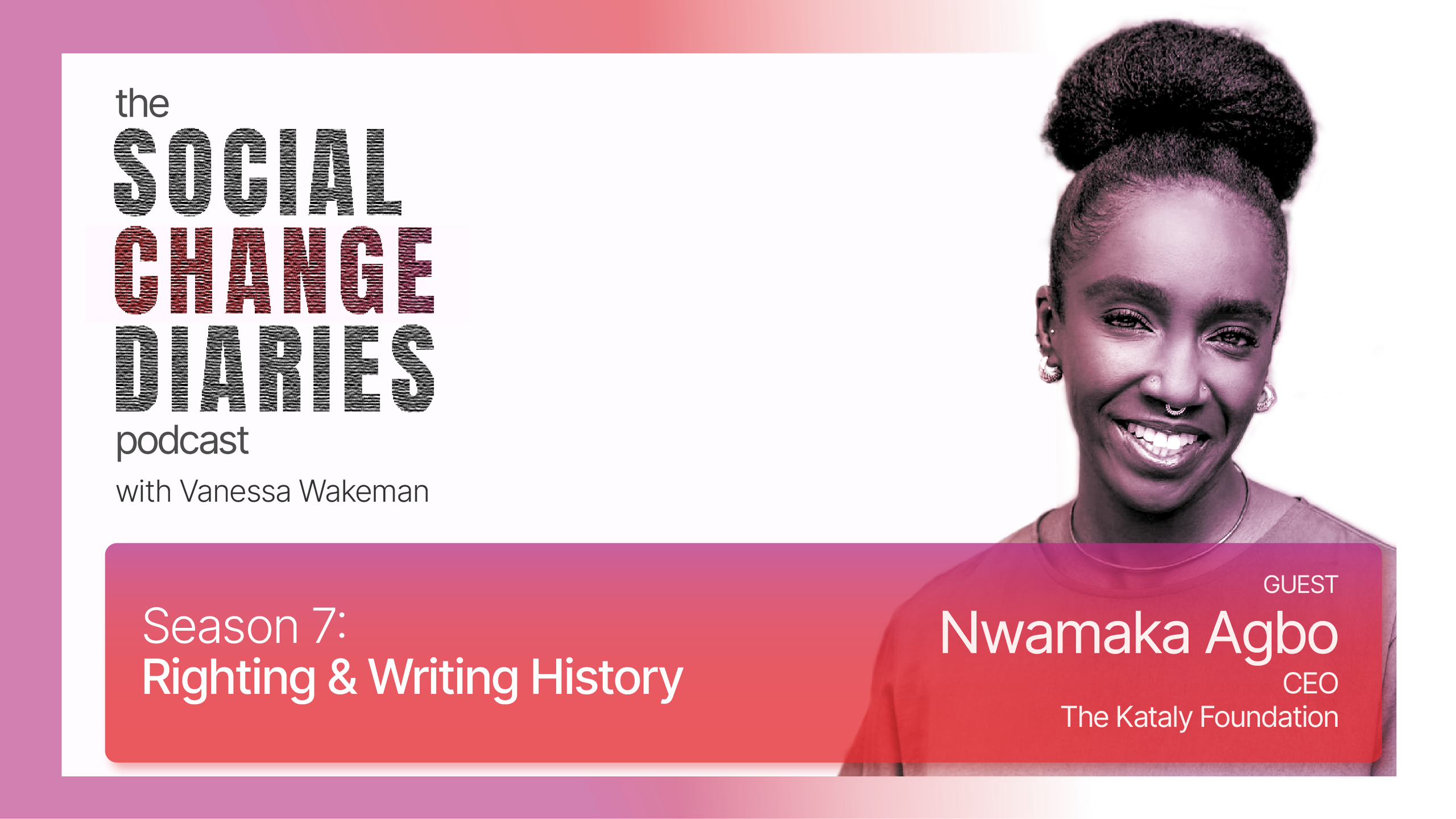
In this episode of The Social Change Diaries, Vanessa Wakeman speaks with Nwamaka Agbo, CEO of the Kataly Foundation, about the connections between democracy, wealth, power, and repair. Nwamaka explores how philanthropy can move resources at the scale communities need, center their dignity and lived expertise, and relinquish control through Kataly’s spend-down approach. Together, they discuss reimagining democracy, the power of mutual aid and collective care, and how philanthropy can support community-led movements working toward a more just future. Nwamaka reflects on the legacy she hopes to leave: not an institution, but stronger, better-resourced communities equipped to create lasting change.
About Nwamaka Agbo:
Nwamaka is the CEO of the Kataly Foundation and Managing Director of the Restorative Economies Fund. She brings a background in community organizing, electoral campaigns, and policy work on social justice issues to her work in philanthropy. Prior to leading the Kataly Foundation, Nwamaka developed the framework of Restorative Economics and built a consulting practice providing strategic guidance to community-owned and governed wealth-building initiatives. Her work is grounded in a commitment to supporting projects that build resilient, healthy, and self-determined communities rooted in shared prosperity.
In her words…
“When we think about repair for our democracy, we have to be honest about the foundation under which our democracy has been built.”
“Democracy is not just a structure. Democracy is a process. And processes are about how we relate to one another.”
“When you move resources at the scale to meet the needs of the problems impacting communities—and when you do that in a way where you are honoring the dignity, the self-determination, and the agency of communities—you are recognizing that because they are the ones that are most directly impacted, they are also the ones best suited to identify what the true solutions will be to address the root causes of the problem.”
“I know my worthiness is not tied to the resources in Kataly’s bank account. And so my sense of self, my ego, my belonging doesn’t come from my role as the CEO of Kataly. It actually comes from how I am in greater relationship with the organizations and communities that we resource.”
“Our work is not Kataly spinning out, it should not be a black hole that sucks in everything around us. It should be a supernova that spurs millions of other stars.”
Transcript
Vanessa Wakeman: Hello, and welcome to the Social Change Diaries. I’m your host, Vanessa Wakeman. This is our second-to-last episode of the season, and I want to go out on a high note. I know today’s conversation won’t disappoint.
I’m joined by Nwamaka Agbo, CEO of the Kataly Foundation and managing director of the Restorative Economies Fund. Nwamaka brings a background in community organizing, electoral campaigns, and policy work on social justice issues to her work in philanthropy.
Before leading the Kataly Foundation, Nwamaka developed the framework of restorative economics and built a consulting practice providing strategic guidance to community-owned and governed wealth-building initiatives.
Her work is grounded in a commitment to supporting projects that build resilient, healthy, and self-determined communities rooted in shared prosperity.
Welcome, Nwamaka. Thank you for joining me today.
Nwamaka Agbo: Thank you, Vanessa. Thank you for having me. Really excited for our conversation.
Vanessa Wakeman: Me too, me too.
So, I want to start with the idea of protecting democracy. There are a lot of conversations happening right now, particularly in mainstream media and in the broader public discourse, about elections, courts, and institutions.
But there’s another part of protecting democracy that may not receive as much attention, even though it’s incredibly important. It speaks directly to some of the work you and the foundation are doing.
Where does repairing harm to Black, Indigenous, and other communities of color fit into this idea of protecting democracy?
Nwamaka Agbo: We’ve had to think intentionally about the structures and processes that allow us to do this in a way that serves the highest and best interests of social movements. That’s where the democracy piece comes in. It’s about the governance, management, and stewardship of these assets and how they’re moved back into communities.
To operate as a trust-based funder, we’ve recognized the importance of creating what we call a distributed decision-making process within the foundation. When our founders and board members established the foundation as part of their commitment to redistributing a portion of their wealth, they were clear that they weren’t best suited to make decisions about who should receive the money or how it should move. That’s why they engaged and hired people like myself and the rest of our team.
We refer to ourselves as practitioner funders. We’re people who come out of lived experience and movement work, who have been on the ground doing this work. We bring not only that experience but also the relationships in the field that allow us to move the capital.
This brings me back to your question about democracy. In establishing a distributed decision-making process to govern how those resources move, we’ve recognized the importance of leaning into relationships, both across our organization and with our grantees in the field.
Relationships allow us to understand not only which organizations and communities we should resource, but also how we should resource them in ways that can help heal people’s experiences of and understanding of the economy. They also help us understand what communities need to be adequately resourced for their own liberation.
Coming back to democracy and repair, I think Nikole Hannah-Jones said it best: Black people have been the great perfecters of American democracy. What she means, as explored in her 1619 Project, is that the very foundation of our Constitution was built around preserving the power and voting rights of white male property holders. It was never designed to include enslaved Black people or Indigenous and Native American people, who were victims of genocide. The system was designed to create the appearance of a governance structure while preserving the power, wealth, and authority of those who held it.
When we think about repairing our democracy, we have to be honest about the foundation on which it was built.
Even in 2026, as we head into the midterm elections and prepare for the 2028 presidential election, we’re still relying on the Electoral College, a system shaped by the compromises made to preserve the political power of slaveholding states. Those compromises helped maintain the influence of those states within the United States while limiting the political power of newly emancipated Black people.
The fact that we still rely on the Electoral College to determine our nation’s leader means that the very mechanisms through which we make decisions remain rooted in this country’s original sin: the enslavement of African people and the genocide of Native American and Indigenous people.
So, if we’re having a conversation about how to save our democracy, we must center the question of repair. We need to think about how we can do more than simply save a system that remains clouded by structural racism, the theft of wealth, genocide, and enslavement. We also need to ask what we want to preserve because it has genuinely served people, and what we need to change, add, and build upon moving forward.
I want to circle back to the point I made earlier about Kataly and the importance of relationships. Democracy cannot be reduced to voting and the court system. Democracy is not just a structure. It’s a process, and processes are about how we relate to one another.
The question is: What kind of relationship do we want people living in the United States to have with the process of electing their leaders? And beyond that, how can we expand our understanding of democracy so that it’s not just about voting, but also about what it means to be a good civic steward to your neighbors? How do we care for one another?
When I was in high school, taking civics, I think during my senior year, so much of what we were taught focused on the three branches of government. But we were also being prepared to become good workers and go out and get jobs. We weren’t necessarily being taught to develop an internal moral compass or a sense of shared responsibility for our neighbors and the well-being of others living in the United States.
For me, as we move forward, the question of what we’re trying to save comes down to this: Yes, a democratic society should provide care and well-being for all people. But I think we need to change how we make that happen. And as part of that process, we must reckon with this country’s original sin.
Bryan Stevenson of the Equal Justice Initiative has said that when you create harm and are unable or unwilling to go through a process of repair, which means acknowledging the harm and making restitution for it, you’re more likely to repeat that harm.
That’s what we’re seeing. We have a democratic system that has made it acceptable to deny people their voting rights. Historically, this included literacy tests that people were required to pass before they could vote. Today, we’re seeing voter ID laws and other efforts that can continue to suppress the vote.
Again, this is happening because we’ve never fully confronted or addressed the ways that the enslavement and kidnapping of African people, along with the genocide of Indigenous people, are embedded in how decisions are made about governing this country and distributing resources for our collective well-being.
That was a really long answer. I tried to weave a lot in there. I don’t know if it landed, but I trust you’ll let me know where I need to clarify.
Vanessa Wakeman: It definitely landed, and I think the fuller context was necessary for this conversation.
One of the questions I want to ask, based on what you shared, is: What happens when people are unwilling to acknowledge the harm that’s been done? Given how Kataly approaches its work and how you think about repair, how do we move forward when people aren’t willing to acknowledge past wrongs, yet people are still being harmed?
What role does philanthropy play in that situation? More specifically, what do you see as the role of your foundation in supporting organizations that are being harmed within the current framework of our democracy and its institutions?
Nwamaka Agbo: Yeah, I’ll start with what I see as Kataly’s role, and hopefully invite my colleagues in philanthropy to join me in this. Kataly’s role is to demonstrate that Black, Indigenous, and other communities of color can receive resources at scale and have the capacity to use them effectively.
There’s a concept in philanthropy that we call the “capital absorption capacity problem.” We’ve tried to claim that Black and brown communities lack the capacity to receive capital at scale and don’t have the expertise or knowledge to steward those resources responsibly.
Our work at Kataly is to complicate that narrative and show that it’s wrong.
When we build trusting relationships with social movements, we create space for people to share their hopes, dreams, and visions, as well as their challenges. They can invite us into conversations about how to bridge the gap between where they want to go and the realities of where they are.
We can then enter those conversations not just as resource providers, but also as an institution with access to information and resources, as well as a bird’s-eye view of what’s happening with our grantees across the country. We can identify common themes and use those insights to inform and support our grantees’ work.
Our work is really about demonstrating what happens when you move resources at a scale that meets the needs of the problems affecting communities. It’s about doing so in a way that honors their dignity, self-determination, and agency, recognizing that the people most directly impacted are also best positioned to identify the solutions that address the root causes of those problems.
When you really see someone and say, “I see you. I believe in you. I’m going to support you, and we’re going to go through this together,” it helps them step into a deeper sense of purpose and determination.
The way philanthropy typically operates is more like, “I don’t really trust you, but I’m going to drop some pennies here and there and see how far you get.” That’s not setting communities up for success. It doesn’t honor their dignity. In fact, it’s an effort to maintain our own power and control.
At Kataly, we want to demonstrate the beauty and innovation of communities as they develop strategies that center their needs. In doing so, they create projects, strategies, and ways of being together in community that ultimately benefit society as a whole.
One example that really brings this to life is a trip our team took last year to Montgomery, Alabama. We toured several sites associated with the Equal Justice Initiative, and we also took time to meet with our grantees and new organizations.
One organization we met was Knights Orchid, a Black trans-led organization based in Selma. They shared that, because their organization was already set up to provide direct services and support to Black trans and queer communities who had been pushed out of their families and neighborhoods, they already had the resources, cultural competency, and skills to support communities during a disaster.
When COVID happened, they were able to adapt the processes and systems they had used to distribute goods and services to their members, including Black trans and queer people. They used those same systems to help distribute personal protective equipment, provide testing, and get food to communities in need.
They observed that some of the people who came to their service lines had previously been hostile toward Black trans and queer people. Kataly Orchid and its members made it clear that they were more than happy to serve and support these individuals, but that anyone coming to them also had to respect and treat them with dignity and care as Black, queer, and trans people.
I share that example because Kimberlé Crenshaw has taught us so much about intersectionality. When we center the needs of those who have been most impacted, displaced, and disinvested in, and put them at the center of our strategies, decisions, and resource allocation, they are better positioned to develop strategies that support their communities.
Those strategies can then have a ripple effect, meeting the needs of others just outside those communities, and then others beyond them.
That’s what we seek to do at Kataly: resource those who are most directly impacted, recognize the ripple effects that can have, and do it in a way that centers their dignity and self-determination.
For philanthropy more broadly, this moment calls on individuals and institutions with wealth to recognize that they have access to the capital needed to resource those on the front lines of challenging power and shifting the conditions that have historically and generationally harmed Black, Indigenous, and other communities of color.
These communities can develop policies, projects, initiatives, and strategies that are essential to helping us move through a moment of resurgent fascism.
Black communities in the South have been living under oppressive conditions for generations. And yet, they continue to thrive. They continue to find joy. We should be genuinely curious about how Black communities have sustained that joy and resilience despite the challenges they face.
Then we need to ask how we can resource those communities in ways that allow them to share that joy and resilience with others who are now also coming under attack under the current administration.
Philanthropy’s role is to resource those on the front lines, provide funding at the scale the problems demand, and do so with care, dignity, and a commitment to relationships.
Vanessa Wakeman: The example you shared was great for helping paint a picture of the impact of that kind of community power-building. I think one important thing to consider, and to call out from what you said, is sustainability.
Ideally, we’re creating new models and behaviors that allow communities to thrive, people to be cared for, and people to care for one another. What does it take to help a community sustain a different way of engaging with and supporting one another?
When we talk about building sustainable cities, we look at things like green spaces and sidewalks. But we also need to think about how people interact and care for one another. Historically, there are so many examples, particularly in Black and brown communities, of how communal care has been central to survival.
How do we expand those models in a way that creates the kind of ripple effect you described? I just wanted to reflect on that and add to what you shared.
The other thing you mentioned was philanthropy’s role in resourcing and supporting these communities. That sounds logical and obvious to me. So, what do you think is behind the hesitation or the slowness?
I have questions about your spend-down, but before we get to that, I want to understand why we aren’t moving more quickly. I recently spoke with Glen Galaich from the Stupski Foundation, and he talked about how, if there were ever a moment to go all in, it’s right now.
We’re facing tremendous threats, federal funding cuts, and so many other challenges happening simultaneously. What do you think is driving the hesitation?
Is it really a commitment to the model of perpetuity and the long-term sustainability of institutions? Is it the mindset of, “My grandfather created this, and our trust says we need to be around for 25 generations”?
What do you think is preventing organizations from being more active in resourcing their grantee partners today?
Nwamaka Agbo: This is where I’m going to get into the woo-woo of it. For those who aren’t here for the woo-woo, feel free to pause. But this is where the social, emotional, and spiritual aspects of the work come into play. They’re what weave together the pieces you’re lifting up.
You just shared that, yes, it would make sense to resource communities and support their well-being, but we don’t. Part of what’s happening is that we’re also contending with a narrative around individualism and isolation. Capitalism has us believing that we have to embrace hustle culture, be self-made, and do everything ourselves. When people buy into those narratives, they’re conditioned to isolate and think only about themselves.
In reality, our moments of greatest need are precisely when we need to turn toward one another, not away from each other. That work is social, emotional, and deeply spiritual. It requires believing that you can turn to a neighbor or community member in need and that they will show up to support you. It means believing that they can recognize your worthiness and that you deserve to be resourced in that moment.
So, to your question about why philanthropy struggles with this, I think part of it is that people in philanthropy are also seeking a sense of belonging. So much of their identity is tied to their positions, their organizations, their role in society, and the resources they steward. Their sense of worth, belonging, and deservingness can become tied to their ability to steward resources at scale.
We also have these underlying narratives in society that people who have a lot of money, particularly billionaires, have that money because they’re smarter or better than everybody else. So, if you’re a foundation leader and someone looks at Kataly’s balance sheet over the years and sees hundreds of millions of dollars decrease to tens of millions, they might conclude that I don’t know what I’m doing, that I’m not smart enough, or that I don’t deserve this role.
If I were someone else, I might believe them. But I know my worthiness isn’t tied to the resources in Kataly’s bank account. My sense of self, my ego, and my belonging don’t come from my role as CEO of Kataly. They come from how I build and sustain relationships with the organizations and communities we resource.
Unfortunately, so much gets wrapped up in the desire to maintain power and control, including our sense of worth and belonging within our institutions and the roles we hold. That can lead us to hold on to the purse strings so tightly that we deny ourselves the opportunity to understand that belonging isn’t about what’s in your pocketbook. Belonging is about the communities you can enter and the people who will welcome you.
So, I think that’s one piece of it: the need for power and control, along with the narratives that reinforce them.
I also think those of us in philanthropy are often so far removed from the problems themselves that we don’t fully understand the root causes of the challenges communities face. Our own economic, social, and emotional stability is tied to the very systems of oppression that are hurting the people and communities we care about. As a result, it can be difficult to imagine moving resources in ways that would undo the systems that have provided us with a certain level of comfort, stability, and privilege.
But the work is about trusting that even our positions in philanthropy can become a little golden cage, a set of golden handcuffs. To get free, we may need to unlock those dollars and make capital available so that more communities have what they need. When more communities have what they need to live well, all of us can live well together, not just some of us.
I think that’s the social, emotional, and spiritual conundrum at the heart of this work. It’s about what it means to lead financial institutions and steward resources at a time when there is so much need, but also when we may believe that the only thing we have to offer is our stewardship and leadership of these institutions. We also need to recognize our own responsibility to be good stewards and community members to the people around us.
Vanessa Wakeman: You’ve shared in several different ways what’s wrong with our current version of democracy and philanthropy’s role in protecting it. Based on what you’ve said, one could argue that philanthropy is doing exactly what it should to protect democracy as it’s currently defined, upheld, and understood.
That makes me wonder: Should we be shifting the narrative? In the immediate term, we’re thinking about the midterm elections and even the 2028 election. Maybe the timing is right, or maybe it isn’t. But should we be having active conversations that help society, particularly at the community level, reimagine democracy?
If we’re in the throes of so much pain, discomfort, and so many attacks and threats, wouldn’t this be a good time to think about what we really want to build? If we want to ensure that all communities have access to the resources they need, that all our children have access to the same educational opportunities, and that everyone has access to clean air and the other things we’re fighting for, shouldn’t we be having these conversations?
From where you sit, do you see an opportunity for philanthropy to start thinking out loud, and perhaps even helping shape, the kind of democracy we want to usher in?
Democracy is a social experiment. Many people would say it’s working well, depending on where they sit, while others would say it isn’t working well for them at all. If democracy is supposed to be about “we the people,” is there an opportunity for philanthropy to use its resources to help build something new? Or is that too idealistic? Do you think it’s possible?
Nwamaka Agbo: I think that’s exactly where philanthropy should be. In addition to what you’re describing around writing and thinking about what democracy should be, philanthropy should first and foremost be resourcing the places, spaces, and organizations that are actively putting these ideas into practice. It’s not just about theorizing. It’s about grappling with the realities of what it takes to build something different.
For example, if our food systems are crumbling and we have community gardens providing access to safe, healthy food, how do we distribute that food? How do we make sure everyone gets to eat? The process of figuring out who gets to eat and how much is actually where we confront the gap between our stated values and our willingness to act on them.
We might say that everyone deserves access to housing, healthcare, and education, but are we willing to do the work to make that possible? That’s where we also confront our own habits and practices around individualism, fear, and scarcity. Some people might start hoarding their little CSA food boxes because they don’t believe their neighbors will take care of them or continue to make sure they have food.
I think philanthropy should resource the organizations and communities that are actively engaging in these experiments. Philanthropy itself should also see its role as participating in this broader social project and experiment.
There’s also a gap we need to close around how we, as individuals, must transform to live in the world we’re trying to create.
I think about it this way: When I dream about a world of liberation and freedom, what it looks like, how it functions, and how I want to live in it, I have to ask myself: Who do I need to be, and how do I need to move through the world today to become a contributing and constructive member of that future, liberated world?
That’s my work from now until then. It’s philanthropy’s work, and it’s all of our work.
When you describe democracy as a social project, I think that framing is critical because a social project requires us to think beyond one election cycle to the next. It almost requires us to think beyond one generation to the next. We have to take the long view. And if we’re going to do that, we must continually grapple with the conditions shaping people’s lives and experiences, and consider how we can keep evolving those conditions over time.
I also think democracy is a political project. It requires rigor in understanding power and systems: who has access to them, who doesn’t, who gets to pull the levers, and who doesn’t. It requires us to keep adjusting the dials to ensure that everyone has access to what they need.
The remarkable thing is that when we zoom out, almost like an astronaut looking at Earth from outer space, we can see that this planet has already given us everything we need, from food to shelter to water. It’s all here.
The question is whether, when we zoom back in to the ground level, we can build the kinds of relationships that allow everyone to have their share of that abundance. Can we care for that abundance not just for ourselves in this moment, but in a way that ensures future generations will also have access to this beautiful planet we all inhabit?
I’m sorry to get so esoteric about it, but that’s how I see it, and that’s how I see philanthropy’s role.
One of the beautiful things I observed coming out of the terror of the global pandemic was how many communities in the Global North began to embrace mutual aid networks, something that communities across the Global Majority have long relied on. Whether you look at the African continent, South America, or the South Pacific, imperialism has pillaged so many places that communities have been forced to figure out how to support one another despite the systems that have failed and exploited them.
Seeing communities in the United States begin creating circles to distribute food and other resources and care for one another was powerful. Those are entry points, the initial threads we can weave together to create the kind of democracy we want.
Philanthropy’s ability to deeply resource these experiments allows us to begin reimagining and living into the beauty and promise of what our democracy could be.
Vanessa Wakeman: Yeah, yes to all of that. When you talked about zooming in and zooming out, looking at the resources available and the reality on the ground, it made me think about something. I process a lot of things through communications, so I want to approach my next comment and question through that lens.
Do you think part of the challenge is that we haven’t crafted the right narratives to help people fully understand both the potential and opportunity here and the challenges communities are facing?
Earlier, you mentioned that some people are so removed from these issues that it’s almost unbelievable to them that these things could actually be problems or challenges.
I’m also thinking about the moment we’re in, when there’s so much disinformation and narratives are being co-opted. Counter-narratives are consistently being fed into our information spaces until they start to feel like the truth simply because people encounter them so often. They aren’t based on facts, but people begin to believe them as if they are.
Where do you think philanthropy can support nonprofits in thinking more intentionally about narrative? I recognize that many organizations are already underfunded and overworked, focused on delivering programs and meeting their communities’ needs. I don’t want to place that additional burden on them.
But how can we better use narrative to address the gaps in people’s understanding of what’s happening? Where do you see opportunities to educate and inform audiences more effectively, challenge harmful narratives, and invite more people into this work in their communities?
Nwamaka Agbo: I really love that, and thank you for bringing up the narrative question, because narratives are the water that we’re all swimming in, right? It’s the culture, it’s the stories, it’s the belief systems. And I think one of the things about capitalism is that capitalism is well-practiced in a narrative of fear and scarcity. And the function of fear is to have you be so afraid of everything around you that you settle for crumbs, not knowing that there’s a whole-ass cake out there for you, right? You would be like, “I’m just gonna take these little crumbs over here.” But, like, wait, we could all have cake? Like, that couldn’t be possible. But it can.
There are so many organizations that have really been thinking about how we shift the narratives. How do we bring some truth-telling into the realities of what’s happening? And what has also been really beautiful for us to see in our work at Kataly is the narratives of communities on the ground.
We have a number of projects that we resource, and when we go out and see these projects, you not only see the transformation in these land-based projects, where people are stewarding land and resources together and providing for one another, but you feel it. And I think philanthropy could do better at resourcing communities and organizations so that they’re able to lift up and illuminate narratives that are actually rooted in hope, connection, belonging, and well-being. We can help people, particularly those who aren’t attached to political organizations or social justice work, start to feel a level of hope and possibility through these narratives, through these examples, that is stronger and bigger than the fear and scarcity they’ve been subjected to living within.
And when we can resource communities to do that, I think it’s not just the narratives that will start to shift, but people’s actual experiences as they engage in some of this work will also shift.
I think that’s one of the reasons I love art. I’m a fledgling writer, but I come from a community of people who are really thoughtful artists. And as you know, as a communicator, when you come across some good art, you feel something. It might take you a moment to understand what you’re feeling, good or bad, but when you feel something, it touches not just the intellectual part of you, but that soul part of you. It can leave you feeling seen. It can also leave you being preemptively nostalgic for a thing that you’ve always wanted and desired but have yet to touch.
And so our ability to resource communities to do that, to tell their stories, to shift the narrative so that the economy isn’t about supply and demand, the haves and have-nots, but about collective care and well-being, is so important. We shouldn’t be telling people that you hustle, and when you hustle, that’s how you make it, and then you can become a billionaire. Instead, we get to have a narrative around how, when we’re in community, all sharing in the collective and the collective work of tending to one another, we all get to sleep well at night. We all get to have some leisure time.
And I think that is what we’re seeing in our grantees. I think that’s what a lot of philanthropy is seeing, but we are insufficiently resourcing communities to not only do the work but also tell their stories in their own terms, in their own ways. And I think that’s what we could be doing.
Vanessa Wakeman: Thank you. And I’ll be keeping watch on that as a communicator. I’m also very much an art lover, and our next season, which starts in 2027, is going to focus on art and its connection to social change.
We are just about out of time, but I have one question for you. I want to look toward the future, when historians are reviewing this period in philanthropy and asking, “What the heck was going on?” What do you want them to be able to write about Kataly?
Nwamaka Agbo: I wasn’t expecting that. I hope that when people look back and write about Kataly, our name is more of a footprint. It’s in the footnotes, right? Because if we do our work well, they’re actually not talking about us. If we do our work well, they’re actually talking about projects like The Guild out of Atlanta. They’re talking about Alwinsong Owlsong, a farm in Durham, California. They’re talking about Kensington Corridor Trust and their work to revive Philadelphia’s Kensington neighborhood and their perpetual purpose trust.
Like, if we do our work well in all the things that I’ve just shared with you, we will be a footnote. We will be, yes, a foundation that moved money and resources, but that’s my job, and I happen to think my team does it really, really well.
One of the tricky things about being a spend-down foundation is that so much gets centered on us as an institution and the fear that people have about our ending as a foundation creating a vacuum. And those of us who are good students of history know that not all organizations are meant to survive forever. Kataly included.
So then the question is, if we do our work well, what is it that we’re leaving behind and handing over to the next generation of funders and organizers so that they can continue to iterate on it?
One of my colleagues, Jocelyn Wong, once described our work as a supernova, right? Our work, as Kataly spends down, should not be a black hole that sucks in everything around us. It should be a supernova that spurs millions of other stars. And that is where I hope, that’s the hope, that’s the legacy and impact I hope we can make.
And similar to how, you know, many people didn’t know that Harry Belafonte was deeply resourcing the civil rights movement, along with a number of other actors and performers, until way after the fact, I think that might be the best way for Kataly to be remembered. That people will come to know that we took our role and responsibility as a philanthropic institution seriously in this moment, and that when we moved resources, it was to support communities in creating lasting, durable change to sustain themselves for generations to come.
Vanessa Wakeman: Beautifully said. I thank you so much for your time and for your insights. This was one of my favorites this season. Thank you.
Nwamaka Agbo: Thank you so much. This is a really lovely conversation.
Vanessa Wakeman: If you have listened to the podcast over the seasons, you’ve heard me talk about the importance of centering the voices and lived experiences of people in communications. Nwamaka referred to the work they’re doing as practitioner funders, meaning people who come out of lived and movement experience are doing the work on the ground. They not only have the experience but also the relationships in the field to move the capital.
That’s a really important consideration: the value of relationships in the field to actually move the money. When we consider the erosion of trust in this moment, in our current climate, that relationship element becomes a necessity. And when we think about an ongoing criticism of philanthropy, that the people with the funding power are too far removed from the issues, the practitioner funder feels key to advancing change.
Thank you, Nwamaka, for sharing that powerful perspective with us.
Thank you all for tuning in. I hope you enjoyed today’s conversation.
Be sure to follow the show on our website, thewakemanagency.com, Apple, Spotify, or wherever you listen, so you never miss an episode.
Don’t forget, we drop our final episodes next Tuesday. Be sure to tune in. See you then!