About This Episode:
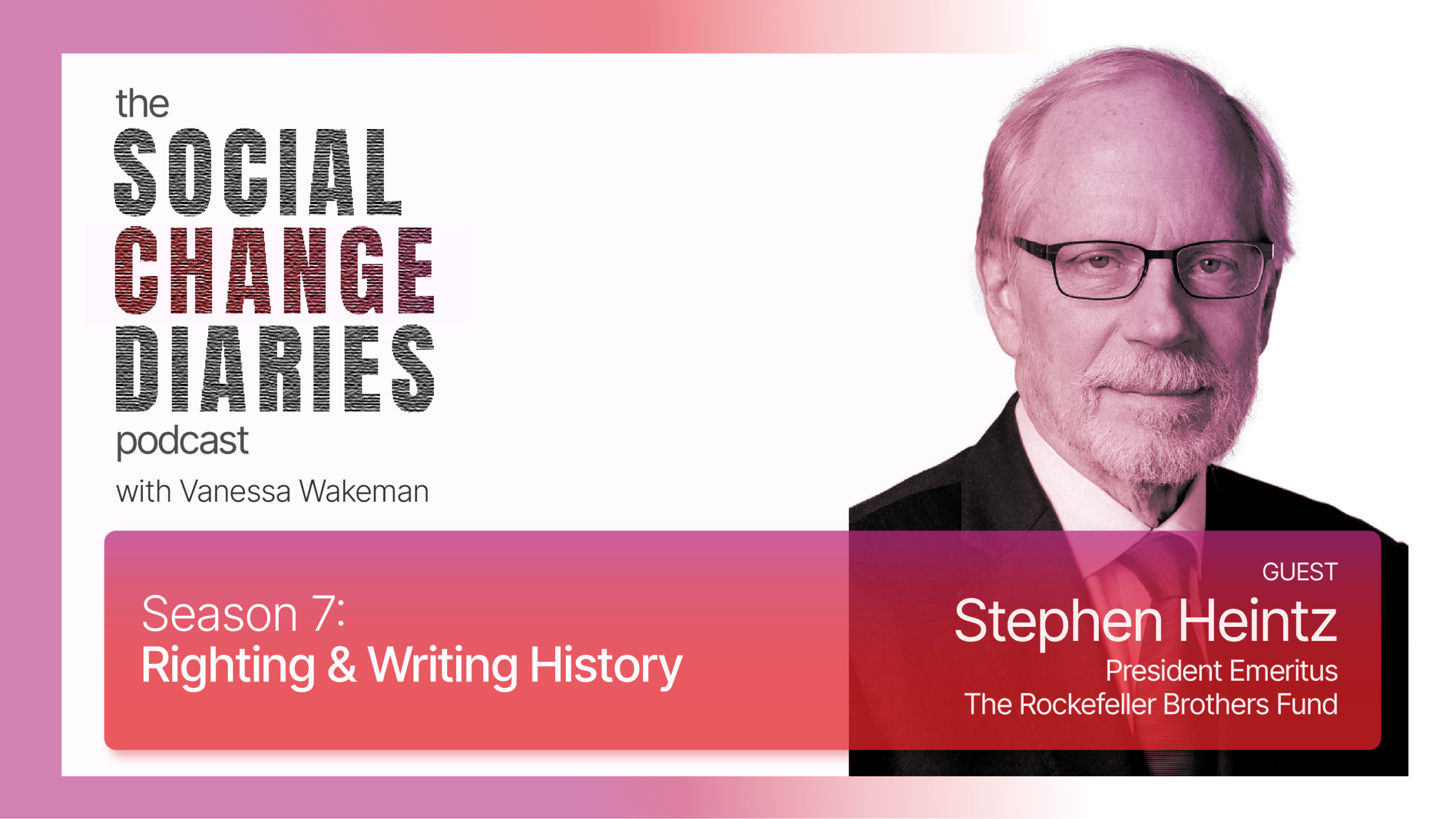
In this episode, Vanessa is joined by Stephen Heintz, President Emeritus of the Rockefeller Brothers Fund. Stephen brings a breadth of experience within philanthropy and a deep understanding of the role nonprofits and foundations play in keeping our democracy alive and well. Together they discuss philanthropy’s urgent responsibility to support communications, the possibility of our democracy’s fourth founding, and the value of nonprofit diversity in our country. This conversation covers a range of topics, framing what is at stake for philanthropy and our democracy today. It also provides inspiring examples of why the social change sector is essential to the ongoing process of strengthening our democratic institutions and culture.
About Stephen Heintz:
As President of the Rockefeller Brothers Fund from 2001-2026, Stephen coined the term “acupuncture philanthropy”: leveraging modest resources to trigger systemic change. He initiated the Fund’s fossil fuel divestment and the Track II dialogue preceding the 2015 Iran Nuclear Deal. Stephen also co-founded the Trust for Civic Life to facilitate national philanthropic funding for local democracy efforts.
In his words…
“We still don’t have liberty and justice for all. We still don’t have all men and women created equal in our society. Those aspirations are, to me, as valid today as they were two hundred and fifty years ago. We have an obligation to every generation to make progress in making them real for people.”
“One of the logics of the past has been, as we know, colonialism, racism, and patriarchy. The new logic has to be based on equity and cosmopolitanism.”
“We have concentrated economic power, technological power, and information power. And as a result of those concentrations of power, we also have concentrations of political power.”
When I worked in Eastern Europe, “it was remarkable to see how quickly citizens took the responsibility and self-organized into myriad organizations to address all kinds of topics and issues and how much that has meant to the quality of their democracies.”
In the history of our country, “foundings occurred in each century, and for all three of them, race has been at the center. Now we are at the period where we need a fourth founding. We still need to address problems of racial injustice in our society. We need to modernize our systems and institutions so that they are more effective, more transparent, and more inclusive. It is time for us to literally have a fourth founding to take America forward and effectively address the enormous challenges of the remaining decades of the 21st century.”
Transcript
Vanessa Wakeman: Hello, and welcome to the Social Change Diaries. I am your host, Vanessa Wakeman, and this season of the podcast, we are exploring the theme Righting and Writing History. This season simply would not be complete without today’s guest, Stephen Heintz.
Stephen has led the Rockefeller Brothers Fund since 2001. If you are familiar with the term “acupuncture philanthropy,” he coined it. He also initiated RBF’s fossil fuel divestment and the Track II dialogue that preceded the 2015 Iran nuclear deal.
He co-founded the Trust for Civil Life to facilitate national philanthropic funding for local democracy efforts. And after 25 years at RBF, he is retiring, so we are catching him at just the right time.
Welcome, Stephen, to the podcast.
Stephen Heintz: Thank you, Vanessa. I’m happy to be here.
Vanessa Wakeman: I’m really excited to be speaking with you. I think your longevity at the helm of a foundation, along with your thinking about the way philanthropy works, is incredibly valuable. And, more specifically for this season of the podcast, I’m interested in the democratic lens through which we’re trying to frame some of these conversations.
So, I want to jump in by focusing on the foundation’s Democratic Practice Program.
The program seeks to strengthen the vitality of democracy in the United States and globally. The idea is that, for democracy to flourish, it must deliver on its promises. Its citizens must be engaged, empowered, and assertive, and its institutions of governance must be inclusive, transparent, accountable, and responsive.
When we think about that first part—the role of citizens—can you describe what engagement, empowerment, and assertiveness look like at their best? And what happens when democracy fails to deliver on those promises?
Stephen Heintz: Well, you know, it’s really about the fact that our representative democracy is based on a very simple idea that is also very complex to implement: it is based on the consent of the governed.
We have a system of government—a system of self-government—that is based on the consent of those being governed. And in order for people to grant their consent, they need to have the power to do so. That means, for example, having voting rights and an accessible way to exercise those rights without a lot of barriers or challenges.
They also need to be able to engage in other ways to influence the decisions that the people elected to represent them make. And so, that means all of us have a responsibility to be well-informed about the issues, well-informed about candidates, and to turn out to vote.
But we not only need to turn out to vote; we need to get engaged in helping to promote candidates that we truly believe in and that we think will help democracy deliver on its promises. And we need to stay involved after election day.
I think part of what has happened in our democracy—our American democracy—is that we have simplified the idea of democracy to just voting. And voting is absolutely essential, but it is only one part. We have to be active citizens 365 days a year, not just on election day.
Vanessa Wakeman: That is a great point to make. How did we get here? When I think about conversations in my family around the dinner table, when grandparents and great-grandparents were around, I remember hearing more conversations—not necessarily more interest, but more discussions, as you said, that went beyond just election day.
So, as someone who has a perspective that is both United States-focused and global, do you have any sense of how, in the United States, we got to this place where we are so focused on the election? Where it becomes, “Okay, I did my part, and now I’m done until the next election”?
Stephen Heintz: I think that part of it is that we have a very different information environment and a very different media environment today than we did even 20 years ago.
During my time at RBF, when I started in 2001, the iPhone had not yet been introduced to the market. Social media did not really exist. And the world has changed so dramatically since then.
I think the social media revolution has separated people. It has given people the opportunity to withdraw into very narrow information cocoons, where they are often listening more to themselves than they are engaging with diverse points of view. And I think that has degraded people’s sense of responsibility.
As a result, people do not engage as much. But the other thing that I think is really important is that there have been very specific efforts to place barriers to participation because there are powerful interests in our society that do not actually want people to participate. They want to control things on their own.
And so, they have constructed enormous barriers and created lots of disincentives to keep people from actively participating. And we cannot let that happen.
Vanessa Wakeman: Yes. So, what is philanthropy’s role in, one, making sure that we are—if there is a role—thinking about democracy beyond just voting? And then, in our current climate, are there additional things that we need to be keeping in mind if we want democracy to deliver on its promise?
Stephen Heintz: Well, I think philanthropy has a very important role to play. And I’m proud of the fact that the Rockefeller Brothers Fund has been doing this work on democracy for 25 years—and longer in some different ways—but explicitly for 25 years.
I think the role is this: philanthropy is an independent source of venture capital for the social sector.
We have independence, and we have financial resources. We can do things that others cannot do, and others will not do.
And so, I think the responsibility of philanthropy is to focus on empowering the disempowered, helping to remove barriers to effective participation, and protecting the rights of people to participate when those rights are being undermined, as we are seeing in our American democracy in real time.
Philanthropy can do a lot in that regard. And so, this year, just to be quite specific, in a critically important midterm election year, I think philanthropy’s responsibility is to do everything it can to help Americans protect the democracy we have.
So that, in future years, we can build the democracy we actually need, because we know our democracy still has inherent flaws that we need to overcome.
Vanessa Wakeman: Yeah, that part, I think, is really important.
We have been talking a lot in conversations with some of our clients and in different circles about trying to band-aid what we have, right? To make it strong enough, as you just said, to continue moving forward.
But I think, as people are feeling so deflated and uncertain about what is possible, there should also be an active conversation about what we want democracy to be. What is the vision? What is the North Star that can guide us?
So, thinking again about philanthropy in the way you just described it and its role, are there guardrails, visions, insights, or other things that the sector should be thinking about?
If we are seeing this as an opportunity to correct some history and author a new future, is there any innovation or disruption that should be at the foundation of that thinking?
Stephen Heintz: Well, first of all, I think there is a very, very profound need to reinvent our democracy for the conditions of the 21st century.
This is a very different period. The technology revolution that brought us social media, and now the artificial intelligence revolution, will have vast implications for society and will challenge some of the concepts and norms of democracy.
And so, there is a very long list of things that need to be worked on. But we will not be able to do that work unless we can protect the election process in 2026 and in 2028.
As we know, there are political forces in this country that are working to undermine the integrity of our election process. Even the President of the United States, unfortunately, continues to make claims about rigged elections in 2020. He is already signaling that he does not trust that the results of the midterm elections will be free, fair, and accurate, despite there being no evidence to support those claims.
And so, in the worst-case scenario, one could imagine that he is laying the groundwork to challenge the outcome of the midterm elections, which could lead to nothing short of a constitutional crisis.
So, in this year, I think philanthropy’s responsibility is to help protect the integrity of the election process: to make sure that everybody who is eligible to vote and wants to vote is able to vote, that their votes are counted and counted accurately, that the results are accepted, and that we move forward from there with the newly elected Congress to do the ongoing work that will be necessary to rebuild our democracy for the conditions of this century in the remaining decades.
Vanessa Wakeman: Well said, well said.
For me, part of the issue that I see—and I would love to hear your take on this—is that, in addition to all of the problems that we have, we also have a communications problem.
We do not seem to do the best job of helping everyday citizens understand the issues, the power that they have to address those issues, and how they can ensure that their interests are represented.
Where do you see the role of philanthropy in addressing this? And, in particular, I think this is really important right now, when organizations and nonprofits are under attack, and there are a number of vulnerabilities with the government.
What do you see as philanthropy’s role in ensuring that we are communicating effectively and consistently to combat some of the narratives that are out there and to make sure that social issues are accurately understood?
Stephen Heintz: Well, it’s a really good point, Vanessa, and it really draws my attention to the kind of work that you do at the Wakeman Agency.
One of the things I think philanthropy does not do very well is support the communications work of our grantees. And that is a really important part of what our grantees do.
They need to build support for their work. They need to communicate with their constituents and with their broader publics. And often, philanthropy does not want to fund that kind of work because we want to fund the more direct engagement work. We misunderstand how important communications is to that direct engagement.
There are lots of ways foundations can help with communications work. They can fund it directly. They can also help pay for training for staff at NGOs to become more effective in their own communications and support efforts like improving their websites, for example.
But we are learning—and we should have learned it a long time ago—that effective communications are absolutely essential to success in the work of the nonprofit sector.
Vanessa Wakeman: So, I’m going to do a quick commercial: While everyone knows that Stephen is retiring from RBF, we will now be asking him to be Wakeman’s spokesperson as we try to spread the message about the importance of communications for social change work.
It is absolutely necessary, and I couldn’t have said it better myself.
I’m very appreciative of hearing this from you, as someone who has been in the sector and in this particular role at this foundation long enough to see the different cycles of change and the issues that have emerged, while recognizing that communications is essential.
Stephen Heintz: Can I add something on this, Vanessa?
You know, I have done a lot of thinking and looked at a lot of data about the 2024 election. And, obviously, we saw that Donald Trump won both the popular vote and the Electoral College.
My analysis is this: He ultimately won because tens of millions of Americans were not necessarily voting because they believed in him. Many were, but there were tens of millions who voted for him not because they were true believers in Donald Trump or the MAGA movement.
They voted for him because they felt like they had lost confidence in our democracy. They do not believe that their vote or their voice really matter. And they also do not feel like they can have confidence in their future in the American economy.
So, they feel like they have no agency as democratic citizens and no agency within our economy. And until they are presented with an alternative that gives them reason to believe that they will have agency as citizens and as workers and families within our economy, we are going to continue to have this problem of demagogues and populists who attract people because they are frustrated, disappointed, and aggrieved.
And half of the problem is policy. We need to have better policies for both empowering people in our democracy and empowering them in our economy.
But the other half of the problem is narratives. And until we are able to tell the American people a story about the future in which they can actually see themselves, we are going to continue to have this political division, polarization, and dysfunction in our democracy.
So, communications, the creation of narratives and stories, and the ability to inspire people and fire up their political imagination—this is essential work if we are going to have the kind of American society that we want to have.
Vanessa Wakeman: So, gosh, I feel like I’m going to be knocking on your door every nine or ten months saying, “Are you bored? Do you want to come back on the podcast again?”
I want to step out of the foundation seat for a second and think about nonprofits, because they are directly working on social issues and are always trying to expand their audiences based on what you’re sharing about the need to create a narrative where people can see themselves and their situation getting better.
How does an organization that is not directly focused on democracy—although I think every social issue intersects with our democracy because we are talking about equity, economics, stability, and so much more—think about this?
What can an organization, whether it is a women’s reproductive rights organization, an immigration organization, or another type of social change organization, understand as being true no matter where it sits in the social change ecosystem?
Stephen Heintz: Well, I think a few things rise to the top of that list.
One is the importance of diversity in the nonprofit sector. The fact that we have organizations working on immigrant rights, women’s reproductive rights, the environment, literacy, health reform, education reform, and so many other issues—that diversity in the nonprofit sector is essential to the quality of our democracy.
And this is something that people, I think, tend to overlook. They often think of the nonprofit sector, of all these NGOs, as very nice things to have. But they do not recognize that they are not only nice to have; they are essential to have.
They are the way that citizens can self-organize. People come together and say, “You know what? We see a need in our community or a problem in our society, and we need to come together and work together to try to address it,” whether it is women’s rights, healthcare, immigration, or any number of other issues.
And that is what makes our democracy function. That is the work that happens between election days. A lot of it is done through the nonprofit sector, which we broadly refer to as civil society.
Civil society is the bedrock of democratic society. Without a vibrant civil society, democracy withers, and demagogues, populists, and manipulators are able to gain and hold onto power because there is no countervailing power in a country where civil society is weak.
And I saw this throughout my career before RBF. My whole career has really been about democracy.
When I graduated from college, I ran for office. And although I was defeated, I ended up serving for 15 years in state government in Connecticut and working in national politics.
Then, when the Berlin Wall came down in 1989, I moved to Eastern Europe to join an international non-governmental organization that was trying to help the new democracies as they were emerging from 40 years of communism and trying to build their own inclusive and effective democratic societies.
I did that for a decade, working all over Eastern Europe and the former Soviet Union, and then came back to the United States.
What I saw in Eastern Europe was countries where, under communism, there was no civil society because everything was controlled by the government. What happened in those early years after the peaceful revolutions of 1989 was that citizens began to organize civil society.
It was remarkable to see how quickly citizens took responsibility and self-organized into a wide range of organizations to address all kinds of topics and issues, and how much that has meant to the quality of their democracies since that time.
I was just yesterday on a Zoom session with the World Bank director in Ukraine, a country that, as we know, is experiencing a brutal war where bombs are falling on the capital of Kyiv every night.
This gentleman is running the World Bank’s programs to try to help the Ukrainian economy. And I asked him about the status and quality of civil society in Ukraine.
All of a sudden, he became so excited and animated because he said, “Civil society here is stronger than anywhere else I’ve ever seen, and I’ve worked all over the world.” He said that it is civil society that is actually mobilizing Ukrainian citizens and helping them in this fight against the Russian invasion.
And so, we often think of war as only involving governments and militaries. But actually, even in a crisis like that, civil society has an extremely important role to play.
That is a long answer, I know, but I want to stress the point of why these NGOs are so critical to democratic society.
Vanessa Wakeman: Yeah, and I think it is also great framing and a reminder that it is the people every time, right?
If we look at historical context, both today and throughout history, it is the people who are making the changes and creating the world that we want to see.
And so, no matter how much rhetoric, disinformation, and distorted narratives we encounter about who should be in charge, we need to re-ground and re-center ourselves on the reality that it is always the people.
And we are the people, you know.
Stephen Heintz: Absolutely. That’s right.
And in our country, in this particularly difficult period, the change we need is not going to come from the top down. It is going to come from the bottom up.
It is going to come from the people and with the people. And that is really important for us to remember and for philanthropy to focus on.
Vanessa Wakeman: Yeah, I have to have a fan moment. Like I said, I was really excited for us to be having this conversation.
This morning, as I was preparing, I do not know why this came into my mind, but I was thinking about how I went to parochial school as a child, and we had to say the Pledge of Allegiance every day.
I was thinking about the idea of “liberty and justice for all” and tying that to something that you wrote last year about how we are operating on outmoded assumptions and anachronistic logic.
The idea of “liberty and justice for all”—we have never quite gotten that right.
So, when you think about these outdated and outmoded assumptions, what do you see as the opportunity for philanthropy to refresh and reimagine that? Where should we ground ourselves so that we can march forward?
Stephen Heintz: Right. So, there are certain assumptions and a certain logic that we absolutely need to maintain. In fact, we have to actually realize them.
“Liberty and justice for all.” “All men are created equal.” These are powerful phrases that are part of our founding. We have just been celebrating the 250th anniversary, and those phrases come from the original founding of this country.
They are not anachronistic. What is anachronistic is the fact that we have not yet realized those phrases. We have not fully implemented them in a way that ensures we have liberty and justice for all. We still have not achieved the idea that all men and women are created equal in our society.
And so, those are aspirations that, to me, are as valid today as they were 250 years ago. But we have an obligation in every generation to make progress in making them real for people. And that is the main focus.
But there are a lot of anachronistic assumptions. One is in the economy. I think that what people refer to as the neoliberal economic model—which is largely about small government, low taxation, low regulation, and giving the private sector as much space and freedom as possible because they are the engine of innovation, job creation, and so on—has created challenges.
What we have seen under the neoliberal model, especially in the latter decades of the 20th century and these first decades of the 21st century, is that this model has produced more and more economic inequality, as opposed to more and more economic justice.
And so, one of the anachronistic assumptions is that neoliberal approach. We need to move away from that assumption and replace it with an approach to the economy that focuses on human and planetary well-being.
We need an economy that treats human beings as the most important beneficiaries of the economy. And we need an economy that does not destroy the planet we rely on for our very lives. So, it is a complete shift from a very anachronistic logic about the economy to a very different logic going forward. And I think that is a fundamental one.
Another one—and when I was writing the work you described, which was published in a monograph called The Logic for the Future—I was really thinking about international affairs and the international system, because there are many elements of the existing international system that are really anachronistic.
And liberal neoliberal economics is part of that. But there are other things as well. One of them is that one of the logics of the past was really based on colonialism, racism, and patriarchy.
The new logic has to be based on equity and cosmopolitanism.
The old logic was based on anthropocentrism—the notion that human beings were the most important form of life, and that we could do with all the rest of life on this planet whatever we wanted for our own benefit.
Now, we have to move away from that human-centered approach and think more about all life on the planet that we are part of, not distinct from. We need to take care of that life because, ultimately, that is also taking care of our own lives.
These are just some examples of how even changes on the international scale have real impacts on the domestic issues we are also confronting.
Vanessa Wakeman: Within those models and those outmoded assumptions, it is also unbelievable how much of that is connected to narrative, right? We were told to believe these things. We were told to believe that the private sector was the answer, and that you go be a teacher or work in the nonprofit sector if you cannot make it in corporate America.
And so, I think one of the things that philanthropy has an opportunity to do through all of this is to remind the general public—to remind citizens—that we have options, we have agency, and we get to collectively, as you mentioned earlier, create what we want. It does not have to be this way.
I also think this idea of how we take care of the planet is so important because that is ultimately what the social sector is doing. That is why we have people working on civil rights, climate, and so many other issues. As a collective, we have an opportunity to reprioritize what is valuable and important, and also to think about where we are situated within that.
If we look at some Indigenous practices or historical perspectives, we were not the center of it all. We were participants within an ecosystem of others. There are learnings that we can return to while still maintaining the idea of progress, right? We know there are some things in modern, contemporary life that we value and enjoy.
And so, I think we can have both if we are thoughtful about it.
Stephen Heintz: I agree. I agree. And I also think that the private sector has an important role to play. I’m not against capitalism; I’m against the way capitalism is currently being practiced.
We need the innovation and the ideas that are generated through the private sector that then produce economic benefit. So, it is not about overturning the role of the private sector; it is about rebalancing.
And I think of this as three sectors: a government sector, a private sector, and a nonprofit sector. It is about the balance among those three and what each can bring to a healthy society.
They each have a role, but they each have to have guardrails, and they each have to have opportunities. And I think we are out of balance in this society at this point in our history, and we need an effort toward rebalancing.
Vanessa Wakeman: Yeah.
One of the things that I have often talked about is the interdependence between the three sectors. Historically, government was the priority. There was an issue, and the government was going to fix it, and we would build around that.
Then, slowly, government began funneling money to nonprofits as part of the model for solving these issues. And then, almost out of nowhere, as the power of the private sector grew, I felt like it began to engage in a way that said, “If you want this money, you have to solve problems in these ways or do these things.”
And so, the nonprofit sector now, in my opinion, has an outsized burden and responsibility for fixing problems without always having the power to address them in the ways that are most beneficial to the people they serve.
Stephen Heintz: Well, you’ve been using a word that I think is so important in this conversation, and that is power.
I think we have concentrations of power in our society today that are unhealthy for a genuine democracy. We have a few very wealthy—hyper-wealthy—individuals, with Elon Musk being the first world’s first trillionaire. I mean, this is an absurd amount of wealth, and it is also a dangerous amount of wealth.
And he is the first, but he will not be the last. There are others who are coming right behind him.
So, we have concentrated economic power, concentrated technological power, and concentrated information power. And as a result of those two concentrations of power, we also have concentrations of political power.
That makes it very hard for citizens—the average citizen—to feel like they have sufficient power, even collectively, to go up against those very strong centers of power.
But that is what we really need to do. That is the core imbalance in our society: the imbalance of power.
Vanessa Wakeman: So, one of my summer projects, which I have not started yet, was that I wanted to play the money game to see how much the top foundations collectively have and where that sort of fits compared to the top 10 billionaires who are on the trillionaire track.
Do we have enough?
I have full, ultimate faith in philanthropy, but I am nervous about the money. Do you think we have enough resources to be able to hold the line, if you will, when we think about some of the external opposing thoughts, opinions, and ideas about how the world should be run?
Do you think that we have enough resources through philanthropy to ensure the stability of our democracy and life as we know it and want it to be?
Stephen Heintz: Well, you know, I think there is quite a bit of money available through philanthropy.
And you mentioned earlier in your introduction my notion of acupuncture philanthropy. The idea is that, in acupuncture, all you have are these small little needles. And the question is: Where do you insert the needle to actually trigger some larger systemic change?
Vanessa Wakeman: Yes. Get the relief.
Stephen Heintz: Right. So, that does not necessarily mean we need more money. It is about how thoughtful, how creative, and how impactful we can be with the money we have.
So, I think that is really the first challenge. And I think philanthropy, in my 25 years in the sector, has gotten more strategic and is having more impact per dollar than it was 25 years ago.
The problems have also gotten larger, and the imbalance has gotten bigger. And so, more money is going to be necessary.
But here is the thing I am worried about, Vanessa. In the next two decades, the estimates are that something like $35 or $38 trillion of wealth in this country will transfer from one generation to the next.
So, the billionaire generation will be leaving $35 trillion, $38 trillion—some enormous amount of money—to successive generations. And because of our tax laws, and I hope because of altruism in some cases, a lot of that money will go into philanthropy.
And that is the good news, because we could definitely use more money.
But the thing I am worried about is that a lot of that philanthropic capital is not going to go into foundations of the type that we know well, like the Rockefeller Brothers Fund, the Ford Foundation, or the MacArthur Foundation—all very well-established, high-functioning, transparent, well-governed institutions staffed with really expert people.
A lot of it is going to go into donor-advised funds, family offices, and new forms like LLCs, where it will not be transparent. The governance will be very weak. Families themselves will be making all the decisions with no kind of outside engagement.
It will be very egocentric. It will be, “Well, I made a huge fortune, and so I’m brilliant, and I know how to spend the money in philanthropy. I don’t need anybody telling me how to do it well.”
And a lot of this money is not going to have the impact that we need it to have.
So, one of the things I am going to be thinking about and working on in my retirement is: How can we connect some of this new philanthropic capital to the really high-performing legacy philanthropic institutions to help make sure that this vast new philanthropic wealth is used effectively?
Vanessa Wakeman: Yes, yes, yes, yes, yes.
This question is slightly related but also broader.
Going back to some of what you have written, there is another quote that I think is important to represent in our conversation. You mentioned that, “To build the future, we must re-examine the foundations of the system we inherited.”
And I agree with that. That feels like the heart of this conversation.
I think that is relevant to what you just said about how money is funneled and the systems that determine where resources go. But it also raises a broader question for me about how philanthropy works.
What are the systems? How do people get access to money? Are there opportunities—or, in this moment where we are fighting for our democracy, are there things that we should be writing down in the margins of our notes and considering about philanthropy?
The world is changing, and some of the older systems may no longer serve us in the same way. I know your quote was not specifically focused on philanthropy, but it feels applicable here.
I’m wondering what your thoughts are.
Stephen Heintz: Yeah. Well, I think there is definitely a need for innovation in philanthropy, and we are seeing some really important innovations and experiments.
People talk about trust-based philanthropy, for example, which to me is really about the quality of the relationship between the philanthropic institution and the grantee community—the nonprofit community—and whether the channels of communication and the channels of participation in decision-making are effective.
It is about giving people the opportunity to feel like the power imbalance in that relationship is not as extreme as it used to be because, obviously, we have the money and people want some of it.
And so, the power imbalance is there, and it cannot be denied. But it can be reduced by making things more participatory, and by making things more clear, open, and transparent.
I’ll give you a very specific example that we have been involved in. One of the things that we and others have seen in the trends of American democracy is that, in small-town and rural America, there is not as much civic infrastructure as people refer to it. There are not as many places, programs, or people focused on giving citizens the opportunity to participate and contribute to the common good in their communities.
This exists in a more robust way in larger communities, urban communities, and larger cities and towns. But in rural America, the data suggests that this is far less developed.
So, we at the Rockefeller Brothers Fund are not able, because of the way we are structured, to make grants to lots of very small organizations in small communities. We simply do not have the staff, structures, or resources to do this effectively.
And yet, we know this work is really important.
So, we got together with a group of other national foundations and created a new philanthropic organization called the Trust for Civic Life. We are pooling philanthropic capital through the Trust, and the Trust has staff that has developed, through a participatory design process, a grantmaking system that involves citizens and leaders in small-town and rural America.
They come to the Trust with ideas, and the Trust supports them not only with money, but with contacts, networks, information, and education.
And we are now seeing that the Trust is supporting these kinds of civic initiatives in small towns in 35% of America’s rural counties, already within two and a half years of operation.
To me, this is an exciting example of innovation in philanthropy, where national philanthropies like the Rockefeller Brothers Fund saw a need that they could not directly address, but knew was important, and figured out a new structure for philanthropy to address that need.
Vanessa Wakeman: I’m happy to have learned about the program. And I am also thinking that, while I am always encouraging nonprofits to focus on communication, I think I may need to turn some of that attention toward philanthropy as well—to foundations—to say, “Hey, you all need to be communicating more actively about some of the work that maybe we do not hear about every day.”
Because I think it is important for people to understand what is happening behind the scenes.
Stephen Heintz: Well, I agree with you. There is a lot of communications work we should be doing.
And, by the way, for our listeners, you can Google the Trust for Civic Life, and they actually have some very good communications materials. I hope people will have a look.
Vanessa Wakeman: Good. Perfect, perfect.
We are about to wind down. I have a couple more questions, but I definitely want to jump into something you said early in the pandemic about us being in the midst of the fourth founding of our country, and that requiring work toward key values and institutional strengthening in service of our democracy.
What is your take now? Are we in the seventh founding? So much has happened since COVID.
Where are we today?
Stephen Heintz: Well, I still think we are in need of a fourth founding. We have not done it yet.
And let me describe what I was thinking about when I was writing about that, because I think it is especially relevant. We are recording this podcast literally days after the Fourth of July, when we celebrate the first founding.
The first founding was both the Declaration of Independence and then the Constitution, which created the system of self-government that we have. It was a remarkable invention and, at the time, a truly revolutionary innovation in government.
The second founding was forged by the Civil War, when we had to fight a civil war to end slavery and to ensure the future of the Union of the United States of America.
And the second founding was really codified in the amendments to the Constitution that were adopted during the period of Reconstruction, which abolished slavery, gave Black citizens the right to vote, and extended the rule of law to all. That was the second founding, and it was extremely important.
We had the first founding in the 18th century, the second founding in the 19th century, and the third founding in the 20th century. The third founding was the civil rights legislation: the Civil Rights Act itself, the Voting Rights Act, and the Fair Housing Act. Those three pieces of legislation finally overturned the ongoing discrimination of Jim Crow, separate but equal, and states’ rights.
And it is interesting that we have had one of these foundings in each century, and all three of them had race at the center.
So now we are at a period where we need a fourth founding. We still need to address problems of racial injustice in our society. We need to modernize our systems and institutions so that they are more effective, transparent, and inclusive.
And it is time for us to literally have a fourth founding—to take America forward and effectively address the enormous challenges that we are going to experience in the remaining decades of the 21st century.
And the thing that excites me about this is that, while it sounds like a daunting concept to have a fourth founding, the exhilarating part is that every one of us, every person in this society, can be a founder in America’s fourth founding.
We can do it, as we were talking about earlier. It is we the people. It is going to happen from the bottom up.
We have the strength, the innovation, the ideas, and the passions to actually create a better democratic society and to look back on it in 20 or 30 years and say, “You know what? We really did accomplish a fourth founding, and our representative democracy is stronger and more effective than it has ever been before.”
Vanessa Wakeman: I think that’s what it’s going to take. I think a fourth founding feels daunting and scary for all of the obvious reasons, but it also feels like the only way forward, right?
The challenge is that, sometimes when you are in a period of transformation or in the thick of change, you do not always realize it. I wish there were a way to have a checklist, right? What are the things that we can point to? What are the markers that help us understand where we are and where we need to go?
Because it can feel overwhelming and too big, and it can make people wonder, “How can I, as an individual, actually make a difference?”
But if we had some guardrails or some information—because we spoke about this before—we need those guideposts so that people understand that, regardless of where they are in our country’s ecosystem, there is a place for participation and there is a place for progress.
Stephen Heintz: That’s right. I can also offer our listeners another important resource, which is a document called Our Common Purpose: Reinventing American Democracy for the Twenty-First Century.
This is a report that was issued by a commission of the American Academy of Arts and Sciences, which I co-chaired. The report was issued in 2020, but it is still absolutely valid and relevant for 2026 and the future.
It is, in essence, a blueprint for what a fourth founding would look like. What do we need to do? What are the steps? What are the building blocks of a fourth founding?
I really recommend that document to people. You can find it very easily by simply Googling Our Common Purpose.
Vanessa Wakeman: I look forward to reviewing that and then emailing you my comments.
Stephen Heintz: Great. Please do. Please do.
Vanessa Wakeman: My final question—only because I want to let you get back to work—is that your work is so wide-ranging, and I have absolutely enjoyed this conversation.
But I want to ask you, as you are coming to a transition point in your career and retiring from your 25 years at RBF, what would you say is the sentence that you want to be able to say you helped write through your work?
Stephen Heintz: That’s a really big question.
I think it is what we have been talking about. I think if, 30 years from now, historians were looking back at the 250th anniversary and wrote a sentence like this:
“After the celebration of America’s 250th anniversary, American citizens together created the conditions for a fourth founding of American constitutional democracy that provided for the well-being of the population, the equal rights of all, and the opportunity for all Americans to shape the future.”
If that sentence could be written, and I could say I had some small part in making that sentence possible, I would be extremely happy.
Vanessa Wakeman: Wonderful, wonderful.
Well, folks, our time has come to an end. Please send Stephen your congratulations on his retirement—a job well done and all those good things. It was a pleasure having this conversation with you. Thank you for joining us.
Stephen Heintz: Thank you, Vanessa. I also really enjoyed it.
Vanessa Wakeman: Clearly, I did not want to end this conversation. There were so many more questions and thoughts in my head. Hopefully, Stephen will join us again in the future. Perhaps we can persuade him to come back after the midterms.
One of the things I want to sit with from this conversation is: How do we create the conditions for a fourth founding of America? This season is about righting and writing history. So often, we forget that we are actually living today as part of tomorrow’s history. What is our individual role in creating a fourth founding? There is something incredibly exciting about that idea, and we need to be thinking about action.
We know that our current model is not working, and as Stephen mentioned, in the third founding, race has been at the center. And it will very much need to be centered in a fourth founding. This feels like the starting place for how philanthropy can protect democracy and build something better. And as Stephen said, it is literally time for us to build this. I think we have more to dive into.
Also, the perfect bookend to this conversation may be Heather Gerken, the new President of the Ford Foundation, who also happens to be a constitutional law expert. Hmmmmm…let’s see if we can make that happen.
And lastly, as CEO of a communications agency, I would be remiss if I did not comment on Stephen’s very clear endorsement of the need for communications in the sector. I have nothing to add except a plus one. I could not have said it better myself.
So, folks, I think it’s time to reimagine communications as part of institutional governance. I will talk more about that later—or on our website—but I’m going to end our episode here. Thank you all for tuning in. I hope you enjoyed today’s conversation.
Be sure to follow the show on our website, thewakemanagency.com, Apple, Spotify, or wherever you listen so you never miss an episode. Don’t forget, we drop new episodes on Tuesdays. Be sure to tune in next week. See you then!