About This Episode:
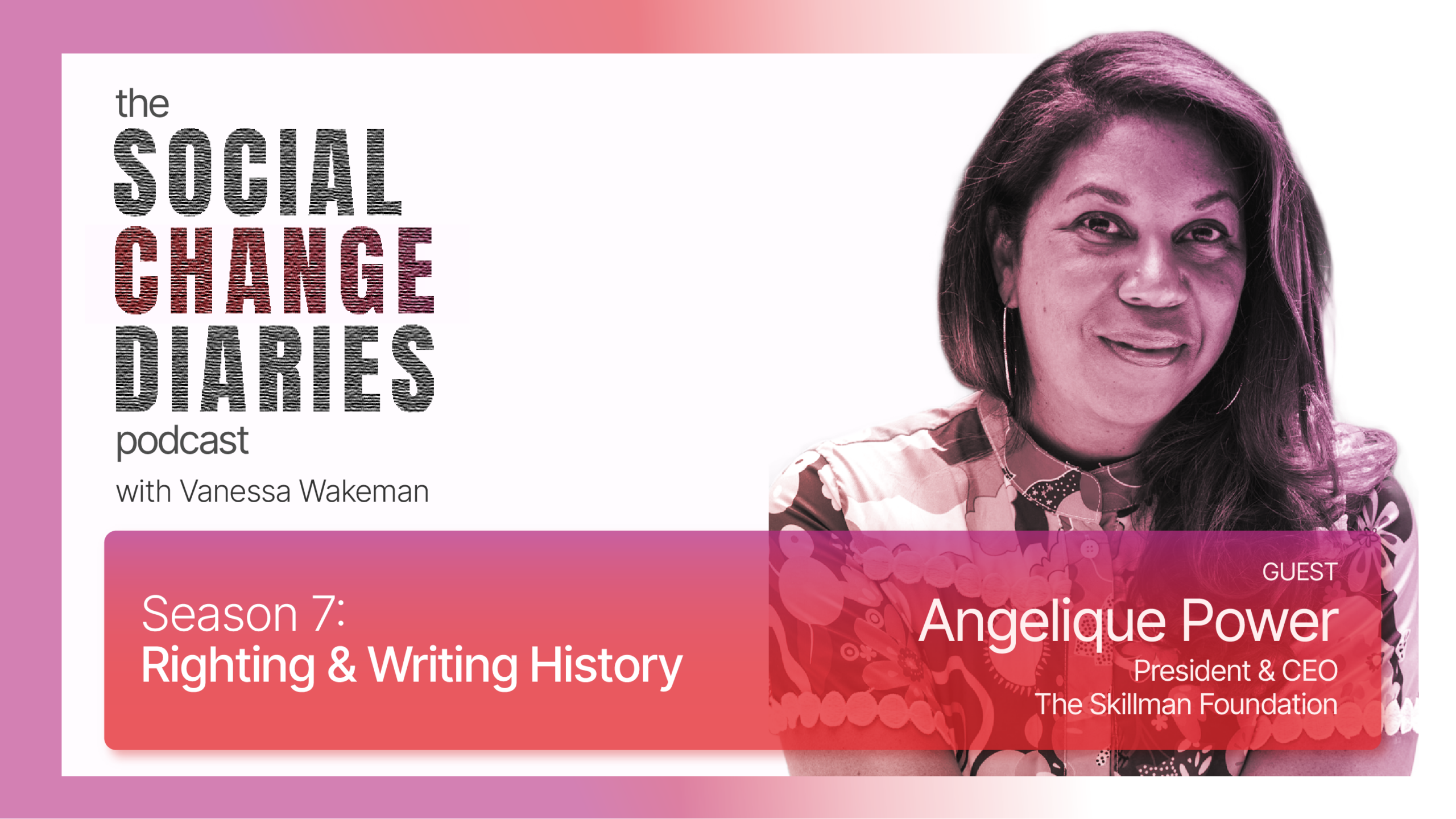
In this new episode of the Social Change Diaries podcast, Vanessa is joined by Angelique Power, President & CEO of The Skillman Foundation, a private, independent foundation that works with grassroots and grasstops advocates to transform the education system. In their discussion, they explore the inspiring energy of Detroit’s youth, the role of foundations to function as connective tissue for the social change work that young people are driving, and what partnership in a purple state looks like when not compromising values for common ground. Together, they dig into the importance of place and a city’s history, for how foundations can communicate to advance grassroots work for a better future.
About Angelique Power:
Angelique Power, is the President & CEO of The Skillman Foundation, which works with grassroots and grasstops advocates to transform the education system. Rooted in values of fairness, belonging, justice, and bridge-building in a purple state, the Foundation works for and with Detroit youth and grants approximately $24 million annually. The Skillman Foundation actively leverages its financial, moral, social, and reputational capital to ensure young people are designers of their own destiny, and ours.
In her words…
“I absolutely believe that we can create something better. I think that it isn’t just a mandate of this moment, but it is history. Whenever there are massive historical disruptions, a renaissance follows. Realistically, we have to do many things at the same time right now.”
“We’re in a storytelling contest right now. Who is America? And whose is America? And we have to join that storytelling contest because we have beautiful stories to convey. And yet if we sit it out, then a different story will be told for us. We’re thinking about how do we actively engage in narrative and storytelling as a core part of our work. We have to punch back. That’s something we have to do.”
“A lot of folks are scared. And I get it. I’m scared. But this is not the time to sit and think that everything will pass if you just stay still enough. For me, I go back to, who were you on the playground? Were you the kid that they were gonna push around? Do you still wanna be that kid if you were? Or were you the kid that was saying, “do it again. Try do that again.” Especially in philanthropy, we have resources that allows us to actually step up and subsume blows for others. And that’s a part of our role.”
“Youth today have this intersectional analysis of what the problems are. They aren’t just working on public education, they are working on climate justice, they’re working on police reform, they’re working on a whole different view of how a democratic republic can function. And so we have their intersectional analysis, we have their chutzpah, their ability to take risks, and their, natural dismissiveness toward incrementalism. That’s not enough. They want it all. They want it all to change. And so, you know, who better to be in the driver’s seat of trying to ensure this world works in the way they need it to, but them.”
“This hasn’t been working for us for a long time. We didn’t build this. And so let’s not waste an opportunity to ask ourselves, what is public education for? Or, what is education for? What does it bring? What do we need in this world? And what do we need to create to help us get there? Those are big, juicy questions that we absolutely need to be asking. And others have been asking, for a long time. And the answers are already inside of our communities.”
Transcript
Vanessa Wakeman: Hello and welcome to the Social Change Diaries. I am your host, Vanessa Wakeman.
This season on the Social Change Diaries, we are exploring the idea of righting and writing history and asking: How do we protect and preserve our democracy? We are about midway through the conversation with a number of incredible, insightful CEOs of foundations.
Today, I am joined by Angelique Power, President and CEO of the Skillman Foundation. Skillman is a private, independent foundation that works with grassroots and grasstops advocates to transform the education system. Rooted in values of fairness, belonging, justice, and bridge building in a purple state, the foundation works for and with Detroit youth, granting approximately $24 million annually.
Welcome, Angelique.
Angelique Power: Thank you. Thank you for having me.
Vanessa Wakeman: It is my pleasure. I want to jump right in. I have been doing some reading about the foundation, and I know that your focus is on transforming the education system and working directly with Detroit youth.
I imagine that working so closely with young people means the foundation must always keep in mind a sense of responsibility for what you are building for the future.
What do you believe is the responsibility of philanthropy in this moment, when so much about the future of a more equitable democracy feels like it is at stake?
Angelique Power: Yeah, I think that for foundations and for philanthropy, we have to use all of the tools that we have at this moment.
The foundation’s raison d’être, why we exist, is to create the connective tissue to help build and fund the systems and relationships that make progress possible. And if our communities are facing such significant shocks and threats, then we cannot just continue using the one or two traditional tools of giving a grant, sitting behind a wall, and waiting to see what happens.
We are our communities too. And so, this is a moment that calls for us to use our voices, our moral capital, our reputational capital, our social capital, and everything that we have in addition to dollars to help us get to the world that all of us want to see.
And what I’ll say, Vanessa, is that this has always been the job of foundations. But it has never been more clear than it is right now, when the very fabric of what makes the United States the United States — the democratic underpinnings of who we are — is under such threat.
It has always been the time to use all of these tools, but it is especially clear that now is the moment to use everything we have.
Vanessa Wakeman: Agreed, agreed, agreed.
And I wonder, as an organization working with youth, I imagine you have a different perspective or perhaps feel a different level of urgency because you are thinking about future generations. How do we protect and preserve what we have? How do we create something better?
In what ways does the mission of supporting and serving youth influence how you think about the vision for the foundation and what comes next?
I imagine that if we were having this conversation eight years ago, it would feel very different than it does today, simply because of what is at stake and the many challenges and attacks we are seeing. How does that inform the work you are doing and what you believe is most important in this moment?
Angelique Power: Yeah, I mean, I think that in some ways, because our mission is focused on working with and for Detroit youth to help them design their own destinies and ours, we have a leg up.
And by that, I mean the greatest asset that we have in our city is our young people. Detroit is a brilliant, beautiful, incredible, vibrant, and crackling city.
And the average age here is 35. It’s 90% folks of color. It is booming. It has actually grown in population year over year for the last three years, while most urban centers are actually losing population.
And so, the generations of Gen Alpha, Gen Z, millennials — so many of them are the energy, the creative energy, that is helping to propel Detroit forward.
Young people have always been at the forefront of social change. If we study the Civil Rights Movement, if we study some of the leaders that we hearken back to — the archaeologists and architects of the way that we view humanity today and the way we operationalize those values through policy — those are folks who were often in their 30s.
You know, in their twenties. And I always say there is something misunderstood about the advantage of not having your frontal cortex fully formed.
Many of us are like, “I’m scared I’m going to hit my shin on the coffee table.” You know what I mean?
And John Lewis crossed the bridge knowing that he was going to be beaten. Every step he took was not just for himself, but for humanity. It was for all of us.
And so, the advantage that we have in Detroit working with and for Detroit youth is that they see things differently. Young people today have this intersectional analysis of what the problems are. They aren’t just working on public education; they are working on climate justice, police reform, and a whole different view of how a democratic republic can function.
And so, we have their intersectional analysis, we have their chutzpah, their ability to take risks, and their natural dismissiveness toward incrementalism. That’s not enough. They want it all. They want it all to change.
And so, who better to be in the driver’s seat of trying to ensure this world works in the way they need it to than them?
Vanessa Wakeman: So, in philanthropy — and this may not be the perfect language to use, but it helps paint the picture — there has historically been this sort of old guard and a more traditional approach where funders stand back, if you will, and certain resources or groups are responsible for making the decisions.
And then, in more recent years, we have seen a more inclusive, shared-power dynamic, where funders are looking at the lived experiences of the people they are working with and saying, “These folks know best.”
Thinking about where we are today and the work you get to engage in, working with and for Detroit youth, do you think there is an opportunity, using the framing of this season — righting and writing history — to create something better amidst all of the chaos and harm that has been done?
I was having a conversation with someone, and they asked, “Are we trying to protect what we currently have, or do we want to create something better?”
So, thinking about where we are and, as you mentioned, younger generations being fearless in ways that many of us may not be, do you think that we can create something better?
Angelique Power: I absolutely do. I think that it isn’t just a mandate of this moment; it is actually a part of history. Whenever there are massive historical disruptions, a renaissance follows.
And so, realistically, I think we have to do many things at the same time right now. Inside of Skillman, we think about it through the framework of protection. We have to protect our communities from harm and from cruel policies. That is part of the mandate of this work.
We also have to communicate. And so, as I was saying to you before we started, we are in a storytelling contest right now. Who is America? And whose is America? We have to join that storytelling contest because we have beautiful stories to convey. And yet, if we sit it out, then a different story will be told for us.
So we are thinking about how we actively engage in narrative and storytelling as a core part of our work. We have to punch back. That is something we have to do.
A lot of folks are scared, and I get it. I’m scared. I’m scared, you know? But this is not the time to sit back and think that everything will pass if you just stay still enough.
For me, I go back to this idea of: Who were you on the playground? Were you the kid that they were going to push around? Do you still want to be that kid if you were? Or were you the kid who said, “Do it again. Try that again. I wish you would try one more time”?
This is the moment to really understand who you are and whose country this is, and to engage in a way that, especially in philanthropy, uses the resources we have to actually step up and absorb blows for others. That is part of our role.
But the final thing we have to do is to your point, which is this: This hasn’t been working for us for a long time. We didn’t build this. And so, let’s not waste an opportunity to really ask ourselves: What is public education for? What is education for? What does it bring? What do we need in this world? And what do we need to create to help us get there?
Those are big, juicy questions that we absolutely need to be asking. And others have been asking them for a long time.
The answers are already inside of our communities.
Vanessa Wakeman: Yes, I agree with that. And I just have to say thank you so much for elevating the importance of storytelling and communications. I continue to be frustrated, but also have to do sanity checks at multiple points when I hear certain CEOs and support from foundations saying, “Yes, we recognize the importance of communications.”
I really want to make sure that the experiences of the people — right, America is for the people — that those stories are front and center, and that we are not allowing counter-narratives to take over and reshape how people understand who we are and what we stand for.
So thank you for elevating that. I want to understand, at the foundation, talk to me a little bit about what you call groundbuilding and how that connects to organizing power and, if it does at all, to storytelling.
Angelique Power: Yes. So one key area that we fund is investing in community power building. And yes, we call that ground building, and we call them the ground builders.
Some of it is power building, but we also acknowledge that power already exists inside of our communities. What we really see it as doing is readying the soil and ensuring that the soil itself is nourished and fertile so that whatever we are building toward can take root and be successful.
And so ground builders are those that are youth. You know, we have a youth power fund inside of that. We focus on public education, so educators, teachers, and after-school providers. And then we have neighborhood power, which is how all of the folks who are working in communities — it could be community development corporations, block clubs, and others — are part of the power inside of our communities that are the deciding factors of what happens and what can grow.
Schools are this unique network across Michigan. They are inside every community. Nine out of ten Michigan children go to public schools.
In some towns, the public school is the economic driver. It is where people come to vote, it is Friday night lights, it is town halls, it is where we go to see matinees. And I think we forget that in this political discussion over public versus private schools, school choice, or who should have access to what.
But actually, these are the heartbeat of our communities. And so, in terms of our work, we actually want to first explain the importance of public education, but then really zero in on public schools and the role that everyone inside public schools — from the students to the teachers to the parents, to the bus drivers and the school clerks — plays, and how they need to be at the policymaking table too.
Vanessa Wakeman: In Detroit, as a purple state, what you stated at the top of the conversation about bringing people together really resonates. This idea of ground building and even bridge building — I would imagine that in a blue state versus a red state, there are going to be different approaches to how we get people to connect around issues and advance them.
What does that look like in a purple state? And in this political moment, does it require something different? Where is Skillman positioned within that work of ground building and bridge building in a purple state?
Angelique Power: Yeah. So our strategy in terms of funding is called people-powered education. And really, it is a bet on how change happens anywhere, but especially inside of a purple state.
So you mentioned ground building. That’s one of the four pillars: investing in community power. That’s how change happens.
Another pillar is policy and systems change. So we could fund an after-school program here or a literacy coach in this school there, but we actually know that if you pull that lever — that states are responsible for public education, that they have far more resources than we do, and that their policies can accelerate learning and they can also cause harm — we want to make sure that the ground builders are involved at the policy and systems level and helping to drive that.
The third pillar is literally building common ground. And that is a recognition that Michigan flips back and forth in terms of the direction that we move politically, but that is emblematic of the fact that people here are interested in policy and people over partisanship.
And so you don’t have dyed-in-the-wool Republicans or dyed-in-the-wool Democrats who are always going to stay that way. I mean, you have some, but you also have a lot of folks who are actually more interested in, “How is this going to move us forward?” And I’m listening to see where I’m going to say, “Yes, this represents where we’re going.”
So for anything to work here, and to work long term, it requires partnership. It requires seeking values alignment, which is our fourth pillar. How do we know what our values are? How are we very clear so we aren’t compromising our values in a trade-off toward common ground?
The way that actually shows up practically is that, in our ground-building portfolio, we have a lot of organizers that we fund. Some of them work together and have for a long time, but some of them do not.
And so we try to figure out: How do we build common ground even within our partners around the work they’re doing on behalf of education? The same is true for policy advocates at the state level. How do we bring them together so that we have a better understanding of where we aren’t cannibalizing each other, but instead are recognizing that we agree on 60%? Here’s the 60% we agree on. And then how do we build from there with ground builders and policy advocates?
We really think about common ground building as a practice, so that when we have a policy priority, it reflects this larger community around us. We’re going to move faster, and we’re going to achieve change that is more sturdy and long term.
Vanessa Wakeman: In thinking about your policy priorities, are there particular narratives right now that you see as harmful to people understanding and recognizing why certain policies need to be advanced or protected?
Angelique Power: Yes. You know, I think one thing I’ve noticed that has changed — and I have been at Skillman for five years; I came from Chicago and moved to my cousin’s city here — is this narrative that is more focused on cities not doing well or students not doing well has started to abate.
There is this larger acknowledgment that Michigan is forty-fourth in the country in terms of student outcomes. And you can’t actually move policy forward that requires additional revenue for public schools, for instance, unless you have the majority of folks who understand why you have to put more resources into schools.
And so when it becomes a town versus city conversation, you get a zero-sum game. But when we recognize that we are all in this together and that we need each other to advance, you’re going to get better policy results that come from that.
Vanessa Wakeman: That makes a lot of sense. Chicago is one of my favorite cities, but I won’t bore our listeners with all of my fangirling about it. I love the art scene there.
Both Chicago and Detroit have incredibly rich histories shaped by diverse communities. Since you’ve been part of both of these communities, what parts of those histories do you think are important for us to keep in mind as we confront new challenges today?
While Chicago may have more of a metropolitan feel, both cities have faced significant challenges. Detroit, not too long ago, experienced bankruptcy and a period of immense uncertainty. How do we remember and learn from those histories in a way that helps us navigate the challenges we face today?
Angelique Power: Yeah, I would say that place matters, and history and context matter. When I moved here, it was really important to me not to view Detroit as a version of Chicago, or to think that because Chicago and Detroit are both major cities, they could be understood in the same way. That’s why I call them cousins—we’re part of the same family, but we are also very different.
Detroit has such a distinct history, including a prominent African American middle class that was built through the growth of the auto industry. The auto industry recruited workers from the South and provided opportunities for people to have good-paying jobs. People could walk into these jobs without needing a certain level of education, and they could afford a home, have a pension, and access health insurance.
Because of that, there are so many memories among Detroiters of the circulating dollar—the idea that money moved throughout neighborhoods. You would go here, you would support this business, you would support that business, and there was a real sense of economic connection within communities.
In Chicago, I’m a Southsider—and I have to say, clearly the best side of Chicago. Let’s just be honest. We love our West Side friends, but the South and West Sides are where many Black communities lived. That was where we had to live, and then ultimately where we chose to live.
The history of redlining, along with other extractive practices in labor and beyond, created a different kind of neighborhood and economic experience. The histories are very similar, but the outcomes and contexts are different.
The decline that happened in Detroit is directly connected to the same auto industry that recruited so many people to the city and helped build a thriving middle class, but then also contributed to disinvestment as industries changed and highways were built that connected Detroit to the suburbs and facilitated movement away from the city.
It’s an important story to understand because when you meet a Detroiter, they are incredibly proud of their city. You will never meet someone who represents their city as proudly as Detroiters represent Detroit. There’s even a “How Detroit Are You?” game that gets played. And this is how you win: you were born and raised here, you never left. That means you’re a real one. You know?
The history of Detroit is one of tremendous pride. It is hope. It is hustle. It is creating things without having anyone hand you anything. It is building in the midst of a negative story being told about who you are.
And now, as people talk about Detroit being “on the come-up,” Detroiters will tell you Detroit has always been on the come-up. It’s not because of outside people—it’s because of Detroiters. That is the soul of the city.
So yes, there are differences, but I would say place matters. History matters. Context matters. Respect it, recognize it, and come correct. That’s what I’ve learned.
Vanessa Wakeman: Those are very good recommendations. And, following this idea of “coming correct,” I’m thinking about what you shared about Detroiters and how they are writing the history they want to see for future generations.
What do you believe is important for the Skillman Foundation to contribute to that story? As you think about the role of the foundation in authoring a new vision for community, responsiveness, and possibility, what is most important for you to write—even if it is not fully realized during your tenure?
Angelique Power: I think that the story of Skillman is the story of how we find each other again and again to solve problems and create a better world together.
There have been different iterations of Skillman’s focus throughout our history. We have a 65-plus-year history, and I am blessed to follow two brilliant Black women who previously led the Skillman Foundation, Carol Goss and Tanya Allen. Each of them brought such brilliance and passion to the role, and each rooted the foundation in different aspects of the work.
There was the Good Neighborhood Initiative, which represented a 10-year commitment from Skillman to invest $100 million in Detroit neighborhoods. That was at a time when government, businesses, and other foundations were not investing in Detroit neighborhoods in the way they needed to—and, frankly, there is still not enough investment today.
I think part of that ethos came from Skillman’s understanding of Ubuntu—the African philosophy that we are interconnected and that we need one another to build a better world. We are connected. We are responsible for each other.
Tanya Allen then led such deep, thoughtful, community-rooted work focused on transforming the education system for Detroit youth. She did that in lockstep with the community, while also working with business leaders, partners across the state, and communities in small towns across Michigan. Again, Ubuntu: we are interconnected.
We have worked with SANCOFA Consulting, which I would highly recommend to anyone looking for a consulting firm rooted in equity, to map the education ecosystem across Michigan. Through our goal of building common ground, we are asking: How do we intentionally find our way back to each other? How do we see each other fully, hear each other fully, and move beyond our perceptions of difference so that we can truly change the game?
At the end of the day, I want people to remember that Skillman is about youth, public education, and Detroit. But beneath all of that is a deeper belief in symbiosis and Ubuntu—the belief that we are all connected and that we need one another to create the future we want to see.
Vanessa Wakeman: In your role as a foundation leader, and thinking about how you connect the different communities and stakeholders you mentioned—the business community, residents, and others—what do you see as the role of foundations today in telling and/or writing the story?
Individual organizations often have narratives specific to their own focus areas, but where should foundation communications and narrative-building be focused to help bring together that fuller picture?
I feel like we don’t see enough of that.
Angelique Power: I think that we do not all need to be doing the same thing. I know some really brave people who you will never see put out a statement, post on LinkedIn, or give a fiery keynote, but you better believe they are telling stories to people who are influential behind the scenes. They are not only mitigating and preventing harm; they are moving some really significant things forward by using their voices in different settings and in different ways.
There are others who are more upfront and use their voices to say the thing. Skillman is one of them. We use our voice to say the thing, and we can do that even when there are consequences. We know, first, that we are aligned with our board. Our board is 10 toes down for Detroit youth. We have done risk appetite exercises internally, and we have even created our own risk appetite avatar.
If you come to Detroit, there is a sculpture right downtown—the Joe Louis Fist—and that is our avatar. It represents the idea that if you come after Detroit youth, you have to come through us first. We are in a position where that is the kind of storytelling we can do.
At the same time, we also pass the mic because, honestly, who wants to hear from foundations when there are so many other visionaries and brilliant people who are doing the hard work? Passing the mic is really important. Using your platform to lift up voices that are not often heard is important. We all need to do different things in coordination, but we all need to use our voices.
And that is why what you do is honestly so important. I mentioned that we have a radio show and a podcast, and earlier we were recording an episode with young people. They were talking about how, in school, you do not take out a piece of paper and write anymore, and you do not really read physical books. You might read paragraphs or shorter pieces of text, but it is different.
I was saying that there is something molecular that changes when you physically think a thought and write it down. When you turn a page and hold a thought, you unlock your mind to follow where the story is taking you as you turn the page.
What you do—helping people find their story, say it, and share it—is actually the connective tissue. That is what changes the world: one person, one story at a time.
So truly, thank you for the work that you do.
Vanessa Wakeman: Thank you for recognizing us. Thank you, thank you.
I have one final question for you. Of course, I could talk forever, but I feel like this is the perfect follow-up to what you just said about writing and reading.
I have a niece who is in high school, and I am constantly baffled when she tells me about worksheets and how everything is digital. I’m always asking, “Where are the books? I want to see physical books!” There are no books, there’s no paper—everything is technology, but that’s a whole other conversation.
As someone who is a writer, a consumer of literature, and a lover of words, if there was a word, a sentence, or a theme from a book that captures what you are feeling, sensing, or wanting to do in this moment, what would it be?
Angelique Power: There’s not one word that immediately comes to mind, but I do think there is a theme that continues to arise for me: the antidote to cruelty is community. And the way we discover our wildest dreams is through community, too.
So, in many ways, we already have the answer for this moment. We just need to lean into it, show up for one another, and recognize that what we need is already here.
Vanessa Wakeman: Thank you. That is the perfect sign-off.
I want to thank you for joining us today, and I look forward to continuing the conversation in the future.
Angelique Power: Thank you for having me.
Vanessa Wakeman: As with all of our guests, Angelique’s contributions to this conversation about philanthropy’s role in protecting democracy brought into focus how foundations are thinking about their responsibility in this moment.
One of the most poignant things Angelique said was, “We are our communities too.” That recognition feels especially important when we consider the challenges communities are facing today. It also underscores the importance of communications and storytelling in this moment. If we are our communities too, how do we tell stories that shape understanding of who we are, what we value, and how communities are impacted by the issues affecting them?
Angelique reminded us that “we’re in a storytelling contest right now. Who is America? And whose country is America?” If we want to shape that story, we have to ensure that the experiences, perspectives, and truths of communities are heard. Otherwise, we risk allowing narratives that distort reality and cause further harm to take hold.
So, let’s continue exploring this idea of the storytelling contest. Thank you, Angelique, for sharing that powerful perspective with us.
Thank you all for tuning in. I hope you enjoyed today’s conversation.
Be sure to follow the show on our website, thewakemanagency.com, Apple, Spotify, or wherever you listen so you never miss an episode.
Don’t forget, we drop new episodes on Tuesdays. Be sure to tune in next week.
See you then!