About This Episode:
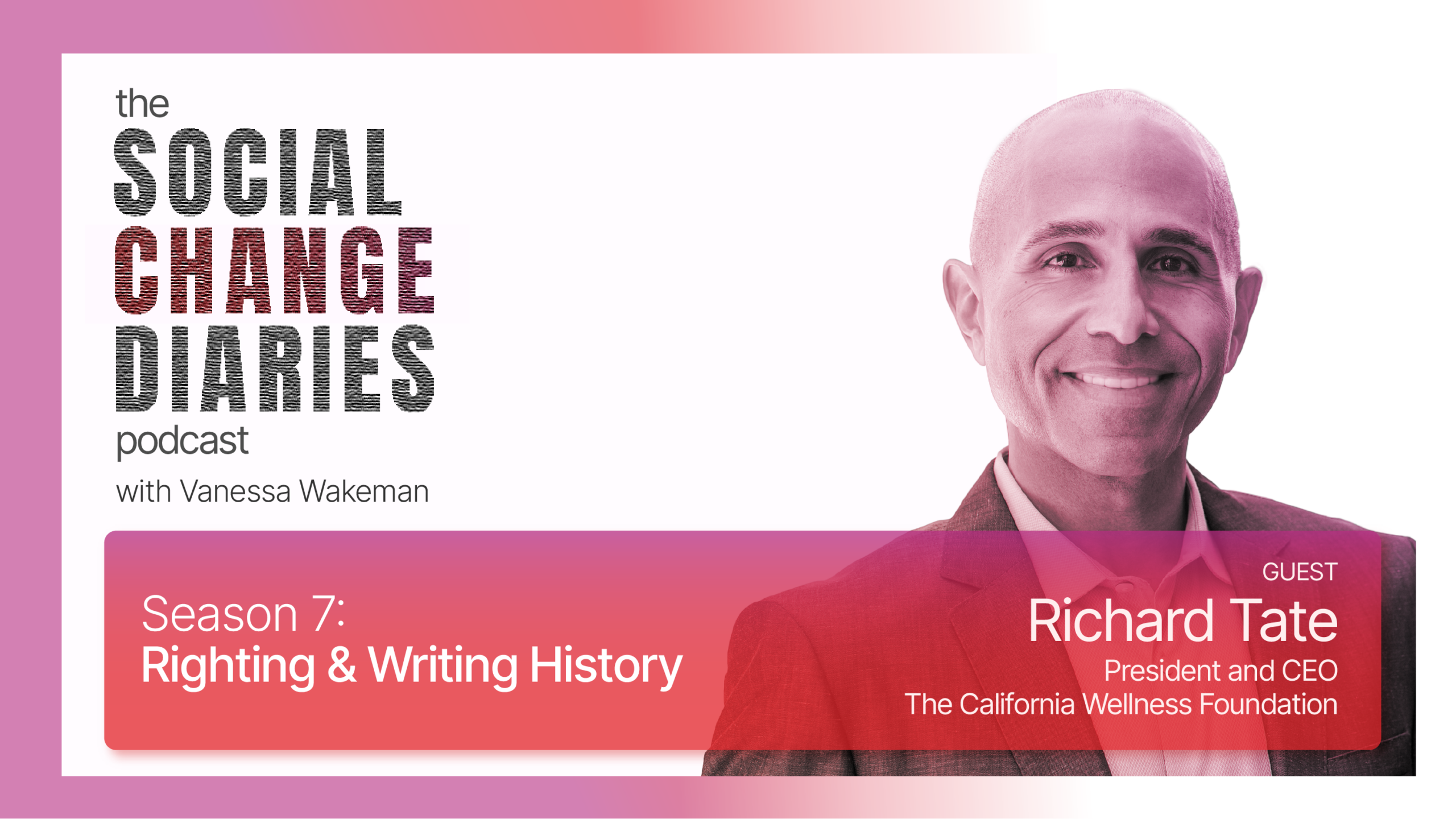
In this episode, Vanessa is joined by Richard Tate, President and CEO of The California Wellness Foundation. Together, they discuss why communications and storytelling are essential tools for social change, and why nonprofit organizations must be willing to use their voices in this moment. They explore what it means for philanthropy to mobilize more than money, how community voice, agency, and power are central to wellness and a thriving democracy, and why foundations should create space not only to address urgent needs, but also to dream about what comes next. Richard also shares how Cal Wellness is thinking about “building the power to be well,” the importance of investing in community-rooted approaches, and what it means to remain unwavering in your values and act with purpose when times are tough.
About Richard Tate:
Richard Tate is President and CEO of The California Wellness Foundation, a $1 billion foundation dedicated to advancing wellness and racial justice for all Californians. Under his leadership, Cal Wellness leverages its full range of resources, including grantmaking, investments, influence, and voice, to support healthier, more equitable communities. Richard brings extensive experience in communications and marketing, with a career spanning philanthropy and the corporate sector.
In his words…
“The power of ideas and stories, and the communications muscle that is required to do that well and consistently, is an essential part of social change work.”
“People are beginning to realize that the most basic unit of change is people in communities showing up to express what they need and what they want within this system of democracy. That is community organizing. That is supporting community voice and agency.”
“For us at Cal Wellness, we’ve been thinking a lot about shifting into a new phase of work that we’re calling building the power to be well. And so to your point, this is really an acknowledgement that it’s not about protecting what was, it’s about building toward what’s possible.”
“The experiences that I’ve had in my lifetime, but also the moment that we’re in, call on those of us who have reached a certain point of privilege and power in our lives. And if you’re sitting in a CEO foundation seat, you have privilege and power. The question is, what are you going to do with it?”
“I shifted in 2025 from a moment of fear and doubt to a moment of determination and resolve. So there are times when I was daunted, but still determined. And that’s the reality that I live in every day when I wake up right now.”
“Foundations and foundation leaders have always had access to conversations and opportunities with decision-makers and civil society that our grant partners and advocates don’t. Using our voice and our influence to talk about the issues that we’re seeing, and that our grant partners are advocating around, is part of what’s available to us. We’re also trying to make positive social change for people alongside our grant partners.”
Transcript
Vanessa Wakeman: Hello and welcome to The Social Change Diaries. I am your host, Vanessa Wakeman. Today, we are continuing to explore the theme of Righting and Writing History with some of philanthropy’s most influential leaders.
Today, I am joined by Richard Tate, the President and CEO of the California Wellness Foundation. With $1 billion in assets, yes, $1 billion with a B, Cal Wellness dedicates all of its resources — grantmaking, investments, influence, and voice — to advancing wellness and racial justice for all Californians.
Richard’s background includes leadership roles in communications and marketing in both philanthropy and the corporate sector. Thank you for joining me today, Richard.
Richard Tate: My pleasure, Vanessa. I’m excited to talk to you.
Vanessa Wakeman: So, I’m trying to balance my overall interest in your thoughts, opinions, and insights with also geeking out a little bit about being in a peer conversation with someone who totally understands communications and public affairs, which is where you started your career, first in the private sector and then in philanthropy.
So, I feel like you have an inner knowledge and an intimacy with how all of this works. And I see that in the way the foundation is positioned. I know you have a tremendous and amazing comms team, but it’s clear and evident in the way the foundation is positioned that communications and voice are important.
Talk to me a little bit about why you think communications is important for social change and why that’s embedded in the approach that the foundation is taking.
Richard Tate: Yeah. Well, yes, I’m a communications person by training, but even before that, as a theater kid and a big reader, I just found words to be a powerful tool in expressing my own experience of the world: how I was feeling, what I was seeing, but also in engaging with and persuading others.
So, to me, communications has always been about moving ideas and moving people. And that has been true in all the work that I’ve done, from my time working as a magazine editor and writer, including time with The Advocate magazine, during a time when I was an adolescent and young adult, during the height of the AIDS crisis.
Working for The Advocate, which was the national gay and lesbian news magazine, I began to appreciate how narratives and stories about people and about communities really do matter. That was a magazine, at the time, in its early days, that was writing about a community that didn’t get talked about. Parts of our lives didn’t get showcased or celebrated in ways that we wanted to see, that we hoped to see.
And it took a long time for mainstream media to begin to cover LGBTQ issues in ways that were authentic, respectful, and really showed the whole scope of who and what that community is about, my community. So, that was instructive to me.
And even in my corporate communications work, working with a variety of stakeholders, I worked in biotech and big pharma, so everything from scientists and researchers who had amazing ideas about what was possible in the world, translating that into something that shareholders and marketing teams could understand was a really exciting part of the work.
And now, in philanthropy, doing social change work, it’s not so different. We have ideas about what’s possible in the world, and our ability to frame those ideas, connect them to real stories about real people in order to move people to action, whether it’s individuals and communities or decision-makers in government, the power of ideas and stories, and the communications muscle that’s required to do that well and consistently, is an essential part of social change work.
Vanessa Wakeman: Yes. So, I think that this conversation is our eighth for this season. I think we’re going to have a total of 15 or 16 CEOs. And I am so surprised and elated at how positive the response has been around the role of communications in this moment for social change and why organizations are advocating for it.
What would you say to nonprofit listeners, who are our primary audience, who are fearful about communicating in this moment? And I know that your posture and resources are different than theirs, but what would you say to those organizations about the importance of communications for advancing equitable change for the communities that they serve?
Richard Tate: I think we have underestimated, in the social sector, the power of voice. I think many folks have been organized around raising the voice of community needs, but really have done that, oftentimes, in academic ways. Appropriately, we’ve relied heavily on research and data to tell the story about why people’s material conditions need to be addressed, whether that’s economic opportunity, access to health care.
Data and information are important and valuable, but also being willing and able to lift our voice around stories and needs and values, I think, is increasingly important. What do we really stand for? Whether that’s basic human rights, human dignity, some of these principles that are really under threat. Folks who are committed to racial justice, who believe that diversity improves our thinking and our strategies about how to make change in the world, not putting voice to those things is a choice. And I don’t think it’s the choice that we should be making.
So, folks who are not thinking about communications as a tool really should, I think, think about it in two ways. One is, if you’re looking to achieve an objective in the world, it’s really important to understand what the current thinking, stories, and narratives are around that particular issue in order to shift the hearts and minds of the people who are in a position to make decisions around those issues.
And oftentimes, we are human beings. Facts and data are insufficient to move hearts and minds. And so, if we are working in a nonprofit or if we’re working in a foundation, we’re trying to move an issue. Really understanding the narratives, the mental models that get in the way of people acting toward that objective, is a critical part of the work.
And internally, I would say that communications is an interesting tool because, as a strategic lever, if you are internally focused on communications, it can be a forcing function to clarify your strategy and your thinking. You think what you’re doing makes sense. And then, when you try to sit down and write it in a succinct paragraph, or what are the words that you’re going to say when you sit down and you talk to Vanessa Wakeman on a podcast, it becomes a forcing function to say, you know what? This should be sharper. We need to be clearer about what it is that we’re looking to achieve.
That’s something that I learned in my corporate days, in particular, when it came to, we want to sell this product into this market, or we want to convince investors that this is the right business strategy. And then, when you say it out loud, it really pushes you to say, you know, have you thought about this? How are you going to communicate that?
So, I would also say that investing in communications capacity can sharpen your strategic muscles internally.
Vanessa Wakeman: Yes, agreed. You previously stated that, in the current climate, philanthropy needs to mobilize more than money. Talk about that. You’re sort of championing the idea of, let’s use voice, influence, and resources in defense of equity and community well-being.
What more and more foundations and other civil society actors are recognizing is that this idea of community well-being and equity is central to ensuring that we have a strong democracy, and our democracy is currently under threat. How do you see that connection in the work of Cal Wellness Foundation? And we’re talking about that idea of more than money.
Richard Tate: Well, before I get to the money, and that’s important, I want to talk about our connection to the idea of democracy as a foundation.
The California Wellness Foundation is an example in philanthropy of an institution that was established not because a single rich person decided to set up a family foundation or to pursue a charitable initiative. We are what’s referred to as a health conversion foundation. So, we’re actually an example of philanthropy coming from our democratic process and system.
So, when Health Net, at the time a nonprofit health plan here in California, wanted to convert to become a for-profit business, there were advocates who worked within the regulatory framework of our democracy to say, okay, what is fair is for the resources that were accumulated by that entity under a nonprofit status and through tax breaks — we, the people, funded the growth of this business. We should receive some benefit from that if they were going to convert this into a for-profit business.
And that benefit was the fair valuation of those assets of the entity at a time. And a portion of those went into an endowment that became the source of our money at the California Wellness Foundation.
So, we occupy a space in which we were sort of born of this democratic process, where there are regulatory frameworks, there are rules about how we, as a people, decide to be governed. And those actually, in this case, bent the bias toward money and profit in our system toward the people and justice, and what people deserve based on the ways that they participated in governance.
So, that’s who we are.
Now, fast-forward to this present moment. What does it mean to use all your resources? Yes, we are made of money, literally. That is the primary role of our institution: to figure out how these resources that were secured on behalf of the people of California get back to the people of California in ways that invest in their health and wellness.
Grants have been the traditional tool that we think about. But there’s also a billion dollars that sits in the global capital markets, and you’ve got to believe that those are having some level of impact as well. And so, part of the work for us as a foundation, and for all of us in philanthropy, is to think about what’s the balance of those charitable dollars that go out against what those dollars in the capital markets are doing. That’s a huge opportunity space.
We committed our resources to be all in on our mission several years ago, and we’ve been doing the hard work to look at our portfolio of investments and say, what’s the impact that they’re having? When we think about social impact, whether that’s job creation or economic impacts, what are these investments doing in the world?
And even in holding those investments, how do we influence those companies and those businesses through shareholder advocacy to shift the dynamics that we see harming communities downstream?
A part of that is voice and influence, just as I described: speaking up as an investor, not being quiet as someone who holds money and influence in our endowment. And also working alongside partners. Yes, giving grants, supporting advocacy in communities is essential.
And foundations and foundation leaders have always had access to conversations and opportunities with other decision-makers and civil society that our grant partners and advocates don’t. And so, the question becomes, what are we doing when we go into those rooms? Using our voice and our influence to talk about the issues that we’re seeing, that our grant partners are advocating around, I think is part of what’s available to us.
So, I see foundations as a key part of civil society. We occupy the space that’s not just about financial transactions. It’s a big part of that, but we’re also trying to make positive social change for people alongside our grant partners.
And that means using the tables that we sit at, the connections and relationships that we have with decision-makers in government and business to really inform and influence the way that people are acting, and to support communities in raising their voices to decision-makers as well.
Vanessa Wakeman: Richard, in thinking about those tables you’re sitting at and working with different communities, as a wellness foundation, when we’re framing the conversation around protecting democracy, how do you see the connective tissue?
If we’re talking about protecting democracy and we understand how this is impacting the communities that we serve and their health and well-being, is there a particular sense of urgency, or maybe even a pivot from pre-2024 to now, in how you’re thinking about what wellness actually means for communities?
When we’re talking about, we want to protect our democracy, we want to make sure that there’s equity and justice, and that everyone has access, what does that look like? Or what’s different today from what it was previously? Are the conversations at some of those tables you mentioned different today?
Richard Tate: I think there’s a growing awareness that being a channel for community voice, raising the issues and the concerns of our partners doing work in communities every day, is part of the role that we can and should be playing.
In a moment where the charitable sector has been under attack, where organizations, entire categories of philanthropic entities, have been named in executive orders, where individual organizations doing legal, important community work have been targeted for congressional oversight, this is a moment for us to be thinking about what our role is in protecting our basic freedoms to give, to give voice to the issues that we see in communities.
And so, that, I think, is part of what it is that we really need to be focused on.
And Vanessa, I lost the thread. Can you ask your question again?
Vanessa Wakeman: Of course. But I think I may have asked you seven questions in one. So, that was good.
Richard, can you share with us the foundation’s sort of focus on wellness? What are the urgencies today if we’re framing that conversation through the lens of protecting our democracy? Are there specific priorities that the organization is thinking about?
What does health mean for people? What does, excuse me, wellness mean for people in this moment? Are some of the conversations you’re having, and some of the tables you just mentioned, different today?
Richard Tate: As a health foundation, the California Wellness Foundation has chosen a name that I think really communicates some basic beliefs about what health really requires. So, wellness as a word is a meaningful way that we see health happening in communities. Wellness speaks to something that’s beyond clinical care, just access to a doctor.
Wellness speaks to the desire for people to have voice, to have agency, to have power over the decisions that are made in their lives. Wellness is beyond simply disease prevention, but the opportunity to build a life for yourself and your family. And that’s really important.
There’s a whole body of research that folks refer to as the social determinants of health that really talk about what causes illness before you ever get to treatment in a hospital or a clinical setting. I think that, over the last 20 or 30 years, there’s been a lot of momentum built around this idea that health happens before you ever get into a healthcare system.
And a lot of the work that Cal Wellness and other institutions have done has been to really try to address those basic conditions that determine whether or not people are able to live healthy and well.
A key part of that for us has been people being able to voice the things that they need, what they see as getting in the way of them living healthy and well, whether that’s access to a job, education for their families, or basic needs like transportation and housing.
The basic unit of change for us has been to really listen to and amplify the voice and needs of community. And that has translated over time to a real focus on community organizing work, civic engagement work, building power and voice in communities so that they can speak to the policies and the issues that they need to see, including healthcare policy and health systems issues, in order to live healthy and well.
I think now, as I sit at tables, regardless of the issue area that you care about in 2025, 2026, 2027, when we see so much of the systems that we’ve relied on being dismantled and disrupted, people are beginning to realize that the most basic unit of change is people in communities showing up to express what they need and what they want within this system of democracy.
That is community organizing. That is supporting community voice and agency. So, regardless of your issue area, health, education, housing, that basic unit of organizing and community voice, I think, is something that we are continuing to focus on. It’s part of the legacy of the work that we’ve done for many years.
But we are moving into a period where recommitting ourselves to a thriving democracy as a core part of our work is part of how we see moving into this next generation of work at the foundation.
But, you know, kidding aside, Vanessa, I take it very seriously that I’m operating in a place where the conditions are such that we can continue to move forward and push for what’s possible.
We’re in a moment where speaking an alternative point of view, dissenting from what the powers that be are telling us we should, what we should look like, who holds power, who belongs in this country, this administration has tried to rewrite the narrative and literally rewrite history about who belongs and who’s worthy of support and access to opportunity.
And being in California, we have become a state of resistance. And I think acknowledging and embracing that, not simply for the act of resisting, but because we want to continue to build what’s possible.
If you take a concrete example with the passage of the Affordable Care Act, which was about providing basic health services to people, that is what that legislation was about. California took that and we ran with it. Medi-Cal has become one of the premier examples of how you can expand coverage and access to people in a state, in a region.
And we’re at a moment where federal funding cuts, rhetoric and language around diversity and equity and inclusion has really undermined commitments to racial justice. Now is the time for us here in California to recommit ourselves to expanding access and opportunity, to protecting the advancements that we gained, and to be rebuilding in the wake of all this disruption, to be pushing forward.
And you’re right, I think we have a unique opportunity. We have leadership, we have a charitable sector, we have people in communities who are ready and willing to embrace our diversity, to move forward with progress and to rebuild.
And I don’t take that lightly. I know that people in different parts of the country are struggling with different issues. So, I want us to continue to lead and to be a beacon for others who are looking to press forward in this current environment.
Vanessa Wakeman: I want to go back to what you said about well-being, because I think it’s so important to how we think about what this moment means for the future of our country.
What does well-being mean when we’re talking about protecting or preserving our democracy? It can be argued, and there is evidence to show, that for particular demographics of people, well-being has never been a consideration.
And so, should we, if well-being is so important, and I believe it is and you believe it is, be thinking about building something better than the democracy that we’ve had?
Like I said, there’s so much conversation about, we need to protect this, preserve what we have. But if we’re prioritizing, which based on the way you described it, we should be prioritizing well-being, should we be fighting for something else?
If we talk about righting and writing history, should we be attempting to author something better that is rooted and grounded in this idea of well-being for all citizens?
What would that look like to you, and what do you see as philanthropy’s role, or even the foundation’s role, in potentially helping to shape narratives or examples of that, that maybe folks can sort of march toward?
Richard Tate: Yeah. The answer is yes, we should be thinking about what’s next. Protecting what was or defending what is is not necessarily the path to well-being and wellness.
That is the big challenge of this moment, is many of us feeling the loss, grieving the disruption and the cancellation of incredible bodies of work around healthcare, education, and other advancements that we’ve made across social issues in the wake of this administration. And part of the letting go is a grieving process.
But I think what’s behind that is really reconnecting with what’s happening in communities. Because communities faced with challenge, they don’t have the luxury of going quiet, sitting still. People are getting up and going to work. They are getting their kids to school. They are facing extraordinary odds in doing just those basic things. And somehow, they are finding reasons to hope.
So, for us, I think reconnecting with what’s happening in communities with an eye toward what comes next. What can we be building together? What did we get wrong that now we have an opportunity to get right?
For us at Cal Wellness, we’ve been thinking a lot about shifting into a new phase of work that we’re calling “Building the Power to Be Well.” And so, to your point, this is really an acknowledgment that it’s not about protecting what was, it’s about building toward what’s possible.
And “Building the Power to Be Well,” for example, when we think about healthcare, is about what would a healthcare system look like that really included what people in communities, diverse communities here in California, really think wellness looks like and healthcare looks like?
Sometimes that’s not just about being able to see a doctor. That’s about being able to talk to someone in your community about whether or not vaccines and vaccinations and prenatal healthcare, what those terms mean and if they really matter. And that means talking to someone, perhaps a promotora in your community who is delivering that health information.
What would it look like to build a system that is taking community-rooted approaches to health and healthcare delivery and shifting the system so that that work is covered? What would it look like to recognize that a lot of this community-rooted care is being delivered by women and women of color? And what if we invested in them as change agents in helping us reimagine what’s possible in the system?
So, that’s an example of us sort of saying, you know what, Medi-Cal is an incredible piece of legislation that’s been advanced here in California. We need to continue to protect and advance that. But if we’re building toward a new iteration of that, what do we need to be thinking about now?
And for us, that’s about reconnecting with community and thinking first, what does community need? And how do we bridge up from that to a system that really acknowledges and honors that?
Vanessa Wakeman: I think that’s so important. Last year, I was having a conversation with some folks about the importance of communities of practice, right? And how do we take the knowledge that’s already existing and just find a way to share it and make sure that learnings are able to reach various audiences?
And this idea of community power-building that you just mentioned, like, we already have so much knowledge available. We just need some structure and, not from a power dynamic, but just organization. That’s a better word. Organization around it so that people can share it and help communities. And so, I love the idea of investing in that to make sure that more of it is happening.
And then I just want to comment on something you said earlier about, again, going back to well-being. There are so many instances where people in communities, right, well-being almost becomes secondary to survival, right?
And so, when you’re talking about building for the future, for what’s next, to even connect to the idea of that, I think, is radical for so many. Like, if you’ve been living under a system of oppression for so long.
And so, I think putting words around that, creating a narrative where people can sort of see what the possibilities are, I think is really important now because so many communities are being targeted.
And so, my concern is, when we’re thinking about all these things, I want to make sure people not only have the challenges being heard and understood, but also where people are sitting in the scale of harm, to make sure that they know that there are opportunities and, together, we can create change.
So, thank you for sharing that. It just sort of prompted me to be thinking about something.
Richard Tate: Yes. Well, Vanessa, you’re making me think about just the importance and the power of people having spaces to come together where they can just take a breath and that they can talk about what they want, what they need. You’re right, basic needs, but also what they want, what they aspire to, what they dream about.
We have, like many, been looking at our strategies and our approach to our work. And part of those conversations has been trying to balance these immediate, urgent needs that we see with this need to really build and dream toward what’s possible.
And we’ve had some really intense conversations internally about meeting people’s basic needs and that being the number one priority. And even at our worst in some of these conversations, assuming that because people are struggling and trying to make ends meet every day, that they don’t have dreams and aspirations.
And that if given the opportunity to put voice to that, we might see an amazing picture of what would be possible that we could actually work toward together. So, there is this opportunity for us to really listen and understand what those needs are.
But to also create spaces for people to dream and to tell us what they hope for and what they aspire to.
Now, as foundations, not all of us get time every day in community talking to real folks. But we’re talking to grant partners and we’re talking and working with organizations where leaders really represent, they are from the communities that they work with.
So, even creating space for them, when we think about the mechanics of philanthropy and funding, funding people to be on retreat, to think and plan in a different way, providing unrestricted general operating support that gives folks flexibility in organizations doing work in communities to choose how to meet their basic needs, but also encouraging them to create programs and systems in their nonprofits to give people time off, to take sabbaticals.
We’ve ourselves begun to fund an initiative called Wellness Together, where we’re bringing nonprofit partners, not only our grant partners, but anyone in the nonprofit community, to have a day of rest and restoration.
These feel like sometimes soft things that aren’t meeting the moment, but it’s part of what I’m painting a picture around, which is that we sometimes focus on the most urgent thing, which is the negative thing, and we don’t create space to think and dream about what’s possible.
So, funding that kind of work is just as important as strategizing around how to change a system to provide basic services to people.
Vanessa Wakeman: Yes. And first of all, dreaming is a birthright, right? Like, we should all, as children, our imaginations and our dreams are huge. And then somewhere along the line, that system gets disrupted. And it’s part of well-being, right? Like, being able to dream and believe that something is different. So, I think that kind of investment is absolutely needed.
You mentioned sort of being in that conversation with other, maybe, funders and grantee partners and other nonprofits.
Thinking about, in some ways, I kind of would assume that’s collective action, but I want to talk a little bit about some of the collective action work you all have been doing.
I know you led the first-ever funder collaborative on gun violence prevention a while back, the Hope and Heal Fund, in the wake of the San Bernardino massacre. What advice can you share from that experience of working with others in the funding space to move beyond fear and take action on maybe an area that folks don’t want to touch?
Richard Tate: Yeah, yeah. Well, that piece of work is a remarkable example of leadership by my predecessor, Judy Belk, and the board at the time.
I joined the foundation about a year after the San Bernardino shooting, and so the idea for the Hope and Heal Fund, the gun violence prevention collaborative that you mentioned, began before I joined.
But here’s what I know: a tragic event happened, and the team at the time quickly organized to really spotlight gun violence as not only an episodic issue around mass shootings, but also an issue that was really showing up every day in communities.
And so, there was an event, a spotlight convening, that really showcased how gun violence is impacting communities every day. In some ways, harnessing the attention that the world had focused after San Bernardino on what was a deeper-rooted community issue as well.
And then, to your question, doing the hard work of reshaping what gun violence is doing in communities, people’s perceptions of what gun violence is doing in communities, and building some understanding and some will to take collective action, i.e., invest in a collaborative, was part of what that legacy of work was.
And so, I mean, what did we learn from that? When I joined, part of my job at the time, as VP of Public Affairs, was to talk about how we brand and position this. That’s why we chose the name Hope and Heal, thinking about what’s possible, not just what the problem of gun violence was.
You can’t shy away from big, bold ideas. In fact, that’s the only thing that makes change. It takes time to move those ideas. And shifting the narrative takes time. Shifting mental models takes time. But that’s the work of philanthropy: to understand what communities need and be willing to lean in.
And that initiative was an example of long, hard work to bring funders along in order to invest in something that felt bold.
Fast-forward, I’m proud to say that the attention around gun violence has expanded and grown. And I think we’re at a critical tipping point.
Over the next few years, our gun violence prevention work will take a more focused shape as we think about building more durable infrastructure to think about gun violence prevention, both in California and nationally, as something that we can continue to make progress on.
We saw a lot of progress under the Biden administration. We’ve seen some retrenchment and some loss of funding under the Trump administration, but now’s the time for us to think about how we build toward what’s next.
So, leaning in on these divisive issues and doing the long, hard work, and appreciating that there is a history and a legacy that we’re building on, even if the current political moment is throwing some real headwinds at us.
Vanessa Wakeman: So, talking about leaning in, let’s jump to this idea of writing or authoring history.
At the beginning of our conversation, you talked about starting your career and working at The Advocate. And I know that today you are on the board of OUTWORDS, an organization that captures, preserves, and shares the stories of the LGBTQIA2S+ community’s elders to build community and catalyze social change.
And at the agency, Wakeman really focuses on the importance of grounding social change in the experiences of people living closest to the injustices and the challenges. So, I want to ask you: How do you understand philanthropy’s responsibility in writing history in the U.S. today?
So, thinking about your work at Cal Wellness and on the board of OUTWORDS, what do you see as how we are telling stories and how we’re writing history today?
Richard Tate: First of all, Vanessa, I thank you for lifting up the work of OUTWORDS, which is an organization that I adore. I was the founding board chair. I stepped off the board last year, but forever will be connected to the work of that organization.
And it was instructive to me as a foundation leader to be part of setting up, establishing, and helping to nurture a nonprofit like OUTWORDS into the incredible organization it is today.
And you’re right, now OUTWORDS is about preserving and amplifying the stories of LGBTQ elders. And here’s how it connects for me to the work that we do more broadly in the sector. And I’ll talk about it from the foundation perspective.
In many ways, to your question around writing or writing, R-I-G-H-T, history, you know, philanthropy’s role is not only to think about the next chapter of history, as we’ve been talking about, building toward something, but also to learn and build on the chapters in history that came before us.
It’s both grounding to remember that we’re part of a long arc of work. Those of us who are invested in social change and social justice work, this moment is a moment. And there has been a long history of people who have struggled and fought and won to give us the opportunities that we have today, even if those opportunities are under threat.
And OUTWORDS was an initiative that really embraced that idea that we’ve got folks, young people in particular, who are growing up in this country who had the benefit of being who they are, expressing themselves, exploring their lives in a rainbow of ways that didn’t exist to some of us.
But they are also facing some pretty extreme challenges. If you’re a transgender youth today, I can imagine feeling more persecuted in the world. But there’s a whole history of people who felt the way that you may be feeling now and who fought to raise visibility and awareness for our reality. And that’s what OUTWORDS is about.
So, I think for us in philanthropy, and for me personally, OUTWORDS has been instructive to this point that, you know, our work is about building toward what’s possible, but we’re also building on history and building on a legacy of work that can really power and inspire us for the next generation.
But I love that work at OUTWORDS and those interviews. I sometimes go back and search the archives. You can put in, you know, I was born and raised in the Midwest, so I can put in the town where I grew up in Oklahoma, and boom, it pops up an interview where someone was talking about Oklahoma.
And for me, I think about the time that I grew up there. And here’s a story of a queer elder who was living out and proud and fighting for the rights that I am the beneficiary of today. It’s great work.
Vanessa Wakeman: Yeah, and I think it’s also important that we think about, or consider, how we think about history, right? Like, what you just mentioned is history and sort of preserving memory of people and their contributions and experiences, and making sure that there are opportunities for everyone’s history and story to be told.
Like, that’s really important and also part of protecting our democracy, that we’re not erasing particular areas and people.
So, to be a little bit more in your business beyond your role at the foundation, I know that your education is in art and creative writing, and you’ve received awards and accolades for your writing as well.
What is the sentence that you want to be able to say you helped write through your work at Cal Wellness Foundation?
Richard Tate: Well, if we’re talking about legacy, I think you’re asking me about legacy. And, as I mentioned when you were talking about California, I do think a lot about my role at this institution at this moment in time.
And I’ll be real with you. There was a moment in 2025, maybe a year and a half into my first CEO job here at the California Wellness Foundation, I thought, whoa.
This is not the job that I signed up for. I didn’t know that there was all this craziness going to be happening in the world under my watch. And then, like many people, I believe, I had a much deeper conversation with myself about why me, why now?
And really connecting to what I believe to be true, which is I am the right person for this job right now. The experiences that I’ve had in my lifetime, but also the moment that we’re in, calls on those of us who have reached a certain point of privilege and power in our lives. And if you’re sitting in a CEO foundation seat, you have privilege and power. The question is, what are you going to do with it?
And that has re-grounded me in thinking about, again, the long history of work that I’m stewarding here at the foundation, the long history of social justice work, and me right now being able to use all the skills and experience that I’ve accumulated to meet this moment.
And I shifted in 2025 from a moment of fear and doubt to a moment of determination and resolve. So, there are times where I was daunted, but still determined. And that’s the reality that I live in every day when I wake up right now.
So, when I think about legacy for me, I think about wanting to be able to say that I led a foundation that was clear, clear about who we are, who we are, what our purpose is in serving the people of California, and that we were unwavering in our mission and that commitment to this work around health and social and racial justice.
And most importantly, that we were willing to act on our values, even when times got tough.
And Vanessa, I hope that the people that come to work here at the organization that I lead look back and think that this was a place that they came and they could do their best work. A place where their gifts and their experiences were respected and honored and valued, and that they were able to put their talents to good use.
And that’s important to me as well as a foundation leader. We try to advance the work against big social problems in everything that we do. And sometimes, at the end of the day, for me, the 48 folks that are in this organization working a full-time job, those are the people that I have the most opportunity to impact day to day.
And so, I want them to look back and see this as a place where they were able to show up and do meaningful work that honored their time and their talents.
There is one sentence in the time that I’ve been here that I do want to point out to you, since you asked about that one sentence.
In March 2025, we published a statement after the executive orders from the Trump administration that we titled “We Shall Not Be Moved,” after the spiritual that was really about standing firm in our values.
And the majority of that statement really was a recommitment to our ideas of what wellness is beyond just receiving access to care, about community voice, about standing firm in your values, about diversity, equity, and inclusion.
But the last sentence, or near the last sentence, is the one that stands out to me, and I want to share it with you. It really was a call to our colleagues and to others in the world who perhaps were feeling fearful and feeling doubt at the time.
And the sentence is: “If you recognize yourself in these words, please stand firm in your beliefs. Know your rights. Take action and pursue your mission with purpose and a sense of righteous freedom. We stand with you, and we shall not be moved.”
That’s what I want to be remembered for at this foundation.
Vanessa Wakeman: Well, I want you to be remembered for that as well. And you will certainly be remembered for that here on this episode, because this is where we have to end.
Like, that’s just the perfect ending to sort of summarize all of the incredible things that you shared. I have more questions, but I feel like that sort of summarizes it. It connects to the theme of protecting and preserving our democracy: “We shall not be moved.”
How we want people in the sector to think about it: we will not be moved. The nonprofit sector is the most trusted among institutions, right? Like, we can’t waver.
And so, just thank you for putting that as a North Star for people. Like, when the ground under us is feeling shaky, we will not move.
And so, Richard, it was an absolute pleasure to connect with you today. Thank you so much for your brilliance and your insights to help us think about communications, wellness, and philanthropy’s role in protecting our democracy.
Richard Tate: Vanessa, it’s been my pleasure. I’m glad to know you. I’m glad to see you putting a spotlight on the role of strategic communications and social change work, and for inviting colleagues in for real talk about how they’re seeing the world.
That’s a big part of this. Even that last statement is about getting clear about who you are, what you have to offer at this moment in time, and showing up and sharing and doing the work together to move forward.
And you’re doing that with this podcast. So, thanks for inviting me in.
Vanessa Wakeman: Thank you for those kind words, Richard.
What a great episode. When I invited Richard to join me on the show, I was thinking about health equity in very basic terms and how it connects to this idea of democracy. After this conversation, I’m thinking more deeply about wellness and how it is linked to our democracy.
I’m still getting my thoughts together, but here’s what’s coming up for me:
If democracy is about the power of the people, but social determinants of health, such as where people are born, the environment they grow up in, and where they live and work, contribute to health outcomes and disparities, which in turn shape that power, how can we fully realize the spirit of democracy without centering the well-being of citizens?
What happens to people when democracy recedes? What does it mean for the citizens of a country?
I think we need to be thinking about a well-being narrative that works alongside the health equity narrative. There’s a lot to think about here.
Thank you all for tuning in. I hope you enjoyed today’s conversation.
Be sure to follow the show on our website, www.thewakemanagency.com, Apple, Spotify, or wherever you listen so you never miss an episode.
Don’t forget, we drop new episodes on Tuesdays. Be sure to tune in next week.
See you then!