
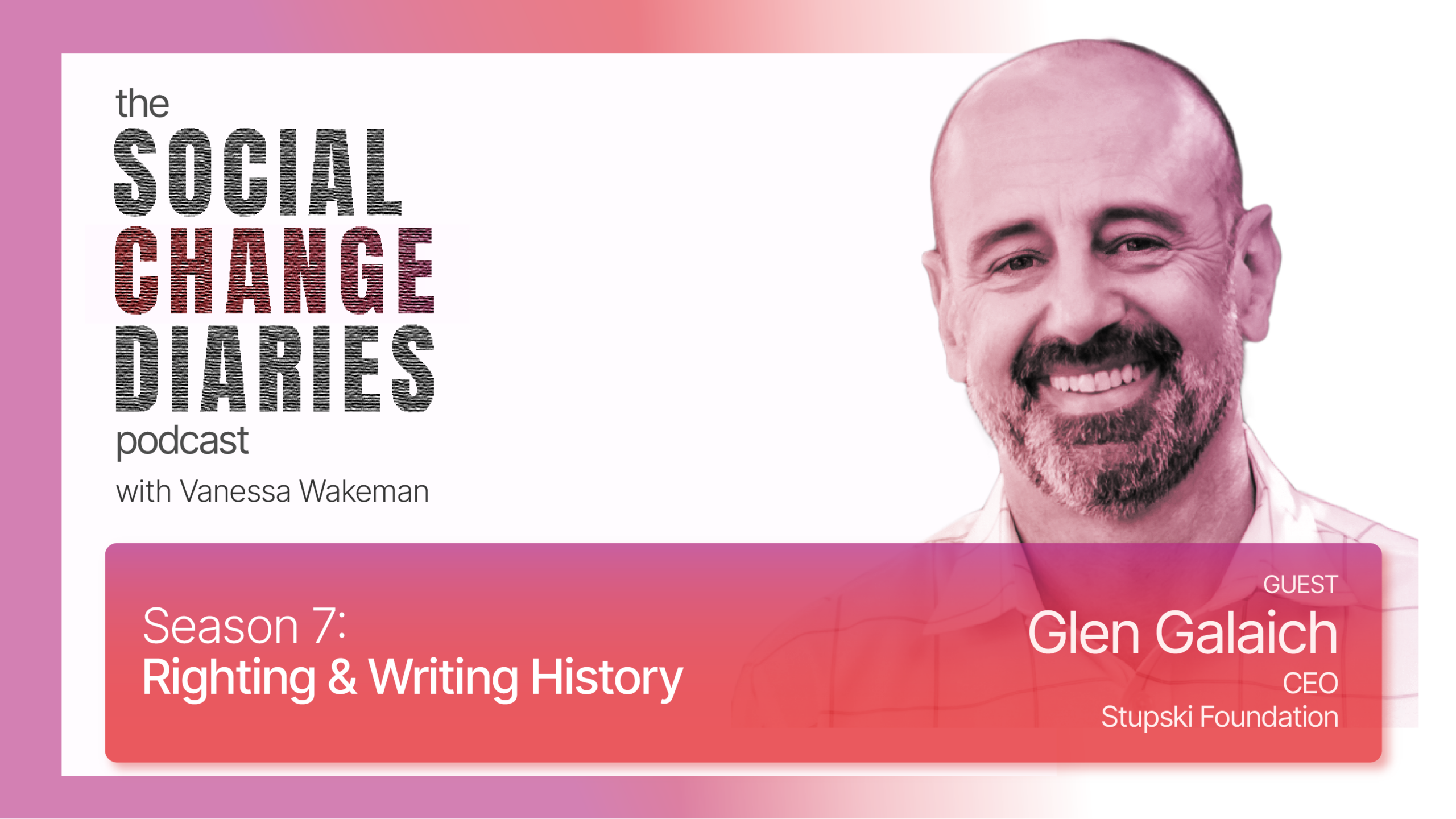
About This Episode:
In this episode of the Social Change Diaries podcast, Glen Galaich, CEO of Stupski Foundation challenges us to reimagine philanthropy’s role in protecting our democracy by breaking the fake rules that preserve a system, but not the people it was designed to serve. Glen shares details of Stupski’s spend-down, what he and his team envision for philanthropy, and all of the ways fake rules are getting in the way of population level social change.
About Glen Galaich:
Glen is the CEO of Stupski Foundation. Named one of TIME100’s Most Influential People in philanthropy, Glen has spent over two decades partnering with philanthropists, policymakers, and community leaders to advance social change. He is the author of the bestselling book, CONTROL: Why Big Giving Falls Short, the co-host of the Break Fake Rules podcast, and the author of the Who Gives?! Substack—all challenging philanthropy’s self-imposed rules in pursuit of lasting systems change.
In his words…
“We have been able to defend against a lot of the threats to democracy, but there are a lot out there. And a lot of foundations talk a big game about wanting to protect democracy. I just can’t even get my head around why anyone can spend their time on anything but moving their trustees to a bigger payout.”
“Since the book came out, we have been able to influence about 17 billion in assets around practice and mindset. A lot of foundations are set up on a template basis. You know, they get documentation from their attorneys who have gotten it from other attorneys. They’ve gotten documentation from estate planners who have gotten it from other estate planners. And it just becomes like a removing set of what people believe to be rules and regulations that we’re to follow. There are very few high-level rules about what we do.”
“I would love that to be the opening question for all of them that are carrying 9, 10 plus billion in assets. Why is it more important for you to be holding on to these assets? How is it even rational at a time like this for a foundation that’s putting the money into counter-mission activity to have that money?”
“I think there are categories of activity that take you to all in. How do you invest your money? So you’re holding on to these assets for some reason. So where is it? What’s it doing? How are you going about deciding where the money goes? How much are you employing an equity lens in your work? How much do those who are affected by your decisions, get input into those decisions somehow. How are you doing that? How much of the money are you moving? Are you moving it in response to community need? Or are you moving in response to donor need? So all of those factors I think are under interrogation.”
“We just recently learned from the Rand Corporation that since 1975, $80 trillion have transferred from the working class to the one percent. $80 trillion not in the hands of working class people, in the hands of the 1%, the very people who oversee these foundations.”
“I was at a talk last year with Diane Yentel [President and CEO of National Council of Nonprofits]. She said, We’re calling on foundations to speak up because how do you want to go out? Do you want to go out hiding underneath your desk or do you want to go out standing in front with a bullhorn? And I thought that was really moving. And I think for people in the room that heard that, they were inspired by it. They found their courage in that moment.”
What Glen would like to say after the spend down: “We moved it all to the front lines. We did. And there’s nothing left to do.”
Transcript
Vanessa Wakeman: Hello and welcome to The Social Change Diaries. I’m your host, Vanessa Wakeman. This is our last episode before the mid-season break, and I’m confident that what you hear today will give you plenty to think about over the coming days and weeks, while challenging some of our beliefs about how philanthropy should function.
Today’s guest is Glen Galaich, CEO of the Stupski Foundation. Named one of TIME100’s most influential people in philanthropy, Glen has spent more than two decades partnering with philanthropists, policymakers, and community leaders to advance social change. He is the author of the bestselling book CONTROL: Why Big Giving Falls Short, co-host of the Break Fake Rules podcast, and author of the Who Gives? substack, all of which challenge philanthropy’s self-imposed rules in pursuit of lasting systems change.
The work Glen is leading, alongside his team at the Stupski Foundation, aligns beautifully with our theme of Righting & Writing History.
Thank you for joining us today, Glen.
Glen Galaich: It’s great to be here. I’ve been looking forward to this for some time.
Vanessa Wakeman: Me too. So, to put some pressure on you, you are the last episode before the mid-season break. I love the way the scheduling and availability of our guests created this wonderful flow of conversation. We started with Supriya from the Libra Foundation, who kicked things off beautifully by digging into philanthropy’s complicated history with democracy and the importance of narrative.
And we’re ending with you. I’m going to focus on some of the themes that came up in your books and this idea of “breaking fake rules,” which I love. But first, let’s frame and ground the conversation in the theme of Righting & Writing History.
Do you see Stupski’s core argument, that donor control undermines community power, as directly connected to democratic health? Let’s start with a difficult one.
Glen Galaich: That is something we talk about a lot. So, first of all, thank you very much for having me. I am honored to be part of the roster of amazing people you’ve had on this season. So, wow.
And, you know, it doesn’t come up directly in the book, CONTROL: Why Big Giving Falls Short, which we released in March, but I’ve been asked a lot about the role of control in democracy. I think where it really stuck out to me in the last couple of years is getting to the core question of: When is it time to use the 95% that you’re holding back in resources every year? When is the time to look at that and really go for it?
And, you know, I don’t know if it’s because we’ve become more normalized to what’s happening, but it seems like we have been able to defend against a lot of the threats to democracy. But there are a lot out there. And a lot of foundations talk a big game about wanting to protect democracy. I have seen so many write-ups about, “This is it. This is the time. This is the battle. This is the fight,” whatever words you want to use.
And yet, so many foundations stay within a five- to ten-percent window at best in their giving. And I do believe that’s because of all the control that prevents action in times when there could be action.
So, we can go through some of the fake rules that I think we follow there, but they’re all in play. I mean, I guess the driving question I would ask, beyond just democracy, is: When is it time? How bad does the world need to be?
When do you do more than five percent? When do you do more than seven percent, eight percent? Because some foundations have gone up this year. They’ve gone up a point. Some have celebrated going up one percent. They’ve started campaigns around it. But is that really the number we’re talking about?
At Stupski, we moved 70% of our available grantmaking assets last year. It sped up our spend-down. We felt like we had to go.
I just can’t imagine—I could not, I still can’t even get my head around why anyone can spend their time on anything but moving their trustees to a bigger payout. So, that is because the control features are really there. You can see it.
Vanessa Wakeman: And help give us some context. What was the conversation like during COVID and the racial reckoning of 2020? And is this sort of a repeat of that conversation, where we’re making maybe the same sort of wrong, mini, micro steps? Or is this a different conversation?
Glen Galaich: Sure. I think they are all the same. They show up a little differently. But I can remember COVID, when all these cities were locking down, and we were—I think I know what we were getting. We were getting phone calls from city governments and state governments saying, “We don’t know where the money’s going to come from to pay for all this.”
And I thought, if you’re coming to foundations, it’s bad. And yet, I can remember early surveys being taken in webinars and things about, “Are you going to do more?” And most everybody said no.
I just don’t think we have asked ourselves, what do we need to do when we need to do it? What does it take to get there?
Let’s just point to one really big one, which we do not talk about. And I always know when I’ve struck a chord with the sector because they get super silent. They don’t want to talk about these things in our sector. We’re the least capable, I think, of constructive conversation.
We really want to see ourselves as doing good all the time. And anything that says we’re not doing as good as we could be doing is seen as bad. So it’s hard for us to have conversations, debates, and otherwise. Debates—whenever you go to a philanthropy debate, they’re always, in my opinion, very soft, and we really aren’t talking about these things.
So, here’s a big one. Most foundations are highly invested in private equity, hedge funds, and other specialized investments that only high-net-worth players can get into. And one of the rules of those investments is that you have to put your money in, and it’s most likely not coming out. It’s going to come out in payouts that’ll increase your percentage each year, but it’s not easily accessible. The principal is not easily accessible.
So, when you run into a situation where you want to move—even if you wanted to move a lot of money—you’d have to get permission from those investment fund managers to get your money back. And most of them aren’t going to give it back to you quickly, if they give it back to you at all.
So, we divested completely from everything for-profit a few years ago. I just couldn’t square that. Why are we making money when we’re supposed to be giving money? It made no sense to me.
And it took, in many cases, six to eight months to get the money back. And in some—and we’re still negotiating with one fund manager now to get the money back.
So, it is that in itself—a structural challenge to addressing situations when they come up. We are just not set up. And you can see we’ve been through this now, right? Like, now we’ve seen it. Democracy can very quickly be undermined.
So, if we’re really going to be there to prevent it, or to play some role in preventing it, we have to be liquid enough to be able to move. And I just don’t think many foundations are set up that way.
Vanessa Wakeman: So what do you think it will take? I’m officially sort of giving you the title of the rabble-rouser on this issue, to make sure that your peers are considering it.
Well, forgetting the logistics around the financial piece of, you know, talking to the fund managers, et cetera. I understand that timing, but before that is the mindset shift, the trustee conversation, the lack of safety, right? Because there is safety in saying, like, we have $700 million or $2 billion or whatever that number is.
So, are we afraid that liquidating means that we lose control or power? What do you think is the psychology there, and how do we start to approach those conversations in a meaningful way? Because if it’s not this moment, right, then what? What’s the next thing? This is the thing.
Glen Galaich: Yeah. So my experience has been, first of all, the people who are interested in this will talk to me and talk to my team, and will talk to people who know my team or whatever. But there are many who will walk out of the room when I talk and won’t, you know, come up and talk to me about it or write me a note afterward.
So, I don’t know what those who are completely shut off to review and reflection feel. But what I can say is that there have been a lot of foundation staff and others. In fact, combined, since the book came out, we have been able to influence about $17 billion in assets around practice and mindset. And those folks came in and said, “I have a family member on my board who I really want to talk to about this. I think we are curious about spending down, for example. How do we do that?”
The first thing that I think is really important is that there has to be a willingness to reflect and ask the questions. You know, at the end of the day, I fundamentally believe that anyone who has a foundation and puts time into it—and that’s a biggie, because a lot of foundations are just a hobby for families. They’re not actually something they sincerely put time and effort into their public stewardship. But if you are really willing to, if you really want to be effective, you often have to be reflecting on the fundamentals of what this work is.
So, starting with number one: most of these private foundations were set up as a tax strategy. Okay, so because of that, a lot—and that’s the control part—the money was given to a separate organization, and the family put themselves into the bylaws and onto the board. So that was about control, period.
So now they’re on the board. Now, how do you get to a place where this is not just about a tax strategy, and that it really is about improving society in some way, about being a public steward and not a private steward? I think an interrogation of what that means and how that shows up is really important to do.
And that’s where all these concepts at Stupski came up, like breaking fake rules, because a lot of foundations are set up on a template basis. You know, they get documentation from their attorneys who have gotten it from other attorneys. They’ve gotten documentation from estate planners who have gotten it from other estate planners. And it just becomes like a moving set of what people believe to be rules and regulations that we’re to follow.
There are very few high-level rules about what we do. But where there are these practices, like a 5% maximum payout, putting family members on boards, not being able—or having to be—in perpetuity, having to see fiduciary responsibility as strictly financial and not considering the risk to the communities you’re supporting, these types of concepts are rarely interrogated. And I think you have to be willing to do that in order to start to make the shift.
The thing I just want to be really cautious about here: I tend to speak sometimes online and in podcasts and otherwise, and I get very riled up on these topics. And I tend to speak in either-or language. And I think I’ve been reflecting on that myself. This isn’t an either-or discussion. It is, to me, a nuanced discussion about coming from a place of excessive donor control over to a place of community engagement. It’s a spectrum that we’re all on.
And I think the goal should be—and I think we would all benefit from more foundations asking—can we take steps toward community engagement and away from control? So first, you have to ask: How is control showing up? Be honest, and then ask, what steps can we take to move there? Which means letting go of some stuff.
Vanessa Wakeman: So, how did you get here, Glen? I know that you all are committed to a 2029 spend-down. Tell me how you got here and what your natural epiphanies or observations were that led you and your team here, because maybe there is hope for others.
It’s like, once we started working with Community X or we saw the results of this, we knew that if we multiplied investment or, you know, sort of collaborated in a shared-power dynamic, these things would happen. What led you here?
Glen Galaich: You know, first of all, it started with the fact that Joyce Stupski had already made the decision to spend out by the time I arrived. And that environment, right off the bat, is a different environment to be in.
There are a lot of ways that we immediately started operating that were very perpetual in practice: how we set up our strategies, how we were thinking in a long-term way that the foundation would exist, what issues we would have, how things were tied to Joyce’s desires. Like, we had centered her in so much of this work, not the communities we were working with.
And she wasn’t demanding that necessarily, but there were things she did want us to do as she wanted. So, all of that, as we started to proceed through the process of spending out, also going through the period of 2018 through 2021—you mentioned the racial reckoning, you mentioned COVID. Well, prior to all that, there was also Edgar Villanueva speaking very loudly. There was Anand Giridharadas putting out Winners Take All. There were conferences that were asking, “How’s your DEI situation?” There were a lot of questions in 2018 through 2020, before George Floyd’s murder, that were already getting us to think. And I was affected by all of that. And so was my team.
So, when Joyce passed away in 2021, as we went into 2022, we were already in a place of, “What do we do now?” You know, like, another $150 million was coming out of her estate. The Stupskis basically moved all of their wealth through the foundation and out. So there’ll be no financially recorded history of them. It will have all been given away by the time we’re done.
And we were just asking at the time, you know, like, how are we behaving? Are we behaving like a spend-out, or are we behaving like everybody else?
Just ask the question.
And the driving question for all of us—and this came up from some of the staff; they were asking this, so I’m piling on to what they came up with—was, “Why was it more important for us to be holding on to these assets than frontline organizations that are actually doing the work?”
I love that question. I wish it was the plenary question of every conference for the next year that foundation leaders have to answer, because you asked earlier: Why don’t people want to give up?
Well, I think there is a lot of ego in our little world. I like speaking on a plenary session. I like it when you call me and say, “Come and talk on my show.” I like it. Well, that stuff goes away to some degree when the money goes away.
But what you tend to see as plenary speakers at these big conferences are the biggest foundation presidents. And I would love that to be the opening question for all of them that are carrying $9, $10-plus billion in assets: Why is it more important for you to be holding on to these assets?
Because, back to your original question about democracy and control, how is it even rational for a foundation that’s going to put the money into counter-mission activity at a time like this to have that money when organizations like Democracy Forward, and others who are really—and so many community organizations that are mobilizing voters and trying to take on the overt racism we’re seeing now again—why is it in any way justified to have that money sitting in hedge funds when we so badly need it right now?
It just doesn’t, to me, make rational sense, which is why the mindset piece is so important. It’s a mindset we tell ourselves that these things make sense.
But anyone on the outside looking in, if they paid attention—that’s the sad part. Most Americans don’t pay attention to this sector. But if they did, and they will someday, I hope they will put that kind of pressure on us to answer it.
Why today is it more important for you to hold on to billions of dollars when organizations on the ground are closing, are stressed out, are burnt out?
I have—I just—people stare at me when I ask that question, and I do it from a stage. I wish it was like breakout sessions. I wish entire conferences were built on this, because that, to me, is the question that forces reflection.
Vanessa Wakeman: Okay, so I’m going to be hosting a conference. Like, I’ve just decided in this moment. Okay, you will absolutely be on the agenda, and we will be asking that question to every foundation leader.
But, on a serious note, as you’re mentioning that, it makes me think about systems, right? Systems of oppression. Sometimes we’re so in a system, we can’t see how it’s impacting others, right?
And so, when we talk about even our system of democracy, it’s riddled with flaws. You know, an abundance of flaws. I think when we think about philanthropy, we’re so connected to the idea of what it can do, and it has absolutely had its impact. We can’t take that away.
But we have not sort of done the full autopsy or sort of looked under the hood to see, with the information that we currently have, maybe the old way of doing things is no longer applicable, right? We know that communities have the ability to articulate and act on their needs. We don’t need to sort of inform that. And often, us informing it is wrong, right?
And so, I think the conversation about democracy, particularly philanthropy’s role, also needs to include: What systems of oppression are we upholding by holding on to this money? How are we contributing to generational racism, poverty, etc., by holding onto this money?
Like, framing it in the issue. If these are the three issues that my organization champions, what does it look like? What harm are we doing in that way? And I think that’s a really powerful conversation that needs to be had, just thinking about all of what you said. There is a sort of contribution to harm if you’re not using the money when it can most be used.
On your website, as I was reviewing some of what you all were talking about, there’s an announcement of the spend-down. There was one sentence that really struck me, and I’d love to just go into it a little bit. It says, “We believe that if we are to live our values, we must go all in on investing in the transformative work of our partners to disrupt and transform systems that create harm.”
Paint a picture for our listeners of what “all in” looks like. I think you’ve given the perfect prelude, but what is “all in”?
Glen Galaich: Well, there are a lot of ways to talk about that. And I’ve already been running on with my answers, so I’m going to try to be sharper here.
I think there are categories of activity that take you to “all in.” How do you invest your money? So, you’re holding on to these assets for some reason. Where is it? What’s it doing? How are you going about deciding where the money goes?
How much are you employing an equity lens in your work? How much do those who are affected by your decisions get input into those decisions somehow? How are you doing that?
And number three is, how much of the money are you moving? Are you moving it in response to community need, or are you moving it in response to donor need?
So, all three of those factors, I think, are under interrogation and line up with this idea of “all in,” because I argue in CONTROL that I think if perpetuity is absolutely critical to your DNA as a foundation, you risk substantially not being responsive to community need.
And to me, that’s the definition. “All in” means you are being responsive to what your communities are asking for. And in most cases, it’s not more harm. It’s really more help, more benefit, more anything that would help them in all these times.
It’s not like now is some unique time, in many ways. Communities have been struggling for a long time. We just recently learned from the RAND Corporation, of all places, that since 1975, $80 trillion have transferred from the working class to the 1%. $80 trillion is not in the hands of working-class people, but in the hands of the 1%, the very people who oversee these foundations.
So, “all in,” in my mind, means thinking and doing and acting in ways that offset that $80 trillion loss.
Vanessa Wakeman: What would be a healthy number, in this moment, if an organization isn’t prepared to sort of be in a full spend-down conversation?
The 1% announcement and sort of campaign on social media, like, “We’re proud to announce we’re doing 0.5% above last year”—what would be a healthy number to sort of build the muscle?
And that may be relative to the size of the organization, but what would you say?
Glen Galaich: So, there are so many ways, again, to look at it. I think even having the conversation and thinking about starting with the idea of: How are we lining up when it comes to our needs versus community needs? Where is that? How are we showing up there?
The numbers will come from that. And it’s a process, and mindset is not easy to take on. Like, what’s the kind of famous metaphor? There are fish swimming in a tank, and one of the fish says, “How’s the water?” and the other one says, “What’s water?”
I do think we’re kind of in that environment in the foundation sector. I don’t think we really think about how we show up outside the bubble and what it looks like.
So, I don’t have any specific numbers. I’ve tried to avoid, with CONTROL, putting checklists and requirements and all that in there. But I do think that starting with that question—where does the spectrum, where do we sit? Where’s the weight? Where’s the balance? Are we more on community need or donor need?
And if we’re not, if we’re really not being in community need, then you really have to ask: Are we getting the impact we want from this work? And I would argue that the number one reason you wouldn’t be is because of control.
So, how you get there is interesting. Here’s one example I think that’s been really fascinating in this last year. The Marguerite Casey Foundation just announced a month ago that they’re going to move $500 million more dollars beyond what they had intended over the next 10 years.
Now, they based that on a very simple idea. Jim Casey, when he first made his donation to create the Marguerite Casey Foundation—he was the founder, I guess, of UPS—it was a $400- to $500-million donation.
Since then, the organization grew to about $1 billion. So, they decided, “We’re going to go back to the original donation.”
So, you don’t have to spend out. You can spend down to a plateau. And in so doing, you get to keep your perpetuity, and you get to make a fundamental investment in a short period of time.
If every foundation went back to their original donation, I don’t think we’d see the kind of struggle we have right now in our nonprofit sector in any way, shape, or form.
Vanessa Wakeman: What are you hearing from nonprofits, right? Like, all of these social issues intersect with democracy. They are, you know, connected. What are you hearing from organizations? What do they need? Yes, money, for sure. But what other things, in this moment, through a lens of how a foundation can be helpful?
Glen Galaich: So, I am—I’m only focused on the money, honestly. And I am because it is the ultimate resource for capacity building and sustaining it. So, I hear over and over again, “We’re struggling to find money.”
And where you see it first, I’m a big proponent—I’ve worked my life in many ways in the philanthropy infrastructure world.
Vanessa Wakeman: Amen. Amen.
Glen Galaich: So, I’m in touch with lots of regional associations of grantmakers. I’m in touch with lots of advisors, lots of national associations of grantmakers. I think this is where change can happen. It has to happen in those environments. And they are always the first ones to struggle, from my experience.
We don’t like to pay for philanthropy education. Again, it all goes back to who’s going to ask the tough questions? Who’s going to get us to reflect? We don’t like to do it.
And so, you can see there’s a real struggle out there. It started with them, and now, of course, it’s across the whole thing. Black-led organizations, communities-of-color-led organizations—these are all really struggling right now. And the answer to a lot of it is money.
You know, I’ll say something that my peers don’t like, and my staff doesn’t always like to hear me say, but beyond that, I’m not quite sure about our role.
You know, I look at what we do as being advocates of moving our trustees in a money-moving direction. That’s what the staff is there to do. We have convinced ourselves that we do things like help with technical assistance and that we’re there to do capacity building. We have convinced ourselves that we’re good at that at a foundation. I don’t know how much grantees really need that.
You know, when you ask—when a grantee asks for capacity-building support, what that says to me is, we didn’t give them enough money to begin with. Right?
And what we’ve done is we’ve created these side pockets that we call capacity-building budgets. And so, we’re able to make, “Here’s $35,000 for a communications consultant,” or, “Here’s $25,000 for a fundraising consultant,” that can come out of my side pocket.
Why not just give them enough money up front so they can hire the people to do the work?
And again, the one reason that’s not going to happen is because of your perpetuity stance or your limitation on what you’re willing to give, or what you have invested in things that are counter-mission.
So, anyway, I don’t know. I just think it’s moving the money right now. Maybe we get to a place where foundations have more of a purpose, but it’s just more of the argument that we need to institutionalize something that was intended to be moved from the beginning.
You know, this money was intended to be a donation from the beginning, and it gets stuck in these foundations or in these donor-advised funds. It doesn’t move. And the institution we’ve built around it is one of the main reasons it doesn’t move.
So, I personally don’t need to ask if a grantee needs something—great, we should give it to them. But it starts first with asking: Do we give enough money to begin with so they can do their work?
Vanessa Wakeman: Yeah. I know many organizations, when they hear that, they’ll be cheering, because of the idea of being able to say, “No, you did not give me enough money,” right? It’s really healthy and helpful.
Glen Galaich: Well, I mean, we have to—we have these, you know, we have a fairly flat organization, and our directors and our program officers hold a great bit of power in our organization, in many ways more than I do. So they do have those budgets. They have them. I see them. I sign the agreements by law, and I see what we’re doing, and, you know, it’s a part of our culture. And I do think these things need to be reviewed.
So, I’m not here to say we’re perfect. We do these things too. There are grantees who’ll hear this and say, “Come on, man, you’ve got one too.” You’re right.
But it’s just—there’s so much, I think, that needs to be rethought. Back to your original question.
Vanessa Wakeman: I want to get into the book, but before we do that, I want to ask about communications. We are a communications agency, and one of the things that I am concerned about in this moment is that we are not putting enough emphasis on narratives around social issues when there’s so much disinformation and people’s understanding of what’s real, what they can do, and what’s coming is just—it’s been augmented. They’re just not grounded in reality.
What do you think is the role of foundations today? I know we’re talking about the money piece, but what is the role in making sure that we are educating the public? Whether that be making sure the budget is there for nonprofits, or even for a foundation in their sort of portfolio, thinking about communications—where does communications live in the purview of a foundation? Or where should it live?
Particularly when democracy is under attack.
Glen Galaich: Yeah. I think a number of foundations have—I think foundations have found comfort in being very active on their communications channels these days about issues of concern. I think that’s been an area where foundations have come a long way, even in this year.
I think it’s easier to communicate with courage than to give with courage.
And so, I’ve been at some meetings where we talk about our courage as foundations, and typically that is about how we have either shown up publicly, as people, human beings in a space, and/or communicated online. And it is impressive, the way many foundations have gone in that direction.
It’s just the giving part is where we’ve struggled to find courage. We’ve struggled to step up to our trustees. We’ve struggled, as trustees, to step up to our bylaws or whatever is keeping us from moving money.
But I do think you’ll see, on any given day in the philanthropic media, on websites, in op-ed pieces and others, you’ll see prominent foundation leaders taking very strong stances now, whereas a year ago we didn’t see that. So hopefully, we’ve learned our lesson. You don’t need to hide under a table when an autocrat gets stronger.
You know, I think about—I was at a talk last year with Diane Yentel, who runs, you know, one of the big nonprofits, and she said—I thought it was very moving—she said, “We’re calling on foundations to speak up because how do you want to go out? Do you want to go out hiding underneath your desk, or do you want to go out standing in front with a bullhorn?”
And I thought that was really moving. And I think for people in the room that heard that, they were inspired by it. They found their courage in that moment.
So, communications, I think, is an area where foundations have found a voice more than they used to. And I think it’s probably not—if you were formally investing or speaking openly about issues of racial justice or gender justice or even class issues, if you pulled that language down and people have not seen it come back yet, I think you’re probably in a tough spot. You mean, you’re going to answer for that somehow, from someone.
So, I do think we’ve seen some positive developments there, and I think foundations need to keep leaning into it. We do have a platform, for better or for worse. So, ideally, use it for better.
Vanessa Wakeman: Yes. Thank you. Now, the moment we’ve been waiting for: the book, CONTROL.
So, the origin story sort of involves Joyce Stupski. And she was, I guess, one of the first rule-breakers that we can point to, where she broke the 5% payout rule to support a cause that she believed in and that was urgent.
But I guess my question is, what do you think is a rule, a fake rule, that is so ridiculous and very low-consequence for breaking that we should—the starter kit of, like, here’s the rule all foundations should be breaking immediately?
Glen Galaich: Perpetuity, for me, is that one. It’s just, first of all, you’re not supposed to talk about it, you’re not supposed to touch it, we’re not even supposed to get into it. The arguments for it have been so weak for so long, and we’ve bought into all of them that I just—it’s stunning to me.
But again, if we just go back to the basics here, a foundation was set up by an initial donation, a significant one. If the foundation structure didn’t exist, the money would either move or it would go into the tax base. It would go out to something that could use it, not just sit in a warehouse, but use it, or it would go into the tax base. That’s what would happen. One of those two things.
So, I start there. Why then lock it up in a place where it’s going to only go out at a 5% rate? It’s going to earn money. It’s going to compound. You’re going to hire really expensive people to run the place, like me, like your advisors, your investment advisors, your legal teams, or whatever. You’re going to then have conferences to go to, you’re going to have convenings to put on, you’re going to have to build a new, beautiful office space, you’re going to have people to run the office, you’re going to have ba-buh ba-buh-buh-ba-buh-buh of consultants. The list goes on, when it could have just gone out to begin with.
And so, in my view, perpetuity needs to be under extreme review. And the arguments for it, to me, fall very, very flat.
I would argue that perpetuity should be the role of the organizations that are doing the work. They should be the ones holding endowments. They should be the ones with large reserve funds. They should be the ones that are able to use their funding, their endowments, for mission-aligned work. Not some outside player that’s holding on to the money and giving it out in dribs and drabs.
The structure, to me, doesn’t make sense. But we keep doing it.
And, you know, Ludovic Blain, who I’m a big fan of here in California—look him up. He will say over and over again, the only benefit of a foundation is to the donor. The nonprofit entities out there do not benefit from this.
And there is no such thing as an unrestricted foundation grant. The minute you put the money into a foundation, you have restricted it in many ways.
And so, again, I could go on and on. I just have not—I think it’s the ultimate fake rule. You start there, you break that one, and a whole world opens up to you of fake rules that you can break from there.
Vanessa Wakeman: I like it. And every nonprofit is doing a silent prayer, saying, “What would happen if we had the endowment?” That would change everything.
Glen Galaich: Right.
Think about it. It goes back to that initial thing we were talking about earlier: why is it more important for foundations to have the money than for organizations on the front lines?
I’ve sat through numerous talks from organizations making the case for building powerful, large-scale racial justice institutions across the country that can take on what we’ve just been through. And what they want is $100 million.
You can name 10 foundations right now that have more than $10 billion. Imagine what would happen if just one of those multibillion-dollar foundations liquidated $1 billion and decided, “Okay, being $13 billion instead of $12 billion probably isn’t that big a difference for us.”
What if they moved that $1 billion into endowments for several major institutions, or what could become major institutions, for racial justice? What would the future look like?
Imagine that. And that’s just $1 billion.
Imagine if 10 multibillion-dollar foundations did that. What would the world look like? What kind of power dynamic would we have?
The reason they can’t do it is perpetuity. So they’ll tell you.
Vanessa Wakeman: Yeah. I’m just thinking about the power dynamic at play here. I think, like I said, the system is an issue, and the power is an issue. It’s a messy model that needs some untangling.
So, this season on the podcast, we are focusing on philanthropy’s past and authoring what comes next. What would you say sits on the side of correction for you all, and what is really about writing something new?
What is correcting, and what is writing something for the future for the foundation?
Glen Galaich: And your definition of correcting is?
Vanessa Wakeman: Well, pretty much, I guess I can answer this for you. Pretty much everything you’ve talked about, right? The spend-down is a correction. It’s the model of giving. It’s maybe some of the steps that have allowed us to be in this mess we are in today, where our democracy is under attack. Some of those are corrections.
Glen Galaich: Yeah. So, what was your question again? Which would have been correcting, and what was the second piece?
Vanessa Wakeman: And what are you writing for the future? So, correcting to make sure we don’t get any worse. And then, what’s the vision for the future?
Glen Galaich: Okay. What some have called “block and build,” perhaps, something like that. Are we in the zone of that?
Vanessa Wakeman: Yes.
Glen Galaich: That’s a great question. And you’re talking specifically about Stupski.
So, I’m running through all of our grant portfolios as quickly as I can in my head, trying to draw a percentage. I think it’s seasonal. I’d say that the work we do on the influence side, which is really a small budgetary item against the backdrop of our grantmaking, is very much part of an overall agenda we have to try to move the sector from donor control to community engagement.
That is very much a long-term play, where we’re trying to build mindsets into the future.
I’d say last year, a lot of our rapid work was very “block.” We were blocking. We were moving as much as we could to organizations that could block executive orders, undo executive orders, and so on down the line. We had made some PRI bridge loans with the hope that, eventually, government contracts would show up and pay those back. So, there was a lot of that.
It’s seasonal in that way. But I think most of what we’ve done has been primarily “build” in our issue areas, when it comes to early brain development, the disparity between white communities and Black communities there, and trying to address that across California, and Native Hawaiian populations and white populations in Hawaii, and so on.
All of our issues—I won’t go through all of them—have really had, from the very beginning, more of a “build” mentality: trying to grow, fix, adjust, and move systems. That’s where we’ve been for the most part.
We have done, when there’s a need for urgent action—unfortunately, in the short time we’ve been a spend-down, which has been about 10 years—there have been some pretty big environmental crises that have come up in both Hawaii and Northern California. And we’ve had to move on stuff like that, too.
In addition to COVID, authoritarianism, and immediate threats related to police activity in Black communities, all of that stuff was very much “block” activity and/or defense activity.
But for the most part, I think we’ve been in more of a “build” position.
Vanessa Wakeman: That’s fantastic. Two final questions. What is the greatest learning so far? Now that you all have taken this posture—it’s been, you know, a decade—what’s the biggest learning? Biggest surprise? What’s come out of this for you?
Glen Galaich: You know, the biggest surprise, I think, for me, is that we spend a lot of time in the sector focusing on how do we get impact, how do we evaluate our impact, all of that.
And you said something earlier that we know there’s been a lot of good stuff that’s come from the foundation sector. I think it’s almost impossible to miss.
And that’s been the part, because the level of scarcity in the nonprofit sector and the level of richness in the foundation sector means that whatever you get into, you can be pretty sure you’re going to do well.
And I’ve been surprised at, you know, we have really talented people, and we’ve been thoughtful about how we move money. But at the rate we move it, otherwise, we really don’t—we’ve had some things that have missed, but for the most part, I would say it’s been a lot of wins.
And it’s because it’s not hard to have them, because there are organizations ready to move if you give them the money.
So, I’m surprised at how much we spend toiling on that, how many strategic plans get done in a year in the sector, how many evaluation teams exist, how much people are trying to squeeze everything they can instead of just moving the money.
And I think that’s been surprising to me. I came from a tradition that I’ve definitely converted out of, but in the early days of my philanthropy, evaluation and metrics and ROI and SROI and all these things were the talk. They were all the talk.
And, of course, a lot of money was wasted on that. We haven’t learned much at all, and we really can’t, in the end, identify foundation impact separate from any other impact on any variable.
So, just trust the fact that when you move money to organizations that do the work on the ground, you’re going to win. You’re going to do fine.
And that has been a really important point for me: to just accept that and enjoy it.
Vanessa Wakeman: I think that’s such a beautiful sort of nod to the work of the nonprofit sector. And, overwhelmingly, folks are doing incredible work on the ground.
Glen Galaich: Of course. These are the heroes. These people are sacrificing. Some have sacrificed to degrees that they can’t pay for their own health care. They certainly can’t live in a home. They have to live in cheaper housing than their education would suggest.
They’ve made enormous sacrifices, mostly because foundations stay in perpetuity.
There’s no reason for that sacrifice if the money would just move. But that’s where we are.
And so, anyway, I do have to acknowledge that I’ve been surprised by the realizations that continue to pour in the more that I think about it all. And I hope some of what we’ve talked about today—whoever is listening—maybe they’re having some realizations, too.
And maybe they’re just fundamentally opposed to everything I’m saying and think I’m a weirdo, which I may be. But I do think there are a lot of wonderful things to realize about how we can all be more impactful if we just think about it.
Vanessa Wakeman: Yes, yes, yes. All right, for my final question: If the spend-down is Stupski’s final chapter, what’s the sentence you most want to end it on?
Glen Galaich: We moved it all to the front lines. We did. And there’s nothing left to do. There’s nothing left for us to do because it was gone.
And I’ll tell you, it is hard right now. There are so many incredible ideas that come up, and when you have capital to move, it’s so exciting to get to move it. And when you’re out of it, having lived that life, it’s hard. I will admit, it’s hard.
I’ve had two calls this morning where I’ve had to say, “I would love to invest in what you’re doing, but I literally have nothing to invest now.” So that is hard.
But the amount of good that every member of this team has done, every board member has done, every conversation, every debate, everything we’ve tried to do—I’m very proud that, in the end, all of it will have moved, in most cases, to the front lines.
I mean, we had to pay salaries. We have a beautiful office, all those things. But we moved far, far more. In the end, we will have moved about $600 million over the 10 years. If we had stayed at 5%, we would have moved $150 million.
So I feel very proud that that’s what we’ll say in the end. And a great question, by the way. I hope everybody has a chance to reflect on that question.
Vanessa Wakeman: Kudos to you and your team, and bravo, bravo.
Well, that concludes our interview. I want to thank you for taking the time to share what’s happening at the foundation, some of your wonderful insights, and your thinking about what’s possible. Thank you for helping us reimagine how philanthropy can play a role in writing the future and protecting our democracy.
And if not in this moment, then when?
Thank you so much.
Glen Galaich: Well, thank you for all you do to get these ideas out for people to be in conversation. What a great platform. So Vanessa, I really appreciate the time. Feelings mutual.
Vanessa Wakeman: What an enlightening conversation. I think having this conversation, or even tuning in to it, makes it almost impossible not to think about what would happen if the philanthropy paradigm shifted and we had widespread adoption of a spend-down model.
I remember early in Wakeman’s trajectory, I was talking to organizations about framing their work through the lens of solving the issue. What would it look like if we put ourselves out of business because this is no longer an issue? At the time, folks thought that was such a radical idea. It’s not.
If we are thinking about protecting democracy and writing a history that reflects the equity and justice we are collectively working toward, breaking some of those fake rules feels apropos.
I think Angelique Power from Skillman has the perfect quote for this. She said, “Whenever there are massive historical disruptions, a renaissance follows.”
We are certainly in the midst of a historical disruption. Perhaps the renaissance in philanthropy is about dismantling fake rules and reimagining systems. That is a correction of the past and an authoring of the future that fully embodies the democracy we all deserve.
As I shared earlier, we are taking a mid-season break and returning in a few weeks to continue this season with more conversations with foundation CEOs about righting and writing history.
If you haven’t listened to the first eight episodes, use the time to catch up. They’re really good!
I want to thank Glen and all of our guests for joining us and sharing their insights and experiences. And I want to thank all of you for tuning in each week, sharing the episodes, and sending in feedback. Keep it all coming.
If you have questions or comments, please feel free to send them to [email protected].
Be sure to follow the show on our website, www.thewakemanagency.com, Apple, Spotify, or wherever you listen so you never miss an episode.
We’ll be back in October with new guests and new episodes.
See you then!