
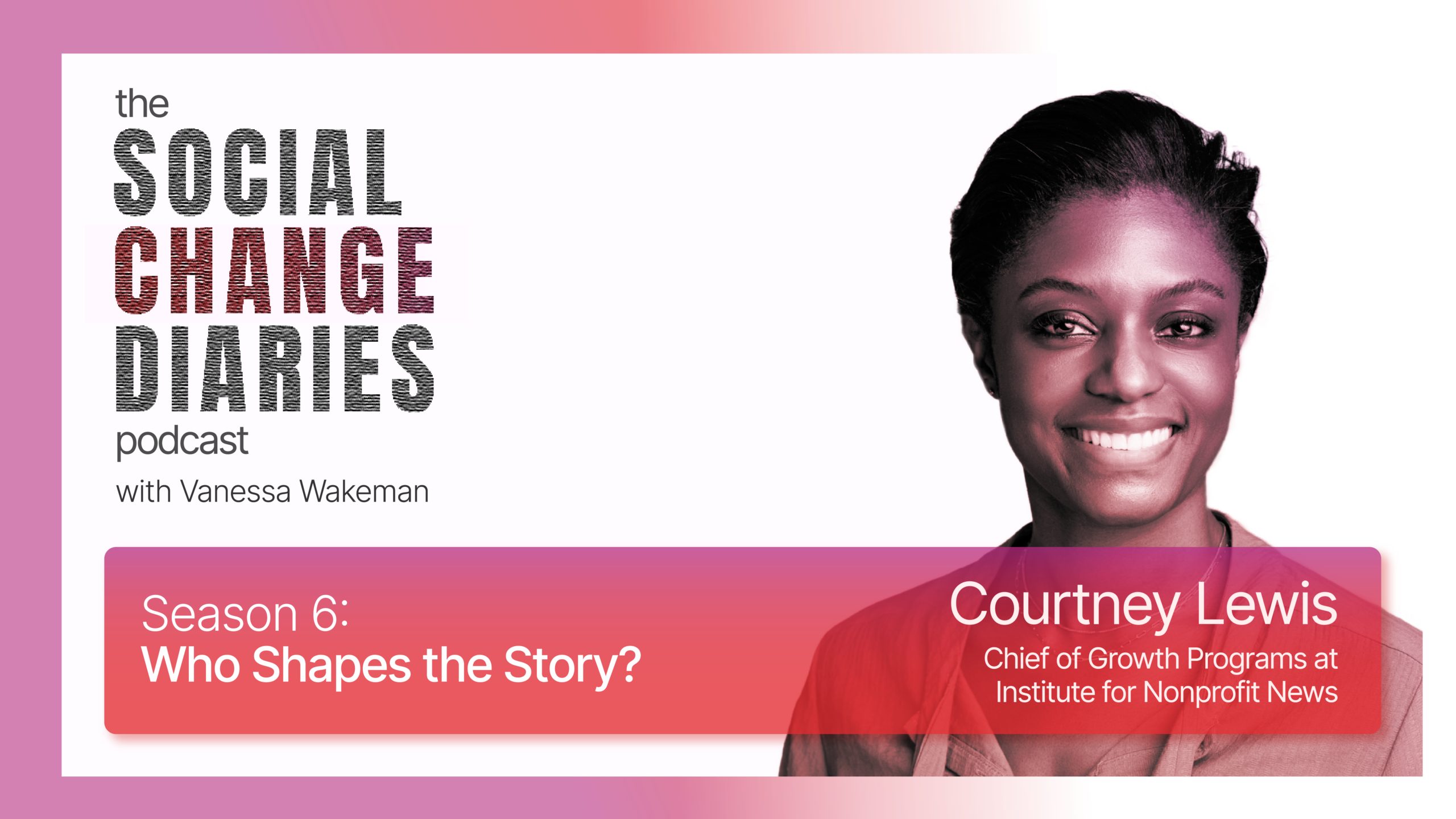
About This Episode:
In today’s episode, Vanessa sits down with Courtney Lewis, Chief of Growth Programs at the Institute for Nonprofit News (INN), an organization that works with over 500 nonprofit news organizations committed to public service. Their conversation explores why nonprofit newsrooms are different, how they center the stories audiences need, and why even conventional newsrooms are having to engage with people on a more human level.
About Courtney Lewis:
As the Chief of Growth Programs at the Institute for Nonprofit News, Courtney Lewis builds and advances programs dedicated to generating revenue and fostering diverse talent for a rapidly growing nonprofit news field. She joined INN in 2020 to lead NewsMatch, the most sophisticated collaborative fundraising campaign for journalism in the U.S. The campaign has successfully raised over $330 million for nonprofit newsrooms. Previously, she led collaborative initiatives to diversify audience and revenue for Detroit’s public radio station.
In her words…
“We see news as service, not just as information to be consumed, but as information that is in service of some greater end. And sometimes that greater end is the quality of life for the community the newsroom serves.”
“You can report on the issues of housing and how landlords aren’t doing the things they should, and are harmful to their residents. You can report on facts and now we all know what is happening, but then what? One organization produced a zine to help people navigate those situations. They created this guide—still using the journalistic skills and practices of fact checking, of resources, of identifying sources to produce the information. It just looks different than a story.”
“For success, you have to commit to allowing this newsroom to operate in a manner that is editorially independent and maybe more transparent than other areas of your work.”
“There has historically been this view of journalists as the first documenters of history, as unbiased, uninfluenced, a group of people who tell the facts and tell the truth…and were therefore trusted. And now people are responding differently, like ‘you don’t have an opinion on this? I don’t trust you.’ It’s changing.”
“We have our journalistic ethics, but what elements of those really need to remain, and what other values and ethics can we invite into our work, to be more human and more authentic?”
Questions Answered on this Episode:
- Where do you see independent news organizations really expanding right now?
- In the current climate, why do you think nonprofit news outlets are gaining popularity, given that many of the legacy organizations are still producing content?
- What conclusions can you draw from your experience with member organizations in the Institute that could be valuable for organizations to be thinking about—whether it’s through a journalistic lens concerning the kinds of content they produce, or other aspects? What lessons could be helpful to them?
- Tell me about how you see narrative power and where that sits in this conversation.
- Do you think that there is a place in the information/news ecosystem today for a point of view that considers the role of news to be in service to the audience?
- If there was one piece of advice you could give to nonprofits that are interested in starting a newsroom, but hesitant to take the first step to fully commit, what would that advice be?
Transcript
Vanessa: Hello, and welcome to the Social Change Diaries. I am your host, Vanessa Wakeman. And on today’s episode, I am joined by Courtney Lewis, Chief of Growth Programs at the Institute for Nonprofit News, an organization that works with over 500 independent news organizations to accelerate and shape the expanding field of nonprofit news. Welcome, Courtney.
Courtney: Hi Vanessa, it’s nice to meet you. It’s great to be here.
Vanessa: I’m very happy to have you. I know I mentioned what the Institute for Nonprofit News does in the brief intro, but can you share just a little bit more so people have a sense of what that looks like, the 500 organizations, and how you all work with them?
Courtney: Absolutely. The Institute for Nonprofit News is a network of more than 500 independent newsrooms across North America. I began at the INN about five years ago, and since I’ve been here, I’ve seen the membership grow incredibly. The network of independent and nonprofit newsrooms in North America has sort of exploded. Our network includes investigative powerhouses like ProPublica, public media news, and public media organizations are also INN members. In Philly, there’s WHYY, for example. And then there’s a group of newsrooms that really go deep on a particular topic, like the War Horse, which covers military service. But the vast majority of INN members where we’re seeing that accelerated growth are much smaller, local newsrooms that are in their community, reimagining news as a public service. And at INN, our job is to help them on the business end of things. We help them think about the nonprofit part of the work of fundraising, thinking about their governance structures, thinking about their strategies, and their growth. We work behind the scenes to really help them serve their communities.
Vanessa: So you all sort of serve as the operational sort of support for these news organizations. Where do you see independent news organizations really expanding right now? And in your experience, how is that impacting who shapes the stories being told?
Courtney: Independent and nonprofit news organizations, to me, I feel like, are at the tip of the spear of this movement of trying to see news as service, not just as information to be consumed, but as information that is in service of some greater end. And sometimes that greater end is the quality of life for the community they serve. The greater end is to see progress and change on a particular issue, like the environment. But I think that’s what makes them different. I’m sure your listeners are familiar with Maslow’s hierarchy of needs. And I like to use this as an example. A few folks in this field are using that as a framework to sort of explain how nonprofit news is different. Like in Maslow’s, which is often represented by a pyramid, basically it reflects the idea that certain basic needs need to be met, like food, water, shelter, before a person’s greater needs can be met, like belongingness or self-fulfillment. So if you look at this in the form of information needs, many newsrooms that are members of the Institute for Nonprofit News are approaching it from the bottom up. They’re providing essential information to help people navigate their daily lives with the hopes that, again, it is able to generate belongingness and intellectual satisfaction, and you know, with self-fulfillment, but they’re really focused on the core necessities and the things that are essential to people’s lives. And, can I give an example? I think sometimes that helps.
Vanessa: Please.
Courtney: One of our members is Documented, based out of New York City, and they exist to serve immigrant communities in New York City. They do regular reporting on things happening in the labor sector, in the housing sector, right, that would affect the immigrant community, but one of the approaches that they take is they do a lot of listening. They do research, they are in the community, and they have lines that are open to people to share information. And through that, they did this one research project that they were focused on, and they discovered the issue of misinformation and disinformation. Yes, that involves like mis and disinformation around politics, but it also was around financial scams. So, what they did as a result of that, they didn’t just report on the fact that financial scams are an issue to which many immigrants in New York City fall victim. They didn’t just state that as a fact. They went beyond that and actually created a guide that’s called What to Do If You’re a Victim of a Financial Scam in order to make that available to their community. And they published that in English and simplified Chinese. So that’s just an example of how the newsroom can report the factual quote of what’s happening, but a lot of our newsrooms are saying, okay, well, how do I turn this into a thing that resolves that for that community? Like what we uncovered is a wrongdoing, but then what?
And so we see a lot of our newsrooms really focused on that element. Another example I’ll just throw out there that I love to share is the LA Public Press. They’re in Los Angeles, the complete other side of the country, and they produced a housing rights zine, this really well-designed zine that was called Get Your Landlord to Do Their Job. It’s basically, right, because you can report on the issues of housing and how landlords aren’t complying with regulations and are doing things that are harmful to their residents. You can report on that as a fact, and now we all know that’s happening, but then what? So, they produced this zine that sort of helped people navigate that. And many of these newsrooms that are working in this way to create guides that are still using the journalistic skills and practices of fact-checking, of resources, of identifying sources to produce this information. It just looks different than a story, right? And a lot of times they’re working with partners like libraries to disperse this information or community organizations or community leaders to make the information, civic information that they’ve gathered available.
Vanessa: Those are fantastic examples. And as you were speaking, I was shaking my head affirmatively because one of the things we have been working on with nonprofits is helping them to think about implementing some aspect of a newsroom into their organization. Nonprofits who are focused on social issues often have tremendous understanding of the problem of the audiences and the solutions and what the benefits could be if that information was disseminated with all of the sort of journalistic integrity needed, but in ways that, you know, similar to the examples you mentioned, where it not only shares the problem, but it also helps people and guides them through how you can get through it. What are the solutions? Here’s what you can do. And I think there is an incredible opportunity for nonprofits with that. In a recent episode, I spoke with Amanda Zamora, the co-founder of The 19th. And she sort of mentioned that same framing that you did, about like, yes, they’re stating the problem, but there is a need and a desire from audiences. Let’s put audiences first, and they want to know, how do you see me in this issue? And what is the approach that I can take? So I really appreciate those examples. They were really helpful. I also want to talk a little bit about, given the current climate, why do you think, I mean, I have my own thoughts on this, but why do you think nonprofit news outlets are gaining popularity? Like we’re seeing, just based on the Institute’s work, an increase in these sorts of independent outlets. Why do you think they are so important today, given that we still have many of the legacy outlets that are doing what they’ve always done? Why do you think this new, increased sort of nonprofit news outlet is growing in popularity?
Courtney: That’s a super interesting question because I think, you know, at face value, some of these decisions are being made mainly from a point of like, what is a viable, sustainable model to fund it? We, the business model to support for-profit or commercial media, are completely broken. And that is a result of, you know, ad spending really funded that product. Now, a small business can put $100 into Meta and get exactly their target client, and it can go a lot farther. So you’re seeing the ad spending being spent in other ways that really crippled and broke the business model, the commercial business model for news. And so some people are pursuing nonprofits. They’re like, oh, this is an opportunity to create a new revenue stream for philanthropic revenue, for donations, for foundations, and etc. But there’s something very distinct that is beyond just the tax status of nonprofit newsrooms. And I’ll be even more specific to say, nonprofit newsrooms that are members of the Institute for Nonprofit News. With members who are a part of INN, there are certain practices and standards that they have to abide by that we vet in order to become a member. Organizations that are members of INN go through an even higher level of vetted standards.
So, for example, if you’re a member of INN and you’re a nonprofit news organization, you have to list your funders, your large funders, on your site. And that gives your audience an opportunity to see who is funding the work. And this is also, in the case of like, we have news organizations that are applying that are doing great work, but they’re not able to disclose information like who is behind this work for whatever reasons, right? It’s not that it means the work isn’t great or good, but they don’t meet that one standard around financial transparency, which we think is really important for audience trust. Another standard is that they produce a significant percentage of original civic public service reporting, that they are not just bot sites republishing other open source content, and that there is a rate at which stories need to be original. And they need to be on civic issues, features. Those are great opinions, that is great. People do that, and it moves other types of conversations forward. But members who are of INN have to have a balance.
Vanessa: Mm-hmm.
Courtney: And then the third thing is that they’re editorially independent. They have to have policies that enforce that editorial decision making is not influenced by board members, by donors, by other forces. We say it’s news that can’t be bought. And so those are some distinguishing values. So we’ve got the tax status, we’ve got values. And then the other thing I will note is the way in which they work. There are mission-driven organizations that see news as a means to a greater vision for their community or for the issue that they’re covering. And in that way, I feel like they have a chance to connect with audiences and be relevant to people’s daily lives, just in a slightly different way than a traditional news outlet. I will say, we are the Institute for Nonprofit News, but by no means does this mean that for-profit news is not doing great work; they are distinguished. They do service different functions, and they are approaching the need for quality news and information in different ways.
Vanessa: So those values and sort of the transparency and the different things that you mentioned, it got me to thinking, like for our listeners, our listeners are primarily nonprofit organizations, foundations, and then other people interested in social change. For a nonprofit that is listening and let’s say their mission is to support unhoused individuals, and they really want to start telling stories and bring a newsroom aspect to the work, based on the requirements of your members, are there things that, let’s say, they’re not ready to be a member or fully embody the entire structure of a newsroom, are there things from your experience, what you’ve seen through your members and what the Institute offers that could be valuable for organizations to be thinking about from whether it’s through a journalistic lens of the kinds of content, as you mentioned, or other aspects and things that could be helpful to them?
Courtney: Yes, I would say like, there are situations where we get nonprofits or even advocacy organizations that have news, a newsroom that’s, you know, a subsidiary or program initiative of the work. And what I will say to that is there could be very meaningful, impactful work being done with that model. But if you are, but what would make something like that sort of distinguish from our standards is if that nonprofit is interested in doing that is willing to sort of, you have to let go of the reins. You have to commit to allowing these newsrooms to operate in a manner that is editorially independent and maybe more transparent than other areas of your work.
So at INN, anyone can go to our website and see templates and examples of what an editorial independency policy looks like. They can see examples of the financial transparency standards and the requirements that we have as a way to get a sense of like, is this something, are these policies that our organization is in a position to adapt? Sometimes the answer is like, yes, and sometimes the answer quite frankly is like, honestly, no, but it doesn’t mean that like you aren’t doing good work, you know, it’s just that you don’t fit within these particular editorial standards that we at INN feel is like really distinct for the purpose of public service and public trust.
Vanessa: So I’m gonna, feel like I’m going to be sending customized notes to some of our clients with this episode. Like here, you’re hearing from someone in the know. So it’s not just me pushing, but these are really important things. So I thank you for sharing that. And also the importance of like giving up the reins in some way, because folks are so concerned about that. Like, you know, like what happens if we don’t control it? So I think that was an incredibly valuable point to make.
Courtney: Can I add one more thing there?
Vanessa: Of course.
Courtney: We, know, it happens in nonprofit too. Like it happens in the sense where our newsrooms also say like, you know, what if we get a donor, you know, what if we get a foundation supporter that wants us to cover an issue and then we discover there’s a story to be told that they are involved in? How do you navigate? like what these standards sort of do, is protect the newsroom from that dynamic to say like, you’re here in service of the audience, not the donor, not the advocacy point of view and vision. You’re here to serve who you’ve carved out as your audience. you need, those newsrooms need sort of a leash to always point to what is in service of the public, what is in service of my audience, not of our funders or our supporters or any sort of other internal dynamics that might exist between a model that you’re describing, which is like one nonprofit that has a mission and vision to accomplish one thing and news is a side of it. But there’s an example of an organization in Lexington, Kentucky, Civic Lex that does this really well. They are a member of INN and they have a mission to basically improve civic life engagement and participation in Lexington. they do all type news is just like a piece of what they do. They also do curriculum development for schools. They also take bids from the government to do community engagement work. They do a lot of things, but the newsroom, they have all these things, but the newsroom itself operates under these standards. But they say, but they believe that the ability for the newsroom to operate in this way actually is a better service of our greater mission. So there’s, it’s possible, but it is a decision and an intentional decision a nonprofit would really need to think about and make. And it’s not a right or wrong answer. It’s just like, what is in service of your mission? Yeah. Yeah.
Vanessa: Yeah, and I think that tension between audience and funder absolutely exists for organizations. like, I understand, right? Like you need the funding to be able to do the work. And so I know a lot of organizations grapple with that. So let’s talk a little bit about narrative power and where that sits in this conversation. Like, do you see that power shifting with journalism today?
Courtney: I really love this question. The power is shifting way outside. I mean, it’s shifting within journalism, but it’s shifting in a much broader environment that journalism is just in context of.
How I could best sort of say it simply is I think narrative power is shifting from what used to be a formal model to an informal model. And so by that, I mean, if we see power as like the currency to influence how people think, you know, what they believe, how they act in the world, that narrative power used to be held by very formal institutional things, you know, institutional things that could be certainly people in power at one point, but journalism in itself functions and sort of embodies that institutional model in the sense that Journalism has been you know, I remember when I first started working in news I’m not a journalist so I came into this like what are you talking about? Like I remember when I first started working in news someone told me “News is the first record of history” and I was like “really?” it gets it wrong, like, it gets it so wrong.
Vanessa: Yeah
Courtney: Yeah, like it gets it wrong. How could that be right? But there there was this sort of—there was this sort of like top down approach to journalists like we the journalists are an unbiased, uninfluenced group of people who tell the facts and tell the truth. And because we are unbiased, we, you know, you can trust us. And now people are like, “you don’t have an opinion on this, I don’t trust you,” right? Like it’s changing. So I think where narrative power was held in the past was in a formal, very institutional model. And that is completely decentralized. We can say democratized, but like it is completely decentralized where now the currency of trust is authenticity, whether it’s real or not. Like if it’s believed to be authentic, that’s who holds the power to of the story of the storyline and what people are, how people are going to perceive what’s happening in the world. So with news, news is trying to respond to that. And it is a tension in the sense that there are certain ethics and like beliefs. sometimes like when I look at this from the outside.
I think some people sort of see news as a craft, you know, like a traditional craft that can be like, there’s a way you do it, you know, you use these ingredients. Otherwise it’s not real news. You know, you have to follow these steps. Otherwise it’s like, not quality, right? But what we’re seeing is like people are not reacting to that the way they once were. People don’t…
Courtney: And in some ways it actually works against the news in the sense that it has no personality. It has no point of view. It’s removed and detached from people’s emotions and what they’re feeling and what they’re experiencing. So news is shifting. Yeah, it’s having to. It’s being forced to in some regards. And like some people are really embracing that. We do see newsrooms who are looking to partner with influencers who have power in some regard because they have audience and they have trust. We see newsrooms really trying to approach things differently. Like I love to share examples because I think it really helps embody.
Vanessa: Yes, examples welcome here.
Courtney: Okay, so another example of like sort of narrative power shift. The Marshall Project, they’re a nonprofit that covers US criminal justice system. They partnered with St. Louis public radio to produce a multi-part investigation on the rate of unsolved murders in the city. Because the city has a high rate of, of homicides and many of those go unsolved and like people who lost their loved ones are left without answers, which is like, it’s painful, right? So the thing with investigations, this is what I’m going to explain. The thing with investigations is they’re critical to holding power to account.
Yes, they uncover wrongdoings, they do good, but for the people who are on the other side of the injustice, it’s not really news. Like they already, like they’ve lived through it. Like they don’t need to be made aware of the injustice, right? They’re experiencing the injustice. So investigation, know, investigative news is like a worshiped form of news in like the journalism sector.
And yet it really speaks to power. Investigative is about influencing power. Yet at the same time, it doesn’t necessarily, it’s not for the people affected. It’s for the people who have the power to change, right? So newsrooms are trying to think of a way to balance that. saying, okay, we definitely want to do investigative stories that hold power to account. But what can we do? We’ve just heard all this wrongdoing. What can we do to relieve the people that are being affected. And so they reported on unsolved murders, which helped to shed light on, you know, failures of basically of the police. But in addition to that, they also created an illustrated like guide for families of homicide victims in St. Louis, how to navigate, like how do you advocate and how do you navigate when something like this happens to you?
The other thing that they did that I think was so interesting and it really is about narrative is like they tapped into the power of storytelling. They didn’t just report on 1000 victims, right? They told the stories of who some of those victims were quite beautifully. They work with six families to produce these audio stories and they worked with a local artist to create portraits of these individuals that would characterize their life as a way of essentially soothing and healing that hurt. And so I think a lot of times like where newsrooms can go to sort of shift power is to think of like,
Courtney: We have our journalistic ethics, but what elements of those really need to remain and what other values and ethics can we invite into our work to be more human and to be more authentic? And so we’re totally seeing newsrooms navigate and approach that to all varying degrees in the nonprofit news sector.
Vanessa: So what you’re talking about to me, what I’m hearing is like organizations are making an investment, right? So to produce what you just provided as an example about creating these stories, telling the stories, not just reporting on like the issue, but telling the stories, highlighting the families, right? Like that is an investment in a particular topic. That is also like a level of like empathy and involved there. And then also, which I think is sometimes missing, and that’s another conversation, is also being able to see the humanity in the people involved, right? And so one of my criticisms of traditional legacy media has been how certain stories are told. As we know, when stories are about Black and brown people, it tends to slant overwhelmingly towards a negative portrayal of the individual. And so when you’re sharing that example of being able to bring life to these individuals and to give some of their families in some way, maybe not closure, but the honor of these people being seen is a totally different approach. I had a conversation early on in the season with Tracie Powell from The Pivot Fund. She talked about this idea of mutual aid, right? We’re here to serve the community, the community is here to give us information. And so that sort of approach that you mentioned to me is an example of that mutual aid. How can we be in service to one another to strengthen our community? And so I think that is a really important way to be thinking about how story is telling and the importance of narrative and the way it’s shaped. Prior to providing that example, you mentioned two things that I’d like to go back on. The first is this idea of journalists reporting and the audience asking the question of, like, you don’t have a point of view on this topic. So that has been widely debated, right?
We need to, you know, maintain neutrality because we just want to report from a factual perspective. Do you think that there is a place for a point of view? I think I know the answer to this, for a point of view in the news world that is in service to the audience?
Courtney: Yes. I’ve thought about this question a lot, and it is because what drew me into news was the storytelling. As I said, I’m not a journalist. I didn’t grow up listening to the news. I don’t have that nostalgic experience with the paper like a lot of people do. So, me entering into it, I’m observing, and I’m like, this is great, but we’re missing something. Recently we hosted our annual conference, and there are a few threads of conversation that I felt like articulated what I feel about the question that you’re asking. There is a job to be done for a newsroom to prioritize what benefits and is in service of their community that they should always remain loyal to. And it is not that the news organization needs to have a point of view on an issue. I mean, you can, but some don’t. And for whatever reason, they don’t. But they do have a point of view, and they do have a mission to serve their audience. So how can I sort of piece this together in my mind? But let me tell it through an example. Sometimes, when you report a fact, right, you can report something as the truth. But that fact without nuance can be in conflict with what people believe and what they experience. And when you don’t acknowledge that the fact is in conflict with what people literally feel or are experiencing, people are tuning you out. They don’t believe the fact. They’re like, “that’s not the fact because what I see when I go to the grocery store is this,” or “what I’ve experienced, or someone else, who I trust, told me this.” So what newsrooms need to do is not advocate for divorcing from facts, but they need to think about whether they’re actually trying to engage their community, and can’t just take the fact without the nuance of other people’s lived experiences. We can’t live in a bubble anymore. So it’s sort of a great answer. But what I’m saying is, news does not have to be advocacy, but news has to be human to resonate with people. So there are approaches and tactics and strategies the news needs to adopt, and we’re not doing it quickly enough, quite frankly, that we need to adopt to be human, to be more human. And so I think what you would, you know, I think what I’m trying to embody, like if I were to ask, you know, a member of INN that question, I think some of their responses would be: “We have a mission to serve our community, we have a point of view that people in this community deserve a quality life, that we have a point of view on.” However, they may not necessarily pick up a point of view on a very specific topic or an issue.
Vanessa: Yeah, there’s a lot to digest there in that it is a total reframe of how we think about the responsibility of the storyteller and the importance of prioritizing the audience, right?
Courtney: A lot of people, just to reiterate, another thing I think is behind a lot of this is agency. I think a lot of news organizations operate under the question of what gives the community that we’re serving agency? Sometimes it’s not, some news organizations are like, we’re not gonna touch a point of view on this topic because that’s just not who we are, right? Some news organizations, you might see them get a little bit closer in the sense that they will present or maybe the subjects they choose, or the manner in which the story is told presents a little bit more nuance to a topic or point of view. And some organizations may even press it more, right? And they’re doing journalistic, rigorous work, but the topics they cover, the issues they choose to cover, really do express a point of view. But at the end of the day, no matter where on the spectrum you are, I think most news organizations believe it is to give people agency to actually change their lives. And that’s what information does. It gives you knowledge, insight, and context to make a decision or choose to act in a way that is in benefit of yourself.
Vanessa: So I think that journalists and media properties need to be reminded of that constantly, just because we don’t see that as the norm. It’s more, sadly, the exception. And then for audiences and communities, I think that they need to be reminded that they have the right to be seen in these stories and to have issues represented in a way that is in service to them. And as you mentioned, to give that agency or to strengthen that agency. So I think there’s some reimagining of the relationship needed and the responsibilities of the parties in this. I have my one final question for you.
And that is if there was like one piece of advice or a first step, is there one thing for nonprofits that are interested, but maybe hesitant to take the first step to fully commit? Is there any small act or a test step that they can do to see if this is something that they have the wherewithal to do, and to do well, to create a newsroom?
Courtney: Partner, partnership, like partner with a newsroom. And this is the great thing about nonprofit newsrooms is that they are nonprofits. And this idea of partnering across sectors with other nonprofits that may be working on housing, or working on education, or working on voting rights, or whatever it may be, our members are very open to partnership, and you see partnerships in all types of models. Sometimes it’s around the story production, sometimes it’s around some other community initiative. But I think one entryway into this is through partnership. If you are a nonprofit that doesn’t have a newsroom, but is thinking about narrative, is thinking about how news could be an avenue to achieve your mission, I would explore a partnership.
We have more than 500 members who you can partner with. We have a website called findyournews.org where you can search for newsrooms by topic or by place and reach out and explore a partnership. That would be my first step.
Vanessa: Thank you, thank you. I am very grateful to have had this conversation with you. You have shared some absolute gems with our audience, and those examples were priceless. Those were not things that someone’s gonna get from just doing a Google search on “how do I think about a newsroom?” And so you being embedded in this work offers tremendous value and insight to our listeners. So thank you very much for being here.
Courtney: Thank you, it’s such a pleasure. I’m happy to be here.
Vanessa: So that concludes this episode of the Social Change Diaries. As I mentioned, there’s so much information and things to think about related to what Courtney shared. I think the top line things that came up for me is this idea of audience. So often, the audience seems to be an afterthought in the conversation around news and media. And I think that there are ways for organizations to prioritize the audience and to think about the needs of the community. And I think this idea of having a point of view and being able to present information by answering the question, what best serves the audience is really valuable.
And so I look forward to hearing from our listeners. As always, if you enjoy the episode, please feel free to leave a review or share it with a friend, and we will see you next time. Thank you.