
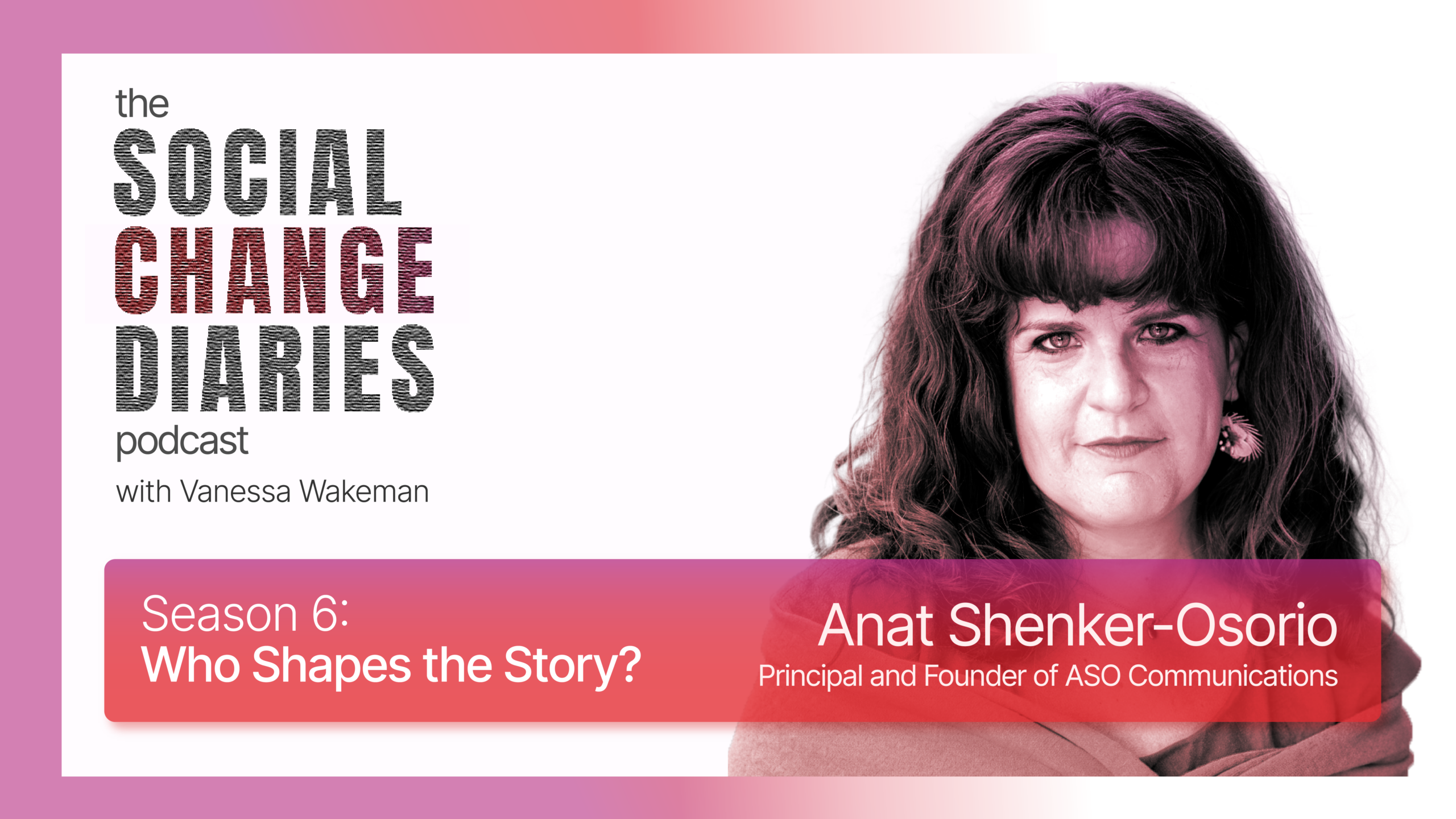
About This Episode:
In our most recent episode, Vanessa dives into how social change organizations can bring narratives to life with our guest Anat Shenker-Osorio, Principal and Founder of ASO Communications. Whether it’s “Freedom”, “Life”, or “Us”, some words are worth fighting over. Listen in on this fascinating conversation, discussing examples of how language can shift social norms, help us reimagine our collective future, and define our moment.
About Anat Shenker-Osorio:
Anat Shenker-Osorio, Principal and Founder of ASO Communications and host of the Words to Win By podcast, is a leading researcher on political and social change messaging. Through priming experiments, task-based testing, and online dial surveys, she investigates why some narratives inspire action, while others fall flat. Her data-driven insights have shaped winning strategies on issues from labor rights and clean energy, to immigration and criminal justice reform, leading to progressive victories around the world. Anat’s research and commentary have been featured in The New York Times, The Guardian, and The Atlantic, and she is the author of the book Don’t Buy It.
In her words…
“We have to recognize that there are certain words and concepts that are so integral to human beings that we simply cannot let the opposition have them, even if we have been conditioned and told that they belong to the opposition.”
“We need to make deliberate choices about our language, including what we choose not to talk about.”
[As a social change organization, your job] “is not to report on what is occurring. Your job is to first ask two critical questions: What do you wish people would believe and what do you wish people would do?”
“If you want people to believe a different story about your city, you can’t make them believe that story, unless you show, not tell, that something else is going on.”
“Narratives that work actually get noticed, and they break whatever the dominant paradigm of speech is—to make people look over there.”
Questions Answered on this Episode:
- What do you see as the most promising narrative areas for social change organizations and other members of civil society to shape in conversations today?
- What role do you see language playing in the development of social and political consciousness and civil education?
- When you think about the evolution of language, how do you gauge when it is time to evolve, when it is no longer working?
Transcript
Vanessa: Hello, and welcome to the Social Change Diaries. I am your host, Vanessa Wakeman. On this episode, I am joined by Anat Shenker-Osorio, principal and founder of ASO Communications and host of the Words to Win By podcast. Anat is a political linguist and strategist and has shown how framing and word choice can either reinforce dominant power structures or unlock progressive change.
I am so delighted to have Anat on our show today. For anyone who has been following The Wakeman Agency or listening to this podcast knows how much we focus on the framing of narrative and the importance of choosing your words carefully. We all heard that as children, but in our professional world, it is even more important today. And so, I’m really looking forward to hearing some of the examples and the projects that Anat has worked on and the guidance that she can offer as an expert and a political linguist. I think there’s just so much to learn. So listen closely, get those pens and paper out, and let’s get into the conversation. Welcome, Anat.
Anat: Thank you so much for having me, Vanessa.
Vanessa: Thank you, thank you. So, I want to talk first about your research, or ask a question based on your research. What do you see today as the most promising narrative areas for social change organizations and other members of civil society to shape in the conversations today?
Anat: Warming me up with an easy one. I appreciate that. Thank you. I guess the most promising areas, and maybe this is going to seem odd, but I think there is a burgeoning recognition that we’re not going to vote our way to democracy. And that is essential and critical, and I do a lot of electoral work, so understand that I do think that voting is critical and essential, but I think that, especially in the United States, and I work in multiple countries, the default towards what I will call electoralism has been really, really debilitating for social change. I think because mostly of philanthropy, so things beyond our control, this tendency to fund groups, and if they’re 501C3s to give them some chump change to do GOTV and voter reg and call it field instead of doing long-term sustained organizing, which is actually about developing a new political consciousness for people and helping them come to a place of understanding of their own agency, of their own power, of the necessity of collective action. I think that the crisis, to use the kindest possible word that I can offer for our present situation here in the States, and not just in the States, but starting here, has awakened people to the fact that if we were gonna vote our way to democracy, we would have in 2018, we would have in 2020, to the extent we staved off the worst of the authoritarian shellacking in 2022. And that clearly did not work because all of this still came back.
Because it had in fact never gone away. And so I think that the focus now, and of course I would like it to be more and I would like it to be bigger and I would like it to be more often, but the shift in attention towards activation and getting people out in what I like to call resistance, refusal and ridicule as the hallmarks of how we actually defeat authoritarianism as opposed to just putting all our eggs in an electoral basket, I think, is really important.
Vanessa: One of the things that I have been thinking about in our current state of affairs and political climate is this lack of understanding by so many Americans of how the country works, how our political system works. And I keep coming back to this idea of civic engagement. When I was in school, we had civics classes, we had those commercials —”I’m just a bill on the Capitol.” Like all of those things, right? And so they informed, to a large degree, along with my family and my community surroundings, how I thought about the process, how I understood the process. And today that doesn’t exist. And so when you talk about this investment in rebuilding, the understanding of democracy, it feels like it’s more than just the words, right? It’s more than just sort of giving people the language. It’s almost like a reimagining, if you will, of the system. Within that, where does this sort of narrative work reside, right? Because the tension that I feel people can struggle with is that we have the language, but we don’t want to only focus on that, because language without action doesn’t advance things.
Anat: Yeah, I mean, there are so many things that I want to say about this. First of all, you know, it’s commonplace to lament the fact that if we look at public polling attitudes towards government, attitudes towards institutions, trust, faith in the media, faith in basically anything is at an abysmal low. And generally, the default response to that is like, it’s terrible, it’s the, you know, destruction of the social fabric. And it is.
Instead of lamenting the fact that people have no faith in institutions and government, I think we need to recognize that people are right and that there’s a reason for that lack of faith because there has been a complete and total hollowing out of the civic space and of true democracy. And so people’s response is just a natural one. I think they’re calling it like they see it. And so what that means is that if you want people to believe a different story, you actually have to deliver a different story. And it can’t just be what you say, it has to be what you do.
So let me give you a concrete for instance, otherwise we’re just sort of in this nebulous, heady space and what the hell are we talking about? So the Portland inflatable frogs. We know that there is a prevailing narrative about US cities being crime-ridden, Antifa, immigrant hellscapes. And this is a story that we get told over and over and over again by this regime. And what I wanna say about that story is that they are a perfect example that if you want people to believe your narrative, you can’t just have talking points. You can’t just have social media posts. You have to perform your narrative out in the world. The reason why they send National Guard troops to our cities is because that is how they prove “that our cities need National Guard”. Because if they’re selling their base a story, that these cities are overrun, crime-ridden hellscapes, then they would have to send troops to them. Otherwise, they’re lying about how terrible and awful they are, or they’re not good defenders of the people. And so when they want people to believe a thing is true, they don’t just talk about it, they behave as if it were true. Enter our standard default response, which does not work, which is, actually, we’ve reduced crime. Actually, we’ve implemented real solutions to take care of crime. And in this city, X percent of crime has diminished by Y percent over this amount of time. Thereby, reinforcing the story that the topic to think and talk about is crime. Have you thought about crime? Did I make you think about crime? Now, have you thought about crime?
And even when we are saying, actually, crime is down, look, this is what happened. This is why there was a surge during the pandemic. And now here is why it is down. Rational argument, rational argument, rational argument, prefrontal cortex, which has no operating mechanism when you’ve got the amygdala firing up and all of the blood going to the fear center. When we make those kinds of arguments, we are living in their frame, and we are tacitly reaffirming the idea that it would be appropriate to send the National Guard to XYZ City if crime were at this rate and now we’re gonna have a math debate about at what rate that would be appropriate when in fact it was never okay and then pile on to that the amount of crime people desire is zero. So it’s basically like your oncologist telling you your tumors have gotten a little bit smaller.
Vanessa: Right.
Anat: You don’t want to stop radiation at that point. You want to keep going. And so it’s not really that comforting to people. Now, let’s look at what Portland did. So what Portland did is thanks to the extraordinary heroism of, at first, a single individual who decided to show up at the ICE facility in South Portland in a giant green frog inflatable costume and withstood the military actually putting tear gas into his air tank valve. And then that courage, because courage is in fact contagious, his standing up made other people come, but so did very smart organizing.
So here is what organizers in Portland did. They went out as soon as he sort of became prominent and became a thing on social media and they bought all of the inflatable costumes that they could find in local shops and online, and they made a costume lending library. So now if you go to that ICE facility and you want to protest, there is a costume, you don’t have to bring one, you don’t have to buy one, it’s waiting there for you on a clothes rack. And now, you know, we saw unicorns, we saw alligators, we saw dinosaurs. And if you look at the pictures from the No Kings protest that happened, these inflatables are now international. We saw these frogs in Dublin. We saw them in Munich. We saw them in Paris. We saw them in Tokyo. We saw them across the United States. And what this does, I mean, usually it surprises people when I tell them, yeah, the inflatable frog, that’s a crime narrative. And they’re like, “What are you talking about?” If you want people to believe a different story about your city, you can’t make them believe that story unless you show, not tell, that something else is going on. And the number one rule of messaging, and this is what is so endlessly frustrating to me, because what I’m about to say, I think is so obvious, it should just be sort of standard, but it so gets lost, is that a message that nobody hears cannot persuade them.
Vanessa: Yeah, thank you. That’s an incredible example. And it’s in a story, as you mentioned, that we are currently in. I like to sort of look at that or categorize that kind of effort as like performance art, if you will. For narrative, I think so often people are only thinking about the actual words. And I think that there are so many different channels and mediums that can contribute to a narrative that we need to not be so singularly focused. And I agree with you. There is a level of like civility and same old, same old in some of the narratives that are fighting for democracy or grounded and rooted in our democracy that simply don’t work against the opposition where there are loud, consistent, multi-channel, multi-actors sort of at play talking about things and sort of, even though it’s misinformation or just blatant untruths —lies, it’s so loud that people begin to question like, well, maybe it is, this is real. And so I think there is an opportunity for us to rethink strategically how we talk about social issues, how we root in all of the ways that people come to become comfortable with new normals, right? And so, how do we break people free from thinking about things, you know, this is how we’ve always done it, and sort of allow space for new ways to build narratives and for storytelling and to engage people, because what you’re talking about in Portland also speaks to the folks who came out and organized, right? There was something they were able to like wrap their arms around and work together, and then that sort of built.
And so I think there’s a lot of value in that. I want to talk a little bit about language, just because I think that what we are seeing right now is language wars, where there are particular words that are being co-opted for use that are being weaponized and it’s happening at a rate of change where people are sometimes unsure like, can I still use this word or does this word still have the same meaning or like, where are we?
One of the things when we’re working with organizations on lexicons, we’re constantly interrogating languages. Is this still the language to represent your organization and its work? How do we know when it’s time to evolve it? Is there a new language that we should be innovating so that you can adapt? So, how do you think about language where it resides in a narrative, and how are you measuring and identifying when something is no longer working?
Anat: Yeah, such a huge question. You know, I don’t know how many times a day I will get a question, “What should our message be about blank?” Right? Right, right. Something just happened. Something is always happening. Somebody just, you know, posted something egregious and horrific. And what is our message? What is our message? What is our message? And the first thing that is extraordinarily important to recognize is that in the universe of social change, social justice, advocacy, whatever it is you call that you’re doing, you’re not a newscaster. Your job is not to report on what is occurring. Your job is to first ask two critical questions. What do you wish people believed? And then let’s say you magically made that occur—
Vanessa: Mm-hmm.
Anat: What do you wish that they did?
Then we ask ourselves, okay, I need people to believe whatever this thing is, and I’m going to give another concrete example. So let’s take, for example, a few years ago, there was a campaign to overturn the total ban on abortion in the country of Argentina. Catholic country, in fact, Argentine Pope, very proud of themselves at the time. And so what was the message gonna be to overturn this sort of always existing law that abortion was illegal in all cases, no exceptions, etc.? And so the message for the base, meaning the choir, was really critical of this green bandana. Why a bandana? Because in Argentina during the time of the dictatorship, there was a heroic group of mothers and grandmothers who would walk around outside of the Plaza Mayo, the Congress in Buenos Aires, protesting the disappearance of their loved ones in the face of dictatorship, and they all wore white kerchiefs. So the kerchief is already a symbol in the culture, in the country of women standing up to sort of the most machista thing you can possibly imagine, which is a dictatorship. And so they took the kerchief, but they made it green in order to sort of symbolize that it’s a different campaign for a different thing, but still borrowing back from their own history.
And the kerchief said in very plain script, Aborto Legal Ya, Legal Abortion Now. And then it said in smaller script, I’m translating, sex education to protect ourselves, contraception to not get pregnant, and Abortion to Not Die, Aborto Para No Morir.
At the time of this campaign, if you went to Buenos Aires, these green kerchiefs were ubiquitous, much like if you live in the United States, there is a certain odious red hat that appears in many, many different places. And I think you know what I’m talking about. When you have people, your choir, physically wearing your campaign, whether that be a Black Lives Matter sign or shirt, or whether that be a green kerchief, then what you are availing yourself of is something we know in psychology as social proof. People do the thing they think people like them do. And when everyone is wearing a green kerchief or, on the flip side, a red hat, you’re like, okay, I’m apolitical. I don’t pay much attention. I don’t really follow politics. I got a lot going on in my life, which by the way, represents the majority of US voters who are very, very low information because they have a whole heck of a lot going on in their lives, then what you conclude unconsciously —which is very powerful— is that “this is what a ‘me’ kind of a person thinks. So I guess I think it too.”
We have to recognize that there are certain words and concepts that are so integral to human beings that we simply cannot let the opposition have them, even if we have been conditioned and told that they belong to the opposition. “Life” is one of those ideas and words. “Freedom,” especially in a US context, is another absolute example. The notion that we would cede the concept of freedom when freedom has been integral to so many social justice victories from FDR talking about the four freedoms to the Civil Rights Movement and the Freedom Riders and Freedom Summer to the freedom to marry; the idea that we would let people who are bound and determined to shut down and shut up and control anyone who doesn’t look, live, or love like them to let them have freedom. It’s ludicrous. It’s not only inaccurate. It’s absolutely detrimental. So there are certain words that just are so important that we have to sit in our truth with them because they are very much progressive ideas and values. And then, and this is the last example that I will offer, there are other kinds of words that really don’t serve us, and we use as defaults because we are just conditioned. And I think striking examples of that, and this is something that we’ve been working on all year, and I would argue we’ve made headway on, is using a sanguine word like “deportation” to describe what are in fact disappearances, kidnappings, and abductions. The word deportation has a legal meaning. It means that there was due process. And when something is not a deportation, because that is not what has occurred, and we default to saying, even in order to say, you know, “Americans oppose this deportation regime,” or “Americans are against all of these deportations,” these are not deportations. So that’s a problematic thing to call it. Equally problematic, and this just sort of makes my head want to explode, is the default to calling what’s going on “immigration policy”. Reasonable people can disagree about immigration policy. What is immigration policy? It is rules about how many visas are granted a year.
Vanessa: Yes.
Anat: What kinds of forms do you have to fill out to enter? How many years does it take to go from having a visa to getting permanent residency, to getting citizenship? What kinds of visas can you apply for? All of that is immigration policy. And people can have different ideas about it. Abducting people, having masked agents going into sacred spaces, or just into plain old city streets, or into Home Depot parking lots, I don’t care, and physically assaulting people and taking them out of our communities with absolutely no reasoning, no process, and then in many cases we know, disappearing them, that is not immigration policy. Those are crimes against humanity. And when we call them “immigration policy,” again, in order to say, “people oppose this immigration policy, people are upset about this immigration policy,” what we’re doing is making it sound more palatable than what it actually is, and we’re being inaccurate.
Vanessa: Yeah, I agree with that. I think part of the plan is to continue to push until we see what we push back against. And when we don’t push back, then those behaviors and that language get normalized. And we are, you know, recklessly throwing around, you know, words that are misrepresenting what’s actually happening. So I think that’s really important to be mindful. I also see in some organizations just discomfort with plainly naming a thing, a thing. Like, if this is what’s happening, let’s say that the reason this is happening is that there are no jobs available. Let’s sort of frame the narrative in a way that is rooted in the facts and paint the picture with language, even if it’s uncomfortable language, so that people fully understand and recognize what’s happening. I think that’s very important.
I want to go back a second for when you were talking about Argentina and the green handkerchiefs and people sort of seeing themselves and wanting to be a part of that. What that framing sort of brought to mind for me is this idea of like culture and identity and trying to figure out where an individual sits within a community, right?
There’s so many overlaps between I’m a woman, I’m a founder of an agency, you know, New Yorker, like all of these things. And so, trying to find where my people are and where I fit. And so I think in narrative and in communications and how people are thinking about it, I think the opportunity that I’m excited for and also quite frankly, in some ways overwhelmed because of this idea of us peeling back some of the layers and how we’re thinking about communications and designing narratives and looking at culture and identity to see where people fit and building from the ground up, I almost feel like all of the social issues that we care about and as we, I’m thinking about on the, who are in this interview at this moment, I feel like there’s an opportunity to like burn everything to the ground and start from the beginning because there is so much in like, when we talk about systems of oppression and institutional oppression and racism and just the way that stories have been told about particular people and issues and how on the other side we have loud and consistent and almost like bullyish in how they are consistently telling stories. I wonder what would happen if we rethought the use of language, to your point, about the words that we absolutely must reclaim. Like these are ours, and we are going to hold them as part of our truth.
I just wonder if we would be able to advance progress on some of these issues if we sort of rethought about one, the intersectionality of all of them, how we talked about them and how we engaged people. And we see in some of the polling that people don’t feel seen in some of these narratives. Like, when we’re talking about SNAP benefits as a perfect example, some people didn’t even realize that their benefits would be taken away. When the shutdown happened, “that’s not me, those are other people.” And so there’s something wrong and incorrect in how we are informing people, how we’re making people understand what’s at risk for them. And also what the opportunity is for them in certain social issues. If you were advising a nonprofit, let’s say a U.S. nonprofit today, and they wanted to play a larger role in advancing, you know, an issue, let’s say if they were focused on education equity, just using as a general example, what things would you be telling the folks about? Would you be saying, you know, focus on your language, like specific words, because these are the things that people don’t understand. Would you be focusing on the narrative? Are there things around geography? Like, are there any particular instructions that you would say for an organization willing to commit to reshaping a narrative around a particular social issue?
Anat: Yeah, I’m happy to do an education example, and I can come back to that, but I wanna, if I can, I wanna give you a super concrete example of like going through this entire process, because we’re in the middle of it and we’ve done it before. I’m just sticking with migration for now. Years ago, I lived in Australia in order to run this giant research project to change public perception of people seeking asylum, which, of course, is commonly known as “asylum seekers,” which, it turns out, is a less useful wording than “people seeking asylum,” which is why you hear me saying that over and over again. And at the time of my arrival, and it is the same in the U.S. today, I would argue, the opposition narrative is exactly what you would guess it would be: “terrorists, fear, taking our jobs.” And the political reality was that the government of Australia, through multiple administrations, left-wing, right-wing, had been shunting people to offshore prisons that were paid for and managed by third-party countries. And this had been going on for three decades plus. So labor governments had done that, right-wing governments had done that. And the pro-migrant, the human rights narrative, because Australia is a country in which human rights is actually a messaging framework, unlike the U.S., was very classic NGO: “As signatories to the Refugee Convention, Australia must fairly police its territorial waters and recognize that we must obey…” You know, like just very human rights, and these are the laws, and we signed a treaty and whatever. And like, are you bored to tears? Would anyone have ever heard that message? And could it possibly stand up to this fear, fear, fear, fear? And so by the time I got there, and this is where we are in the U.S. as well. And this is true in immigration. It’s true across multiple social justice issues. We are stuck in three no-win narratives. The first is that immigrants are villains. I don’t think I need to detail that to you. I think you know what I’m talking about. The second is what I call the “Ay pobrecitos” narrative, that immigrants are victims. And that narrative, which we use in social justice, not just about immigrants, but about people facing homelessness, people who have to live paycheck to paycheck, people struggling with addiction, people who have been victims of the carceral state. I mean, you name it, we have this narrative where basically it’s some form of we need to feel bad for those people. Look how terrible they have it. Look how hard this is. Look at how awful this is.
And all of that is done in an absolutely earnest attempt to make people be like, “look at the horrors, look at the horrors, look at how horrible the horrors.” An issue with that narrative is that most often, what it provokes at best is sympathy. It gets a category of people to feel sorry for those people, which is a form of othering.
If I am getting you to feel badly for those people, then that is not helpful. That is those SNAP beneficiaries, which is not you, even if you actually receive SNAP, because I have created this other category. The third in the immigration space, I shorthand as “valets” because I like alliteration: victims, villains, valets, and that’s my shorthand for doing jobs nobody wants, picking our crops, taking care of our kids, doing our medical care.
And again, that’s another form of other, right? If they’re doing jobs that nobody wants, if they’re picking our crops, then they are them, and they are not us, and so on. So, a similar situation in Australia. And so what we did, what we have to do in all of these situations is, again, if you want people to believe a different story, then you have to actually show, not tell, a different story. What I like to call the truth —that immigrants are awesome and that the purpose of fascism is to make people afraid to be their true, authentic selves and live out loud for any kind of “difference” that they have. And that if we want people to come to our cause, we need to be attractive. And so what did we do? We did things like a cutest baby contest —which, spoiler alert, everybody won because what kind of monsters would we be if we were picking a cutest baby?—for the kids who were stuck in these detention centers offshore, we did a relationship advice column in Women’s Wear Daily, which is like the Cosmo of Australia, where people in detention talked about, this is how we try to keep our relationship alive and these are the conflicts, and these are the issues.
We had the Sydney Morning Herald, which is sort of their New York Times equivalent, write about cooking that was happening in detention and the blending of flavors and people coming from very, very different cuisine backgrounds and making what they could from what they could find in detention. We basically thrust the full three-dimensional humanity of people seeking asylum in the Australian public space, such that the human rights sector was able to win four sequential campaigns in a single year, 2016, and basically vacate three-quarters of those prison camps and move public opinion by 20 points in that single year. And so fast forward to now, where we are in the States. And I would argue a very similar dynamic, where at best, what we can do is say, “Look how horrible this is.” And we do need to be on defense. I’m not saying these horrible things are not happening. Obviously, I just said a minute ago, right? I just said, let’s use the language of abductions. I said, let’s use the language of crimes against humanity. And we also need to remind people that, actually, immigrants are awesome. And so what does that mean? It means, I’m proud to say, a campaign that a whole slew of immigrant rights groups just launched. We call it Brave of Us, the idea that it is brave of us to move heaven and earth to provide for our families. It’s brave of us, if we’re journalists, to tell the truth about what’s going on. It’s brave of us if we’re educators, you know, whatever level, K-12, university, to insist that we tell the truth of our past and the reality of our present. It’s brave of us as lawyers to go up against injustice. And it’s brave of us as immigrants to make a way out of no way at all.
And so folks at CASA, which is a national org, have a really large base in Maryland. They did a Brave of Us launch in the face of ICE coming in and being very, very angry that local law enforcement is gonna be colluding and collaborating with ICE. Next week, beginning of December, there is going to be a Brave of Us art exhibit at Art Basel in Miami. In Ohio, there’s gonna be a Brave of Us tattoo contest. Tattoo artists are actually designing Brave of Us ink, and people can go get ink; there will also be temporary tattoos. I could go on and on, but the overall point is that if you want people to believe a different story, you actually have to provide them with a different story.
Vanessa: That is the perfect comment to wrap our conversation. You have to give people a different story. Anat, I thank you so much for sharing your wisdom and for the work that you’re doing out in the world. And I look forward to us connecting again.
Anat: Thank you.
Vanessa: So much for our listeners to digest from today’s conversation. But one of the headlines I hope people consider is to not think about narrative through a singular lens, please. As you heard from the examples Anat provided, and in some of the other conversations I’ve had recently on the podcast, you need to commit to the narrative and represent it in as many ways as possible.
This strengthens the narrative, makes it more resilient, and gives you more anchors for people to attach to in seeing themselves in the narrative. The second thing I think people should walk away with is around language. Words matter, words evolve. We have a responsibility to consistently examine language and how people respond to certain words and terms.
And when needed, to evolve or retire language when it no longer serves its cause. As always, if you have enjoyed the conversation, please leave us a review. Feel free to send me a comment. I love hearing from you folks. Or share this with a colleague. Thanks for listening.