About This Episode:
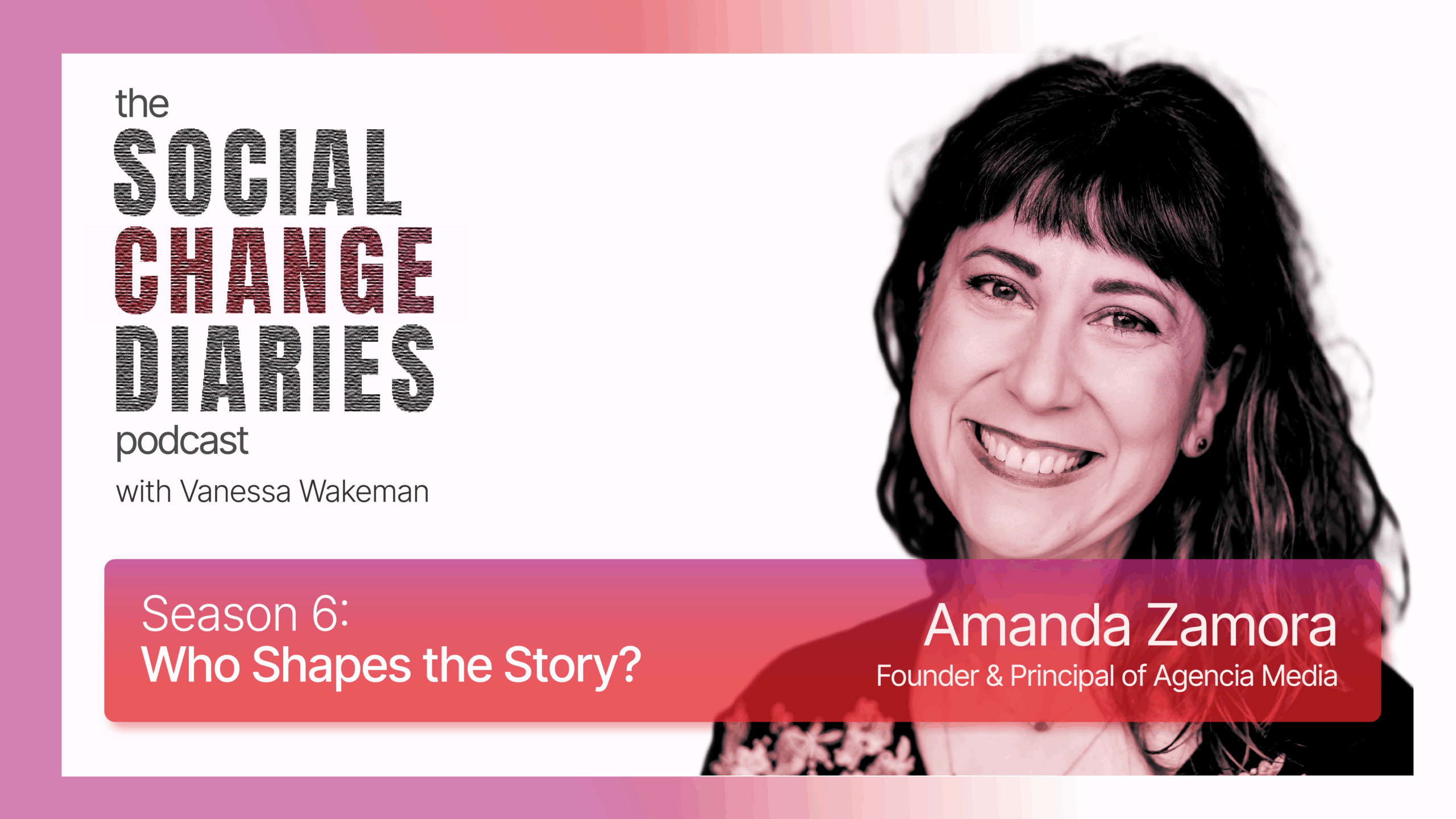
In this discussion, Vanessa sits down with Amanda Zamora, Co-Founder of The 19th, and Founder & Principal of Agencia Media. Their conversation explores the power of story, who gets to be the narrator now that traditional media gatekeeping is no longer the norm, why nonprofits have an important role to play, and how identity and effective storytelling are inherently linked.
About Amanda Zamora:
Amanda Zamora is Founder & Principal of Agencia Media, a consultancy that partners with organizations to drive narrative change and civic engagement, especially with, and for, communities of color. She has more than 20 years of experience as a journalist, storyteller, editor, and disruptor in the news industry, most recently as founding publisher of The 19th and co-founder of the Latino Media Consortium. She is most interested in problem-solving around audience development, product development, and sustainability.
In her words…
“What nonprofits have, that many news organizations lack, is a clear understanding of who they serve. That’s where they begin, and it is an inherent strength.”
“Getting visibility for nonprofits’ messages is really just about partnering with the right people to show the results of your efforts and platforming the needs, the questions, the answers, and solutions that communities have, that everyone else needs to be paying attention to.”
“If mainstream media has been the gatekeeper, they are no more. What other kinds of partnerships can you forge within your community with those trusted storytellers, whose values align and who are seen as reliable?”
“A lot of things that are the most successful start small, but they succeed because people value them and because they’re consistently showing up to deliver that value.”
“Community organizations are flipping the script – they’re leading with the community’s observation of facts, instead of with a press release from law enforcement.”
Questions Answered on this Episode:
- What do you see as the biggest challenge in legacy media today that is impacting the stories that are being told?
- If you were leading a nonprofit considering launching an internal newsroom, what particular guardrails or considerations would you keep in mind?
- How do you approach identity and storytelling? Why do you see those two as essentially linked for effective and trustworthy media today?
- Are there any particular narratives that you see that could use a little extra love and attention through the lens of community-first journalism?
- If we were having this conversation in the future—two years from now—what would we be talking about?
Transcript
Vanessa: Hello, and welcome to the Social Change Diaries. I am your host, Vanessa Wakeman, and I’m excited to be here today with our guest, Amanda Zamora. Amanda is the founder and principal of Agencia Media, a consultancy that partners with organizations to drive narrative change and civic engagement, especially with and for communities of color. She has more than 20 years of experience as a journalist, storyteller, editor, and disruptor in the news industry, most recently as founding publisher of The 19th and co-founder of the Latino Media Consortium. Welcome, Amanda.
Amanda: Thank you so much for having me.
Vanessa: Thank you. So, I have so much to ask you. I am a fan of The 19th, and I am familiar with the Consortium. And so when I was thinking about this conversation and having some time with you, I would really love to get a sense of your take on the media landscape today. What do you see as missing and what do you feel are the things that we should be running towards in this moment to build out more infrastructure or more support for?
Amanda: Yeah, well, it’s such a big question, and the list of issues is long. But I think fundamentally, I would say, depending on where you sit within the media landscape, this is either the most depressing moment ever, just as we see our role diminished as people continue to lose trust in media institutions. At the same time, we have such a critical need for reliable, credible, trustworthy news and information. Or you see it as an incredible opportunity because in this moment, people are saying the need is so great. And if it’s not being satisfied by these media organizations and institutions that we have looked to for decades, for generations in some cases, we’re going to solve for this ourselves. And so what you see, especially post-pandemic, post-2020, is folks who are seeing a specific need, information gaps in their community and the tools that are available to solve for those information gaps and they’re stepping up and creating digital publications, they’re creating channels on WhatsApp, on Instagram, on YouTube, they’re solving for these information needs, they’re not waiting for the media organizations in their communities to do it or to be given permission. And that is where I see the opportunity for people to create new ways of meeting our audience’s needs, but also frankly for mainstream news organizations to learn from communities about what they need, how they need it, and what news really is if it’s in service of a community, in service of an audience.
Vanessa: Yes, yes, yes. So today we’re seeing so much transition and change in legacy media as you just spoke to, and the bubbling up in different forms and different geographies and groups. You’ve played a really important role in that. You saw a need and came in and felt it and offered a different approach to journalism. What do you see as the biggest challenge in legacy media today that is impacting the stories that are being told?
Amanda: Yeah, there are, again, the list is long, but I would say I’m someone who’s rooted in the second half of my career. It sort of shifted from being on the front lines of creating content, knowing, editing, producing, helping newspapers shift into a digital landscape. And then the second half of my career, I would say, was my audience era. I was one of the first social media editors at a major newspaper in this country, and helping journalists figure out what Twitter was back when it was Twitter, and are we editing our tweets? Just really the most basic fundamental questions that you can imagine that newspapers had about how to create digital news.
But my bias has always been towards not just growing an audience for the sake of gathering as many eyeballs as possible or for scaling for the sake of scale, but really humanizing the person on the other side of that page view and understanding that they’re more than a commodity, that they are a participant in the story, that they’re the protagonist in the story oftentimes. And how can I use my digital news toolkit to engage audiences directly in the journalism, versus just seeing them as passive consumers of these stories? And so I think it gets at one of the fundamental issues that I see that legacy organizations have. It’s an audience problem. They’ve made a lot of assumptions about who they serve versus really scoping, understanding, and quantifying the audiences that they’re trying to serve. You cannot be creating a business that is going to be viable or relevant, much less journalism that is meeting the moment or having the impact or serving the mission if you don’t understand who you’re creating for. So that sounds so obvious, but that is still, as I’ve transitioned into consulting work, I’m astonished, but also in a weird way, not astonished that this is still a fundamental problem that legacy news organizations have, which is just this disconnect with what they think that they’re doing and who they think they’re serving and the reality of who they’re serving. And that begins with taking a stand and saying, OK, what’s my mission and who am I serving in that mission, and actually doing the work of scoping that audience to understand who they actually are and what they need from you.
I think there are some external factors that are impacting legacy news organizations and also all of us, which, if we have all now become so addicted to our phones, like social media is the primary way that most Americans get their news nowadays.
I don’t think that’s news to anyone listening. I’m sure we’re all trying to manage our relationships with our devices, but as the platforms have really disrupted that relationship that news organizations had with their readers in permanent ways. I don’t know that that relationship is ever going to be the same. I think maybe that was a good thing, not in the grand scheme of things, but in the sense that it hopefully should have moved.
Legacy news organizations need to wake up and understand that they need to do more to earn that relationship, rather than just take it for granted. But that’s a huge issue, right? And we see it now more than ever in the last two election cycles, the extent to which those platforms don’t have the same values necessarily that the journalism organizations that I grew up in have. And so I don’t have the same incentives for fact-checking or for making sure that the information that’s being distributed is of a particular standard. And so you see misinformation that is rampant. What’s being done about it? These platforms don’t have the same incentives. For them, that’s helping the bottom line. The more enraged we are, the more we’re sharing whether information is true or false, regardless of the motives of the people who are creating that information. They’re making bank, and so they’re good. Well, those are not my values. Those aren’t the journalistic values that I got into this for, that I espouse. But the fact that those platforms have really disrupted our relationship with audiences in that way is a fundamental problem. Well, now we have AI, and I know that you mentioned this is like a huge topic, but like this is the next wave, this is the next frontier, this disruption, yet another complicating factor, another layer separating us as publishers from the audiences that we’re trying to serve. Frankly, I feel like we’re sort of on our back foot even in tackling this problem because we were so late, and I say we as the mainstream media. I don’t know exactly where I fit in that mainstream anymore. We can talk about why I stepped out of it. I’m definitely on the side over here, and I’m really grateful, actually, to be in a different position at the moment.
Vanessa: You can be wherever you want to be.
Amanda: Precisely because it gives me the perspective and the independence that I feel like is really necessary for me to work in this moment. But my point is just being AI now, I mean, it’s still a very small percentage of people who are getting information through AI chatbots, but it is sure growing, and I can tell you as someone who is utilizing it, because I need to understand how this works, I also don’t want the publishers that I serve to be left behind.
But that brings in all of these additional ethical concerns about what the impacts are, or even utilizing this on communities who are in these spaces where these data centers are causing harm. So, this is multi-layered; this is the next frontier. But those are just a few of the kinds of issues that the mainstream media is struggling with.
We can talk about the business model, too. There are just so many things, but those are just a few of the headlines, I think.
Vanessa: Those are all really important. And the thing that I extracted, relative to the work that we do, is with all of these disruptions, I see an opportunity for further disruption and the disruption to hopefully bring us back to the truth. And so when I think about journalism, the respect that we have held for it, if an article was written in the New York Times, nobody was questioning it. like, is the exact, these are facts. We know this, we’re trusting it, we’re believing it. It’s shaping our perception, all of these things.
And then when I think about when social media first came about, how we were a little unsure, but as we started to see people sharing information and the way from an international sort of global perspective, how it really allowed people who were silenced to be able to share information, like, this is a good thing. And I don’t think what any of us planned for in those early days was like this sort of access and freedom.
It also allowed people to really not take the responsibility of what we think about when we’re talking about media and news, like, you have a responsibility to share facts, right? You have a responsibility to make sure that you’re not causing harm with this information. So as we have allowed more people to be in these spaces, it has fragmented, like, what can I trust? What’s the misinformation? What’s a total lie? What’s the harm against an important narrative? And so in our work, the two things that we have been really focusing on over the last year is this idea of narrative resilience, making sure that organizations have narratives that can withstand what’s happening from the opposition, so to speak. And then also this idea of building nonprofit newsrooms, which every time I mention it to a nonprofit, I feel like they go running into the corner, in the fetal position, because we are asking them to consider yet another thing on top of whatever program or services they are offering. My sort of thinking about this is that nonprofits are currently the most trusted institutions in America, in times where the goal is to trust no one, believe no one. So for them to continue to build and maintain sustained trust is really notable. And then secondly, because the social issues that we are facing right now, like we’re in such a fragile state, as the attacks are happening against women’s reproductive rights, voting rights, hunger, economic stability, all of these things. It feels to me, even though this probably wasn’t part of anyone’s strategic plan three years ago, to be considering how can we be content creators in the form of producing news and create, as someone shared with me a couple of weeks ago, Tracie Powell from The Pivot Fund, used the term “mutual aid”, right? So, how do we create this mutual aid to be able to support organizations and communities? And I’m thinking like, this is a moment to me for nonprofits to enter this space and be able to share facts about really important things to educate communities.
Do you think I’m just being naive? What is your take on that?
Amanda: No, no, I love it. I don’t even know where to start because there’s so much that I love about it, and I just want to plus 100 this. I think that what nonprofits have that many news organizations lack, coming back to the first thing that I really mentioned, is a clear understanding of who they serve. That’s where they begin. That is where you begin.
And therefore, that is an inherent strength that you have that so many media organizations over here are struggling with or are not even tackling because they’re so busy just kind of trying to keep the wheels on of a production problem versus an audience sort of impact problem. And so if you all are leading with that, there’s a couple of key ingredients that you just need to add. The second, I think, is sort of just the product development, like what does it look like to create stories in service of this community to advance a particular outcome, whether it’s healthcare, wage equity, myriad issues, you know, that people might be working to solve for. And there are plenty of people out here who are talented, who have the time and talent. I’ve been one in my consulting world. I’ve met so many people over the last couple of years. And I feel like there’s more and more folks who have a particular expertise. I just met this woman, Stella Mock, who’s just launched a consultancy. She comes out of finance, but she was wanting to figure out how to show up in this moment and see how local news organizations are struggling. Like she’s shifted now into helping apply her data skillset to media organizations, community organizations, and local news. That’s the kind of finding the people who have the time and talent. You don’t need to have that in-house. Maybe you just need to partner with someone to get kind of get yourself set, so it’s someone who can help you package those stories in a way that’s gonna meet your audiences where they are. And then, what’s the third thing? I was thinking, the people you’ve got, and just like a systems approach, right? The feedback loops, right? So, figuring out how you’re gonna keep the conversations going with your audience, it’s just a different rhythm. You’re already accustomed to doing it, so now you’re just setting a new sort of cadence to those feedback loops, and you’re sharing what you learn from your communities in a public way. That’s all it is. It’s what you already do. You’re just doing it at a different frequency, and you’re showing your work. And hopefully, you’re finding people who you can partner with and can help you with the packaging of that show and tell. Like what I would say, I hope is encouragement. First of all, it’s so needed, but you already have this amazing relationship with the audience or with your community.
It’s really just about figuring out, partnering with the right people to show the results of that effort and really start to platform the needs, the questions, the answers, and solutions that communities have that everyone else needs to be paying attention to. The last thing I’ll say about this, too, just in terms of the relationship with mainstream media, when I was leaving The 19th, one of the last events that I, and I love, there’s so much I love about The 19th, they do a great job.
They do less, I think, in-person events now, but the in-person events that we had done then were great at sort of pulling together stakeholders around all kinds of different sides of an issue, including a lot of folks in the nonprofit world, right? And I remember someone in a nonprofit asking me, like, how do I go about getting visibility for my message? Because that’s another big question that you all have, right? And I think people are so accustomed to, like, press releases or, like, pitching reporters, but that’s not the name of the game anymore. I don’t know who reads a press release anymore. People are on social media now. And so, thinking about whether mainstream media has been the gatekeeper, they are no more. And so what other kind of partnerships can you forge within your community with those trusted storytellers whose values align and who are trusted? Who can help also amplify the work that you’re doing? I think that there’s so much opportunity for problem-solving here and finding new ways to partner and collaborate in community to elevate these really important stories.
Vanessa: Yeah, I agree with that. And that connection to the audience is so valuable. I think that sometimes, because it’s in many ways built in, they have such a close relationship that if they don’t even recognize how much value there is and the trust that they’ve built. Have you, I’m sure you have, heard of the term brand journalism before?
Amanda: Yeah, creator journalism, brand journalism, I think this is similar. Okay, yeah.
Vanessa: About 10 years ago, we started playing around with this idea of brand journalism. How can we, and this was before any of the chaos sort of broke that we see today in legacy media, mainstream media, thinking about what would happen if organizations sort of found ways to tell stories, but through the lens of their interests, right? So it wasn’t a pure journalistic model. Like, okay, we are interested in getting people to understand the harms of sugar. And so we’re going to spend a lot of time talking about our opinions, our experiences, a biased approach. And we were able to get some organizations to start thinking about that and finding ways that, like, we see this is really helpful in getting people to understand our stories. We have a foundation that we work with, and we talk to them about brand journalism. Like, let’s hire some journalists to go out into the world and like represent some of the social issues that are important to you. And they were interested but not fully convinced at first. And now they’re in the swing of things, right? Like they’re finding their rhythm. They’re like, well, you know, let us know if you have any folks we should be talking to. So I think that organizations, you know, recognizing that not all organizations have the capacity, the financial wherewithal, I think that there is an entry point for anyone. For the smallest organization to the largest. I mentioned this because I see this newsroom model as the next frontier of what we were thinking about in the past. I was in a conversation or listening to a webinar with, I think it was, the Local Media Association, and there was a speaker who shared that even in some of the hyperlocal organizations, they may have just a part-time reporter, and so people are thinking they need so many resources, but you know, start where you are. Are there any thoughts or suggestions you have for, let’s say, if you were leading a nonprofit and this was something of interest, if you were consulting with a nonprofit and this was something you were recommending, are there any particular starting guardrails or considerations you would mention?
Amanda: Yeah, great question. I love the start where you are, ethos. I think it can feel overwhelming, but the first thing that I would suggest is, once you are clear on who you’re serving, kind of what the information needs is, pick the one channel that is going to be the most relevant to that community. Where are they day to day? Some of our publishers, by way of example, with LMC, started out doing state house coverage, but for Spanish speakers, for the immigrant and Latino community in North Carolina. When they transitioned, their platform evolved to cover or to serve farm workers who were out in rural areas. That was not necessarily the right solution for that community. So they wound up on WhatsApp, and it wasn’t daily because they’re not checking every day for news, the question was when seasonally did it make sense? When did they have questions? So, if you’ve got that again, if you go back to the audience and you start with the audience and ask what’s their frequency? How engaged with news are they, and when and why? And like, what’s the one channel that makes the most sense for them? Just start with that. I think if you look at the news you’re like, I need to have a website and a newsletter and I need to be publishing every single day, but maybe not. Coming up with, again, the channel to prioritize based on where your audience spends the most time. And as long as you’re transparent with them, this is what you can expect. We’re gonna be here twice a week, we’re gonna be here once a month, but it’s gonna be awesome, and it’s gonna be worth checking in with us because you’re gonna get, X, Y, and Z. You get to set the terms of engagement as long as you’re really awesome at following through and delivering value. You really can operate at the speed of your organization’s capacity, if that makes sense. So I hope that helps sort of dispel, kind of the “how do we even start?” We’re so stressed out, and we have so much to do. But you can start small. A lot of things that are the most successful start small, but they succeed because people value them and because they’re consistently showing up to deliver that value.
Vanessa: I love that and the idea of WhatsApp being the medium. I think we have ideas about what it needs to look like, and there’s an opportunity for it to look like whatever you can do consistently and with integrity.
Amanda: Yeah! Exactly.
Vanessa: Yes, I have a question about The 19th. You shared in the past how the early mission was to shift away from language about neutrality as journalists. How do you approach identity and storytelling? And why do you see those two as essentially linked for effective and trustworthy media today?
Amanda: Yeah, I mean, identity is at the core of The 19th. It’s why The 19th exists. It’s because, you know, Emily’s original idea, I’m sure, hopefully, as folks know, you know, wanting to see politics and policy coverage told in a way that centered women, women of color, queer folks, anyone who is disenfranchised, disaffected, and marginalized by virtue of their gender.
So identity is at the core of The 19th’s existence, right? And the reason for being. And I think that was always table stakes for The 19th. But one thing that was maybe at odds with that was something that we adopted from what we learned from the Texas Tribune, which is where both of us met and were working together before we launched The 19th. And that was just this idea that for politics and policy coverage, it made great sense to have this nonpartisan framing, not bipartisan, but nonpartisan. And that was pretty typical, I think, for a lot of nonprofit news outlets, to adopt that nonpartisan framing. So we created The 19th with both of these things as part of our identity, just this focus on women, women of color, queer folks, and also this nonpartisan value.
It became crystal clear to me early in our existence that the juxtaposition of those two things was not going to get us very far. That there are particular positions and political parties that are making very partisan issues out of the people that we cover, like we’re not making it partisan. Other people are making voting rights partisan, and gender identity, and access to women’s health. And we’re not gonna stop centering those issues or those communities. So, the most logical thing I think for us was to say, we’re gonna just like, by step of this paradigm and say, we are independent. We have the same journalistic values, but language matters, right?
Vanessa: Mm-hmm.
Amanda: We’re not going to be put into this box where you’re telling us we’re partisan or nonpartisan. We’re independent. We will cover any party or ideology with curiosity, with rigor. But we’re not going to be put into that bipartisan, nonpartisan box. There’s no way that we could adequately center the communities that we’re going to center and also try to carry that label. So it just didn’t make sense.
Vanessa: How do you navigate doing that? When there are issues, issues that you care about, you have a certain perspective, right? So, you are first a human being, with your own set of beliefs and identity. And then you have this other identity as a journalist. And in this sort of moment of uncertainty and clear attacks on certain issues, how do you sort of navigate that as a journalist? Wanting to provide your audience with facts, but also understanding the risks, right? If this thing happens, the entire building burns down. How do you navigate that? I’m curious.
Amanda: Yeah, at a fundamental level, I think, at least in terms of how we thought about it in forming The 19th, was that your identity and your lived experience were an asset to journalism. And that, sadly, was a profound departure from the newsrooms that most of the journalists who joined The 19th, from the newsrooms that they came from.
I went to the University of Texas School of Journalism, and I remember even at that time having conflicted ideas about politics and identity because I am a Latina, a white-presenting Latina, who grew up in a very conservative family, but also my father lived the “American dream”. And I could see that the experiences of my family, the opinions of my family, were more complicated than what I saw portrayed in mainstream media. That was another kind of propelling force for me, fast forward 20 plus years later, and founding The 19th of wanting to see that complexity reflected in the journalism. And I think that’s one of the things that people appreciate so much about The 19th is that they’re getting into the nuance and they’re looking into legislation and policy and power to kind of see, you know, what’s omitted in mainstream coverage because there’s a lot of flattening.
There’s a lot of flattening on purpose. It’s by design. There are people who from the flattening of groups of people into criminals or enemies or an other, because it serves their political purposes. The 19th is the opposite of all of that. So, I think it is very possible to do things at the same time, which is to say, this is a newsroom that is going to acknowledge that our journalists relate very personally to the issues and the stories and the people and the communities that they cover. We’re going to be very transparent about that connection. We’re going to let it inform the kinds of stories that get pitched and approved and written.
But it’s also possible to not be from a community and cover that community fairly, by the way, and the next ingredient that frankly mainstream media is missing that The 19th brings is empathy and humanity. It makes a huge difference. We see it with the way that immigration is covered now. And it pisses me off every day because it’s not about covering the issue or about a community, it’s about covering the issue for the community. And that is the fundamental difference. And I am excited to see that there is more happening at the grassroots, community-first level of publishers, and they’re young. It’s like this next gen of media makers that is so inspiring to me that they’re saying, you all are gonna just cover immigration as if it’s just a game of gamesmanship and enforcement actions and statistics. And we’re gonna actually talk to you, the audience, about what do you do if your family member is taken? What recourse do you have? How do you navigate the system if you have a visa pending?
If you’re a worker and your wages have been withheld, and you’re now worried about the safety of your family, like all of these fundamental issues that people need actionable information. Journalism has, for too long, seen its main success metrics as Pulitzer prizes and page views. And those are not the success metrics that matter to people, to human beings. Like they want to make sure that their kids are safe at school. They want to make sure that they are getting their paycheck on time. Anyway, I could go on and on and on, but this, to me, is the difference in community-first journalism versus mainstream journalism. I think that identity is the humanity of journalism that journalism has been missing. And I see the door opening wide for that right now. As long as there is a process, journalism, by the way, is just a methodology.
You don’t need a degree to do journalism. Let us be clear. It is a methodology for gathering information, for fact-checking that information, for interrogating it. And by the way, mainstream media is not so great at interrogating information when they’re parroting the Trump administration or law enforcement or this and that. These community-first organizations, they’re doing the same thing. They’re just flipping it, and they’re leading with the community, the observation of facts as the lead instead of leading with a press release from law enforcement. I’m sorry if I sound like I’m worked up about this, but I might just be worked up about this. Anyway.
Vanessa: It’s a good topic to be worked up about, for sure. In community-first journalism, as you just mentioned it, this is my first of my final two questions. Are there any particular narratives you see that could use a little extra love and attention through the lens of community-first journalism?
Amanda: I mean, I’m gonna come back to immigration because it is such an existential right now. I think part of the reason that we’re in this place to begin with is that it has been covered time and again as this football, a political football, immigration reform, and it has not been covered in terms of the real human and community impacts of what it looks like to be disenfranchised, to be in a position where we benefit economically from the labor, the sacrifice of people. But we don’t really want to talk about what the implications are of not addressing humanity, like their needs.
Civil rights, their human rights. And so here we are in this moment. Again, mainstream media will say, but we’re covering this issue. They’re covering the issue. It’s all over broadcast news. It’s all over streaming. It’s all over the front pages. But like, what does that amount to? To step back, I remember the first time that Trump ran, and the media was like losing their minds because he just lied. Like that was his hallmark. I mean, quaint now that that was the biggest issue we had was like, he’s, he just lies. And the media was like, well, we don’t know, we’re just going to fact-check more. And so all of these funding initiatives and fact-checker apps and this and that, did it solve the problem? No, he’s still here. We’re still dealing with misinformation and lies.
More content does not solve the problem. More of the same bias toward parroting, inaccurate, and they’re like, but I fact checked it in the moment, but like for whom? You do not have a relationship with the audiences, first of all, who need a different kind of information, otherwise you wouldn’t be relying on that as your idea of successful immigration coverage. What I want to see as a human being in this moment, is not just the highlights. I see it already in my Instagram feed. I’ve really kind of narrowed the scope on what I’m checking. I consume news a lot differently now, but I still have Instagram, and I’m seeing it all. I mean, it’s horrifying, but I also want context. I want to see what people are doing about it.
I want to see examples that I can mimic. I want to see solutions that I can amplify. There’s so much more missing than just covering everything from the day by day, blow by blow, the gamesmanship, I call it, coverage. If that’s what you’re reading every day, it’s just about the criminalization of people in this country and winning. Who’s winning? Is it the administration and hitting their deportation numbers? It’s very hopeless, bottom line. And what we need more of is the humanization of people who are actually impacted by all of this, and to see what could be done about it.
Vanessa: So that’s a beautiful call in with the appropriate amount of pressure for nonprofits to emphasize that they have a role to play in this ecosystem. I can’t stress enough the importance of those relationships with the communities, that earned experience, lived experience, and the trust that’s there. So thank you for framing that. My last question is, if we were having this conversation in the future, let’s say two years from now, what would we be talking about? As someone who has the experience with legacy media and an understanding of what’s happening today, I feel like you have the foresight to be able to give us a look into the future. What would we be talking about?
Amanda: I don’t know if I can forecast, but I can manifest. Let me see what I can manifest here. I hope, you know, I’m going to nerd out a little bit because I’m like a data analytics person. And maybe you’ve talked about the 3.5 % kind of this participation rule, like what makes mass movements successful. Okay, so it’s this, I hope that I get it right, I think probably on another podcast, maybe within the last year, shared this research out of Harvard about the percentage of people that need to be actively engaged in a nonviolent movement in order to achieve their objectives, including averting authoritarianism, let’s say, for instance. And I think about that a lot.
Vanessa: Why would that be relevant today?
Amanda: In audience development, we think about engagement rates and conversion rates. I’m sure you’re heard it from a ton of nonprofit folks. They’ve got their own version of that, like what they’re looking to convert, you know, sustain their operations. And I think about that a lot. And I’m looking at it, and it had been, I think the biggest single day demonstration was the Women’s March. I think now this, one of the last No Kings demonstration days exceeded that.
Those that turning out, getting people to come out of the, I mean, we’re all day to day in the grind trying to put food on the table and stay sane and take care of our people day to day, but also figure out like, what are we doing about the news that we’re consuming every day?
And if you’re not seeing examples of people who are able, like what does it look like to show up? And it will be different for everyone, whether it’s mutual aid and helping other communities who are particularly in immigration, right? Folks who cannot speak up, who are not safe to speak up or speak out. Like, what could you be doing? Walking someone’s dog because they don’t feel safe walking their dog or making the calls to get them a healthcare appointment, whatever the case may be. But we cannot wait for the one rally to rule them all. It’s got to be all of these little actions of showing up that get us to that three. I’m like, how do we hit that 3.5 %? I’m like, what’s that magic engagement rate? And I want to see more of it, but I think to do that, we need to be showing, telling, and inspiring each other more. We need to counter all of the information. We need to counter all of the heartbreaking stories with light. And so I think this is another role that all of us can play, whether media organizations, community-first publishers, nonprofits, like how can we also be amplifying the light so that people feel inspired and motivated and energized to step up and like get to that 3.5%? That’s what I think about. And so what I would manifest in two years is conversations like this one and the other ones that you’re having to hopefully inspire action on the ground within the nonprofit sector, that more of these conversations happen and people feel like we can do it. The answer is us inspiring each other to tell these stories and to create as much light as we can across platforms, across channels. And so my hope is that in two years, we see that we’ve moved beyond these daily events that have been turning out, we have somehow figured out how to turn out on the internet to make a difference. I don’t know. That’s my hope.
Vanessa: Listen, that is a good hope. And I think that we are seeing signs that people are interested in being part of that movement. I think we need consistency around information and what’s at stake because there’s so much misinformation out there that’s sometimes its like, that’s not really an issue we need to be worrying about now. When it’s really like, no, we need to be worrying about everything. And so I think that you’re spot on.
I wish we could talk all day, but you have problems to solve and publishers to help. And so I want to say, Amanda, thank you so very much for your time and your foresight. It was really a pleasure to speak with you. I hope that our listeners find pieces of this conversation that will help them consider the ways that they can engage in sharing information and supporting communities.
Amanda: Thank you, Vanessa. It’s so great to be here. Thanks for creating this space. Appreciate you.
Vanessa: To all of our listeners, if you liked this conversation, I ask that you please leave a review, share it with a friend, and of course, tune in for the next one. Thank you so much.