
About This Episode
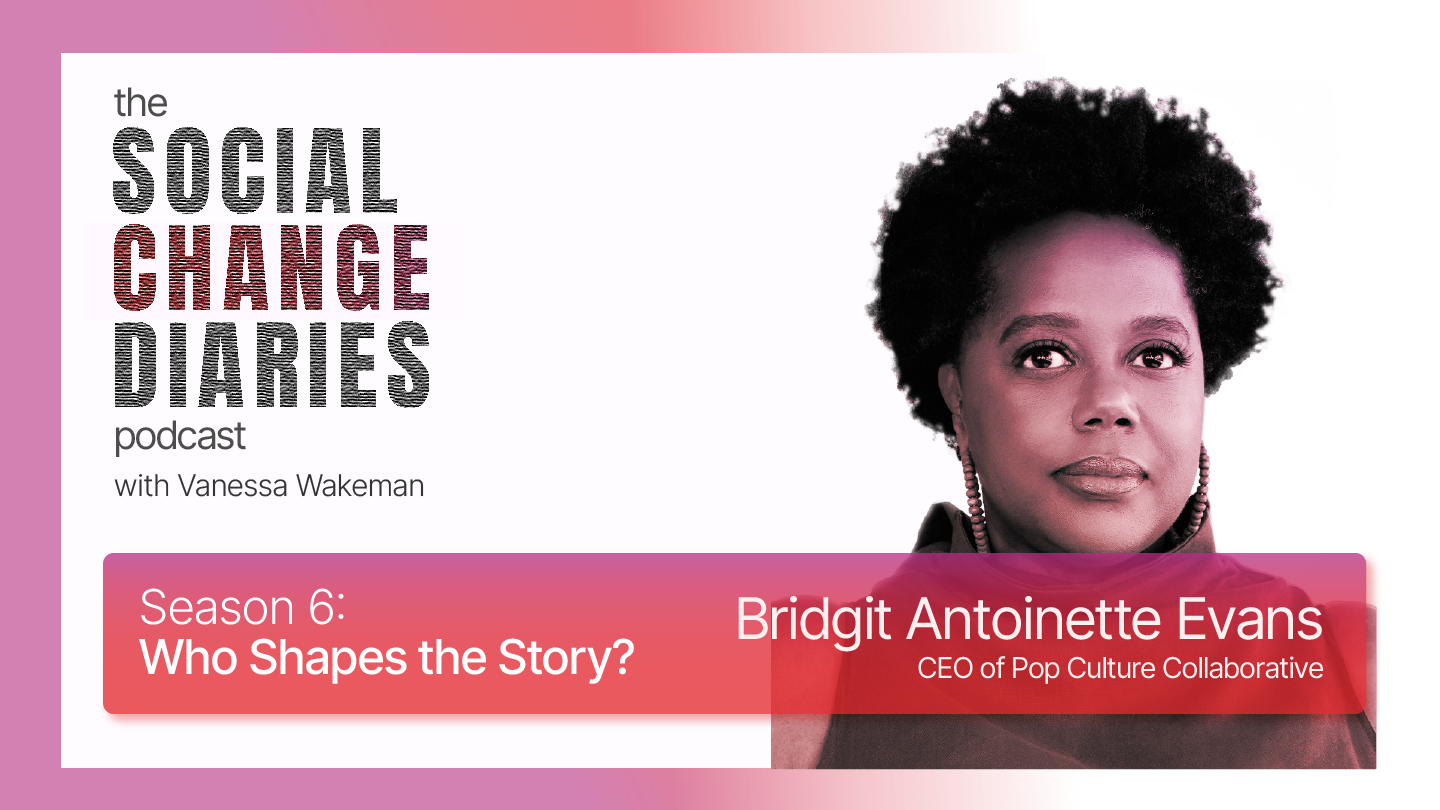
Vanessa sits down with Bridgit Antoinette Evans, CEO of Pop Culture Collaborative, to explore how storytelling can drive social change by reshaping culture and challenging deeply held beliefs. Together, they discuss the role of language as a tool for cultural transformation and what it means to navigate the vast ocean of narratives shaping our world.
About Bridgit Antoinette Evans
As a teen, Bridgit Antoinette Evans was obsessed with one question: What is the relationship between a great story and widespread cultural change? She has since explored this question of impact and scale from every angle—as an award-winning Off-Broadway and international actor-producer, a social impact advisor to high-profile artist-activists, culture change strategy designer collaborating with renowned social justice leaders, and narrative researcher for global foundations. Today, Bridgit is a widely respected narrative change thought leader, investigating this question as CEO of Pop Culture Collaborative.
In her words…
“Culture shift is when there is a sense of a tectonic shift in the norms, in the rules of society, in the way that we understand how the world works.”
“All of us are immersed in these kinds of deep, all-consuming environments—narrative oceans—except instead of water swirling around us, there are narratives and stories and ideas and norms.”
“A lot of our narrative oceans are incredibly toxic. They are dividing us, destabilizing us, creating incredible trauma in our communities, dismantling the social systems that we all care about.”
“Today, it’s not the story itself that we are congregating around. It’s actually the surround sound on a story that is the shared experience that we are having. Think about a mega successful film, like KPop Demon Hunters. It is a global phenomenon as the most-watched movie in Netflix history. But it’s not just that. It’s this huge narrative ocean of stories and content and relationships and experiences around the film that is the catalyst for cultural change. And it lasts much longer than just the film itself.”
“There is so much evidence and proof that people can change and that pop culture has a role to play, and storytelling has a role to play in how people change.”
Questions Answered on this Episode
- When we talk about culture change, through the lens of social change, what does that mean to you? What is your work, and how does it influence social change through cultural change?
- Do you think culture change drives the narrative, or is it the reverse?
- I tend to think of pop culture as trending—changing quickly—but how do you see pop culture, and how do you suggest social change organizations engage people through it?
- Where does language fit into cultural change?
- What would your advice be to an organization that wants to advance the understanding of a social issue, through the misinformation that’s out there? How can pop culture help support how people are thinking and talking about things?
- Where does technology come in? What do you see as the role of technology in cultural change as it relates to social change?
- What is the pathway for an organization that is trying to shift beliefs and shift understandings of topics that have been co-opted? How can they right the ship in this moment?
Transcript
Vanessa: Welcome to the Social Change Diaries. I’m your host, Vanessa Wakeman. Today, we are continuing our conversation about who shapes the story. I’m excited to be in conversation with Bridgit Antoinette Evans, CEO of Pop Culture Collab. She’s a leader in the field of culture change strategy. Bridgit has helped push innovation in the field of culture change by insisting that creative and social justice leaders work together to create and popularize stories that shape the narratives, values, beliefs, and behaviors that define American culture. Welcome, Bridgit.
Bridgit: Hello, it’s really great to be here.
Vanessa: So Bridgit, I’m gonna jump right in. I feel like I have so many things that I wanna ask. When we talk about culture change through the lens of social change, what does that mean to you? What is your work, and how does it influence social change through culture, cultural change?
Bridgit: I think that culture change is actually an experience that we all know when we see it, when we feel it, or when we are in the midst of it. The best way that I would describe it is moments or those periods in our society when there is a sense of tectonic shift in the norms, in the rules of society, in the way that we understand how the world works.
In the way that we understand how we work inside of our society and in the way that we understand the big ideas that shape how we make decisions and make meaning every day. So culture change looks and feels like the tectonic shift that happened in the late 60s, when our understanding of who belonged in the American project and who has the right to raise their voices into American democracy and American society. Culture shifted through the Civil Rights Movement. Culture change looks and feels like how all of us felt when marriage equality became the law of the land across the United States, and not just a legal innovation, but culturally millions and millions of people, in fact, the majority of people in this country came together and agreed that every person should have the right to experience the protections, the joys, the complications of legal marriage in this country. Those kinds of big shifts are what I would define as culture change. Now, I know we’re gonna get into it, what it takes to actually get to those big shifts, but one of the things I’ll lift up is that every big tectonic shift like that in our culture is the result of many, many, many strategies and actions and wins and defeats, right? That actually pushes a group of people who have a vision forward towards those kinds of big, big, big shift moments in our culture. The interplay between these societal level shifts and those strategies that bubble up until they become momentum for that level of change is really the work of the cultural change field.
Vanessa: So, in the way you describe the different strategies and the different things that need to happen, framing it within this conversation of who shapes the story and the idea of narrative, does culture, I have my opinion on this, but I’d love to hear yours, does the culture change drive the narrative, or is it the reverse? Is the narrative sort of shaped first, and that’s driver or one aspect of how culture change happens?
Or does culture change happen and then narrative is built out on that to like become the supreme ideal or like a governing sort of storytelling frame that folks are extracting from and working through?
Bridgit: My experience in being involved for many decades in culture change work in a variety of forms, my experience of how culture changes is actually that almost always a group of people comes together with the intention of changing culture. And through their work, through their strategies, which include redefining and reshaping the narratives, right? And then building power around those new, more transformative narratives. Through that work, over time, steadily, the momentum builds for what we call never-go-back moments, like moments when culture shifts in a way that is lasting in our society. So the thing that has helped us at the Pop Culture Collaborative think about the strategies that are enacted to create cultural change is to really think about the concept of narrative oceans. That’s what we call them, right? And oceans, because we really believe that all of us are immersed in these kinds of deep, all-consuming environments, except instead of water swirling around us, there are narratives and stories and ideas and norms and behaviors and characters even, who are constantly feeling like reality to us and shaping how we think about ourselves, think about the world around us, and think about our decisions.
On a good day, these narrative oceans are actually creating clarity. They are grounding us. They are making us access our power and agency. They are bringing us together, connecting us. So if you think about the narrative ocean that Toronto Burke and the Me Too movement sparked, and really, really uplifting the reality of harassment and violence across America, but also the power of survivorship and survivor leadership in really moving our society forward. That’s an example of a narrative ocean that made us stronger as a people, right? But the reality is, a lot of our narrative oceans that we’re immersed in today are incredibly toxic. They are not helping us. They are dividing us. They are destabilizing us. They are creating incredible trauma in our communities. They are dismantling the social systems that we all care about, that make us stronger. So the work of changing culture is first about changing those narrative oceans, right? Creating new content, new experiences, and new community spaces where people can actually engage with these different ideas, begin to try them on for size, and begin to actually move in their day-to-day lives differently, right? It’s about transformation. And when we get to a point where a narrative ocean has really reached surround sound level, where all around us, we are engaging with this new possibility and this new potential reality, we’ve created the conditions for cultural change to actually happen and last.
And that’s actually the key. It can’t just be a spark of different energy. It has to be a change that is durable and that can sustain itself, particularly when it is challenged, as we see so many shifts that have happened in our culture being challenged right now.
Vanessa: So, what you’re describing around the durability and sustainability, we refer to at Wakeman as Narrative Resilience. We want the narratives to be able to withstand opposition. We want to stress test them. I think about pop culture as being historic, things that we remember, those important moments, often popular, but not always durable. Possibly durable, but not always. I love the idea of drawing people in through pop culture, but how do we keep them engaged? How do we help organizations think about that?
Bridgit: Yeah, well, there are a couple of ways to look at it. One is that some pop culture is quick, and some pop culture is very, very slow and steady. Right? So I just started watching, believe it’s the 22nd season of Grey’s Anatomy. Right? There is a huge population, all over the world, that has been with these characters for over two decades.
And so the potential there with those shows that last for five years or seven years, or in this case, over 20 years, the opportunity to actually evolve the way that this audience is thinking about a whole range of issues, whole different communities, different kinds of work and workplaces, all of those things is really high. And a lot of people in social justice movements have deep relationships, for instance, with the producers of Grey’s Anatomy or other television shows, they can stay with those shows and with the fans and audiences of those shows for years and years and years. And we’ve seen incredible impact through that kind of long, sustained collaboration with that content. Music albums also last.
A good album, a good song, because of digital culture, can last and resurge again and again in culture. And so there are actually pop culture experiences that sustain. I think when we think about the quickness of pop culture, it’s often because we think about those stories as these independent experiences that rise and then disappear. And so, like, how do you actually create any kind of sustained momentum? I think that that’s actually a part of the way of thinking about the impact of story and content that we’re transitioning out of that, that is actually rooted in a previous way that we engaged with content. Let me give you an example. When I think about the power of pop culture to make change, and I think about my own life and my own childhood, the stories that I remember changing me, one of them that stands out is my experience as a child sitting down with my family to watch the Roots miniseries. So my family was one of the over 130 million people who sat down together at the same time to watch that miniseries.
And it created a model for how pop culture can change things at the societal level. You sit down together, you watch the same experience, and then everybody is changed by that story experience. Except that today, because we have this different media landscape, not everybody’s sitting down to watch the same things.
And certainly, very few of us are watching it at the same time because of streaming and all kinds of other ways that we discover content. So we might be inclined to think there’s no way to get to critical mass. There’s no way for us to have a shared experience because there’s so many things that we’re engaging with. But what I kind of encourage and what those on my team encourage is to really assume that, actually, we’ve moved into a place where it’s not the story itself that we’re congregating around. It’s actually the surround sound on a story that is the shared experience of pop culture that we’re having. So if you think about a mega, mega successful film like K-Pop Demon Hunters, for instance, yes, it is a global phenomenon because it is the most watched movie in Netflix history, maybe in world history, I don’t know the numbers, but it’s a big, big deal in terms of how many people have watched that film, but more so than everybody who watched the film, it’s actually all of the digital conversations that have emerged around the film.
That’s creating the water cooler. It’s the album that people have on repeat. It’s the TikTok dance videos that are teaching us the choreography from the film, or the songs from the film that everybody is singing. It’s the fashion that has been inspired by this film, the Halloween costumes that we are going to see all over our streets in just a couple of days. It’s all of the digital influencers and content creators who are riffing on all of these trends in social media. For, you know, I like to say for grownups who are in connection to all of the kids who discovered this movie and made it the popular phenomenon that it is, it’s also like the podcasts that we’re listening to and the reviews and critical analysis and all of the other content that grownups are watching to understand what all of these kids are so excited about. So it’s this huge ecosystem or narrative ocean of stories and content and relationships and experiences around K-Pop Demon Hunters that is the catalyst for change. And that lasts much, much longer than the experience of one film or even one piece of content that’s inspired by it. And we will, in fact, see that the fandom around K-Pop Demon Hunters will outlast us all, right? People will be in that fandom, in the communities that have been born as a result of that film, for many, many years to come.
Vanessa: What would your advice be to a nonprofit, based on what you just shared about K-Pop? What would your advice be to an organization that wants to advance the understanding of a social issue or some of the misinformation that’s out about it, using some of the threads of what you spoke about, and the phenomena of how pop culture can help support how people think and talk about things? How can they make things relevant?
Bridgit: Yeah. So what we are doing at the Collaborative is a lot of investing around the intersections of content, influence, leadership in the digital space, and the kinds of communications or other kinds of storytelling work that the movement is doing. So it’s not about producing the perfect video, right? Putting that online and hoping that people watch it. It’s actually about looking at where people are talking about your issues, content about your issues, following narrative leaders who are talking about your issues, and influencers who are talking about your issues, and beginning to actually dive into waters, with the assumption that building trust, contributing to community, and actually thoughtfully introducing content from other experiences into those spaces is now the work. It’s not about necessarily producing one piece of content or even producing content at all. It’s about being a trusted contributor and collaborator inside of the digital spaces, the digital communities and fandoms in which people are having conversations about the things that matter to you as an organization. So a great example of this is, for instance, our partners at United We Dream, who noticed that a lot of people, younger people of color, are actually having really, really meaty discussions about who belongs in American society inside of Twitch. Inside of video gaming communities and fandoms around video games. So they’re building a whole strategy and testing ways to actually, not kind of, you force conversations inside of those spaces, but to actually join them, join the conversations, you do so from a place of real trust and authenticity. And you are beginning to actually really build relationships with those influencers and narrative leaders who can then be kind of cultural stewards on a different level and a more justice-aligned conversation inside of those fandom spaces.
We see that kind of pivot happening across a lot of movement organizations who are figuring out how to be in community and maybe rise in leadership through authentic selection from within those communities, right? With thousands and thousands of members, who are they trusting? Who do they want to listen to? And how do you become one of them, right?
Vanessa: I love that example. It brings up for me this idea that we’ve been talking about a lot around culture and identity. Well, like find the people who have a similar shared experience and be in those conversations and try to pull people together to sort of find the strength and advance a particular agenda around a social issue. So I think that example is really valuable.
When you talked about the K-Pop example, you referenced the digital, and you just mentioned gaming. Where does technology fit in? What do you see as the role of technology in cultural change as it relates to social change? Are there particular things that we should be thinking about, or should we be prepared for from a foresight perspective? What would you say over the next one to two years, people should be paying attention to, in particular ways to engage around issues or conversations for advancing movement work?
Bridgit: Yeah. So I think that what we already know to be true, and folks like Rashad Robinson, former president of Color of Change, were really at the forefront of naming that we have to draw a different relationship with the decision makers and financiers of technological advancement, of the tech platforms that we’re all engaging with.
And we have to both do so from a place of trust and also from a place of accountability, right? Holding platforms accountable for the ways in which they are either fostering pro-social pluralist norms within their platforms, or they’re actually fostering really, really hateful, divisive behavioral norms inside of their platforms. And we’re really contending with a moment where a lot of these platforms have absolved themselves of any accountability for the harms that they’re doing. And that’s really concerning. We have to continue to build the power to engage in those more accountable conversations and negotiations and real visioning for how this could look differently. So movement power that can actually create greater accountability within tech is incredibly important.
And we’re seeing that play out in real time now as we begin to think about the implications of a hoarding of power in the evolution of AI, right? I remember being at a conference two years ago when OpenAI and others were just beginning to kind of move their products out, and people were really beginning to engage with what the possibilities of AI could look like. And what was clear in the room at this very large conference was that the number of people, the small number of people, mostly Americans, mostly men, who were in control of the direction of AI was incredibly startling and alarming. And it was because of access to money, right? The wealth that was driving the innovation was very, very behind the gates of inequity. And so now we are seeing the need to democratize not just access to AI, but access to the resources to design and to envision the use cases and to build the tools and platforms upon which millions and millions of people will engage with AI. So that’s actually really important work as well. How do we actually get to the place of ownership and agency around the development, the design, and the use cases of AI? That’s really important.
The next thing that I think is important, and an exciting area of narrative infrastructure growth, is moving to a place where movements in collaboration with philanthropy and with other investors can begin to own the next generation of tech platforms, social tech platforms in particular. So that as we’re sort of all beginning to migrate to the next generation of places where we gather, the digital water coolers, the digital community spaces that are inherently designed to generate pro-social culture, pluralist culture, just culture. We can do that. And it doesn’t necessarily mean that those platforms will be less profitable if they are for-profit ventures, or that they will be less impactful in terms of the number of people around the world who want to engage with them. You see that with sort of what’s happening with Black Sky right now, that like, if you build it, we will come. And what we want is to be the ones building it, because we can actually affect a very, very significant swath of the population and create the spaces for people to build towards the just, the pluralists, the inclusive, the democratic futures that we seek and that we need in order to survive as a human race. Like we need that evolution, and we need to work together to get there.
Vanessa: I was speaking with Safiya Noble, the author of Algorithmic Oppression, and she sort of shared some of the same points that you did about the need to build something that represents all of us and for people to have the awareness of the biases that are inherent in these platforms that we’re using and how that shapes narrative and how people walk away thinking that just because they found it online or they Googled it, it’s true.
And so wanting to make sure that there are spaces that one are safe for people, but also sort of reflect the history and the truth of what is happening, versus using someone’s opinion to influence the information as it’s shared, and what that does and the challenges that that causes. So yes, I would love us to have more inclusive spaces, and the opportunity for people to feel safe, to share the truth and what’s happening and how people are sort of impacted by those things. I wanna ask you about the concept of language relative to cultural change. Lexical discovery is something that’s really important to us as an organization. And when we’re working on communications projects with organizations, we’re always trying to help them adapt language that reflects who they are. So it may not be the most popular sort of framing that others in a sector are using or the things that people are most comfortable with, but this sort of is an accurate depiction of where your organization is today and how you want people to be talking about this thing. How do you see culture change, how do you see language? Do you feel like it is an important element of culture change? Like, is this something that as you are observing the steady stream of narrative waters becoming stronger and working together, it’s like, wow, people have adopted this language. These are the terms. We’re hearing this everywhere. Where does language fit into how you are identifying if something is taking shape? And do you think that that is something that an organization should be determining at the onset of, like, this is the change we want to see, and this is the language you want people to use, or do you see it happening organically?
Bridgit: Such an interesting question. I mean, I think what’s fascinating about culture as it moves and shifts today is how much we are actually engaging directly with language and explicitly with language as an experience of culture, right? So if you look in terms of social media, for instance, in digital culture, half of what we’re experiencing in any post is the words that people are using to express themselves, to tell a story. And even with the innovation that’s happening more recently with just transcription as a form of AI that is actually helping people to make their videos more accessible, people rely on the written word as a core part of their cultural experience more and more. And so I’m always somebody who loves writing and reading and is always fascinated with vocabulary. I am hyper aware of the ways in which we are interrogating instinctively as we’re engaging with, you know, a video about the latest dance craze or the latest song, but we are constantly engaging with and digesting language and vocabulary and the ways in which people riff on it. The other thing that’s happening is that there’s no doubt that digital culture has enabled a lot of communities that we may be not hear from to have a level, a scale of voice and influence and reach that has never before been possible.
And so each of us, each community, is bringing with us the innovation that we have around language and speech and dialect and the ways in which we’ve actually made up words and phrases that have become deeply resonant in our culture over time. We’re all bringing that to the table and then it becomes this kind of deeply intersectional call and response and riffing and people building on top of each other. And so I think actually we are now living in a space where we have to assume that how we craft language, how we invent words and phrases, how we create poetry out of the mundane in our content and in our conversations, particularly in digital culture, is now the norm. It is a part of the art form, and it is a part of cultural generation. And so I’m really excited by the ways in which that is, it’s not a function of culture. It’s actually a deeply sort of rooted aspect of cultural production.
Vanessa: I love that. I guess my last question, because we’re running out of time. If thinking about culture change, thinking about where we are today politically, the social issues that are under attack, what is the pathway for an organization that is trying to shift beliefs and shift understanding of things that have been sort of co-opted and meanings have shifted, and culture is questionable, and people are unsure, like, what does this mean? Or should I still believe in this thing? Or I’m hearing all of these stories, but I’m not sure. What is the pathway to shifting something that has been negatively held up to be true and heavily resourced to be adopted? Organizations on the other side of things are like, no, we need to reclaim this narrative. We need to culturally shift the way people are thinking about this because it’s harmful. What can be done? So I find that in our work, so often we’re hearing organizations saying, we’ve owned this issue for a very long time and everyone understood it. And now with so much distorted narratives and conversations, people are just unsure of what’s real, what they should believe. Should they still care about this? How do organizations sort of like right the ship in this moment?
Bridgit: That’s a really great question. So I’ve been really fascinated lately about the interrelationship between fact, truth, and mythology. Because all three of those things are at work in our imaginations all the time. They all have power. And I think very adept narrative strategists and narrative workers within fields understand that those three things have power. I don’t necessarily know if in the social justice movement, we fully comprehend how much power truth and mythology have. And the reason that I point that out is because the instinct that think that a lot of us in movement have is to talk about an issue as an issue, and to enter through the lens of communication as the primary way in which we try to sort of debate false information or misinformation or disinformation. And so we say, no, no, no, no, no, that’s not true. No, no, no, no, that’s not factual. This is what’s factual about immigrants, about climate, about gender justice, about the trans community, about all of these things. We say, no, no, no, no, no. And we assume that debate is the vehicle, the most powerful vehicle through which we can change the script or change the narrative. When in fact, in many cases, truth and mythology are the powerful ways in which misinformation and disinformation gain power. And we have to actually understand that we have to operate at the level of truth and mythology as well. So, for instance, a truth that some people believe to be a fact, is that if you are a guest in someone’s home, you have to play by the host’s rules. If somebody is hosting you in their home, the host’s rules go, and you are a guest. And if you don’t follow those rules, the host has every right to kick you out. That’s a truth, right? It’s a deeply held idea in our culture. is a truth. So, we might think that has nothing to do with social justice. That has to do with like, Thanksgiving dinner party or whatever. But in reality, this idea which we call like the guest covenant in our research work, deeply, deeply relates to many people’s truth around immigration. So many people believe that immigrants and I would say people of color broadly, are guests in the home that is America and that white people are the hosts.
Vanessa: Hmm.
Bridgit: That is a belief. And we see that idea rising even more today through like the heritage American narrative work that’s happening, right? So that belief is deep and it’s core and it is believed to be true. So then all of these other decisions and meaning making happens because people are aligned with that truth. And if we’re not as social justice movements contending with that truth, which isn’t fact, but it is true to many people experienced as truth, we actually have to look for other things that people believe to be true and build strategies, transformative justice aligned strategies around that truth. And the way to do that is not through debate. It is actually through storytelling. It is through cultural experience. It is through one-on-one relationships, the forging of bonds with people who may be immigrants, who may be having a different experience of belonging that was transformed through their relationships with other people. We have to find the truths and we have to build our strategies in alignment with those truths. And it’s harder, and it, I think, screws with our sense of logic sometimes, but that’s why storytelling becomes a more and more important tool in the process of getting to cultural change because someone may hold the guest covenant truth in their being and at the same time they have another truth about what it means to be a decent, kind human being, right? Those two things are worrying against each other in this person.
Vanessa: Yes.
Bridgit: But if we can actually appeal to that truth, what good, kind, decent people are, right? Then we may be able to actually override the value that a person places on the guest covenant truth that they hold. So that’s deep work. Narrative analysis, cultural analysis.
When research and lived experience and sensing of people that we have to do in order to then build the stories that activate a person’s truth about being a decent, good, kind person. For instance, there are other truths that we can actually tap into. We have to find the ones that are as strongly rooted as these really harmful toxic truths and then build our story strategies and broader narrative strategies around those.
Vanessa: Yes, yes, yes. And I very much connect that to the idea of identity and how people see themselves. Thinking about how can I, now that I know your truth, can I build on that to integrate fact and still keep truth? What I am taking from what you shared based on our understanding of the work is that folks need to really know their audience at a much deeper level than previously. We need to be thinking about what people care about, even if it’s the wrong thing, right? Because there are clues in that to help people understand if this is what they care about, I need to get them here. Like, what’s my entry point? And I find sometimes that the mythology, you know, as you mentioned, some people don’t even want to deal with that. It’s like, okay, that’s far out there. I don’t even want to deal with that because that has nothing to do with my work. And I think that in many ways that can be a bad decision, right? Like you need to understand the full picture and again, try to understand what brought someone to that place. So I feel that there is much more work in the research of the audience to understand the places where you have permission to enter the conversation with them and the places where we are totally at odds. I think the framing of the facts is really important. So often when you feel like you’re right and deeply confident that you know best that it is sometimes difficult to create that spaciousness to be in the exploration of the opposition. And I think that as we continue to see the way issues are being played out, how the media is even now telling stories, which creates a different sort of channel for people to be misinformed. There is a greater responsibility on social justice movements and nonprofits to be thinking about all of the ways and all of the actors in this ecosystem to see what we can do to advance some of these narratives and call people in. So, I think there’s a period where it’s like, okay, we know who our people is. This is our community and we’re just sort of talking to those who already believe.
And I think they’re the people who are unsure, right? We have an opportunity to pull them into our space and now is the time before they cross over. So pulling those people in and I think they’re the people who are 100 % not interested in anything we are talking about because they have a different belief system.
The real challenge, but also the greatest opportunity, is can we shift their behaviors? It sounds from your work and through my work, that is possible, but it requires an entirely different set of tools, bandwidth, and resources to do that work and for it to be meaningful.
Bridgit: Absolutely. I feel like through the work that I’ve done in a variety of movements, I have so much evidence and proof that people can change and that pop culture has a role to play and storytelling has a role to play in how people change. We have to be doing the work.
It does actually require significant investment and we do need for philanthropy and others who are financing narrative change work to hear that sustained investment in narrative strategy work and pop culture strategy work matters and is required in order to achieve the level of cultural change that we need.
Vanessa: Let’s repeat that. Long-term investment is needed in narrative for social change. I will be taking that clip and sharing it to the top 50 organizations. Folks, we do need to invest in this. Communications has for a really long time, up until recently, been seen as a “nice to have if we have money left in the budget”. It needs to have a permanent seat at the table because everything that an organization is trying to do is driven by through the way that we communicate the narrative, the storytelling, the culture change, all of those things have a calm foundation. And so we need to change behaviors around investment. So yes, yes, yes, yes, yes. Thank you for joining me for this conversation. I am sure we will be asking you to come back again and again Any parting words you’d like to share with our listeners?
Bridgit: No, I loved it. I had a really great time and I’d love to be back. And what a joy to talk to somebody who has such a depth of knowledge about this work. Your questions were amazing and I appreciate it.
Vanessa: Thank you.
Well, another great guest and another great episode. I hope today’s insights inspire you to think differently about the narrative shaping our world. Thank you for listening and for being part of our community. If you enjoyed this episode, please subscribe, leave a review, or share it with someone who would benefit from the conversation. Until next time.