
About This Episode
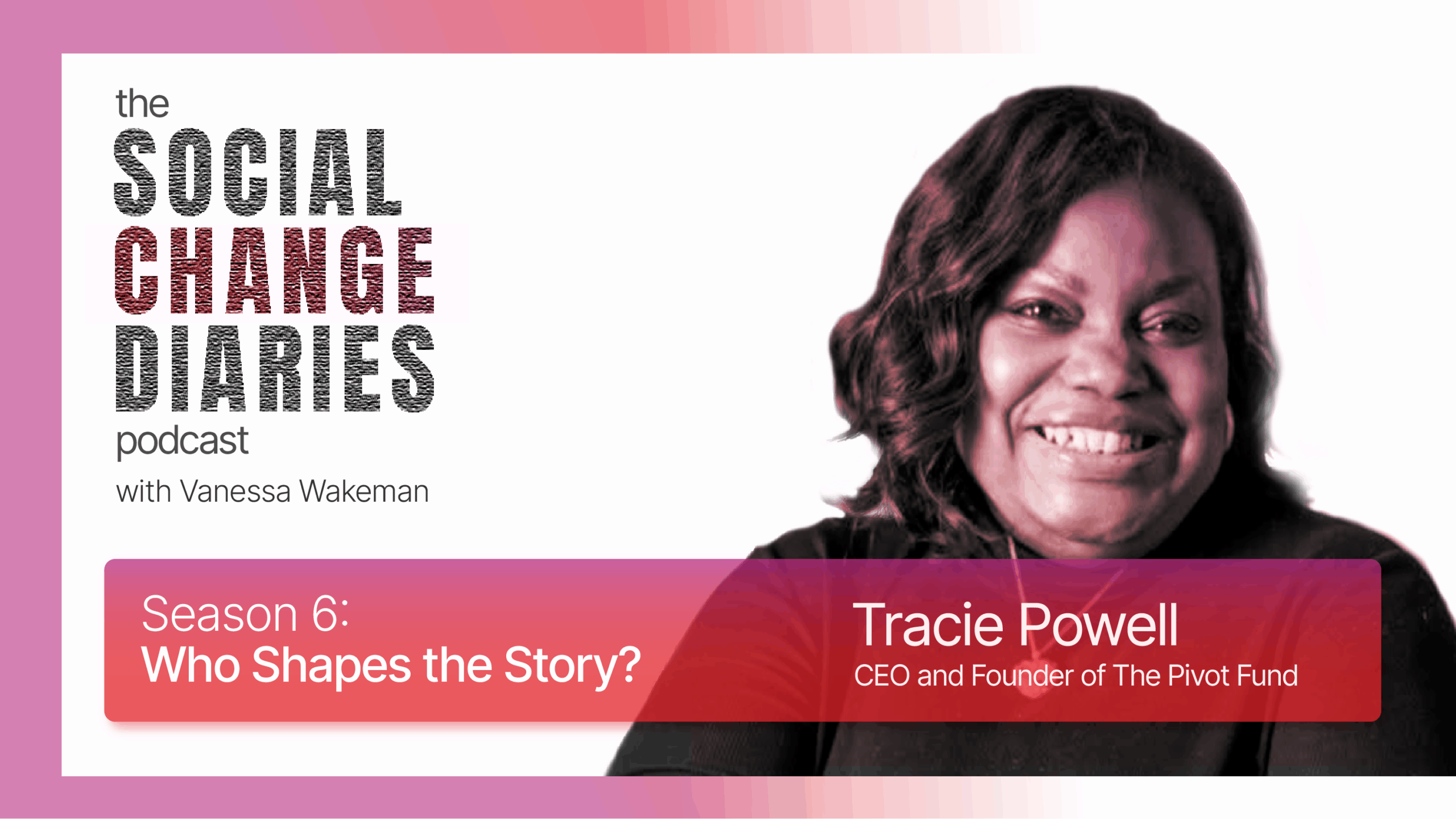
In this important conversation, Vanessa is joined by Tracie Powell, CEO and Founder of The Pivot Fund, which works to shift power through equitable journalism funding by investing in independent community-led news organizations.
About Tracie Powell
Tracie Powell, the founder of The Pivot Fund, is committed to ensuring the digital transformation of the news industry makes it more equitable and inclusive. She is the former board chair of journalism support organization, LION Publishers, and the founding fund manager of the Racial Equity in Journalism Fund at Borealis Philanthropy. She has been a fellow at Harvard, Stanford, and the Democracy Fund, and holds degrees from the University of Georgia and the Georgetown University Law Center.
In her words…
“When you talk about information ecosystems, you can’t talk about it without including nonprofits and community-based organizations as trusted messengers.”
“Storytelling shifts power when it’s produced by people with lived experience, produced with ethical standards, and amplified through durable channels that reach decision makers as well as neighbors.”
“Today, civic news and information is mutual aid. It’s conversations, it’s dialogue, it’s representation. All these things that traditional media has not been.”
“What we are seeing is that traditional news media are no longer gatekeeping. They can’t. They’re not in that position anymore.”
“We need to prioritize civic literacy, explain how systems work, why something matters for everyday life, and how readers can act. And we need to build resilience against disinformation by amplifying trusted local messengers.”
Questions Answered on this Episode
- Who shapes the story, and what is their responsibility to the public?
- How do you see community-based outlets changing the who and the how of storytelling?
- Do you see a role of nonprofits in the ecosystem of newsrooms and infrastructure for sharing news?
- When community organizations are telling news, do you see a shift in how people are telling the story?
- If you were in front of an audience of your peers and foundations, what would you recommend them to do based on what you are seeing and the needs of the community in terms of the way the news cycle and the media cycle is happening today?
- Is it a worthwhile investment (in terms of time, resources, etc.) to attempt to improve the way some legacy outlets are looking at news? Or, is it better that we focus the investment on the smaller community-based institutions?
Transcript
Vanessa: Hello, and welcome to the Social Change Diaries. I am your host, Vanessa Wakeman. As you all know, if you’ve been listening, this season we are exploring the theme, who shapes the story, and really focusing on who holds the power to tell stories, how narratives are constructed, and who benefits. And my guest today, I’m pretty confident, is going to have a lot of opinions about all of what I just said, because Tracie Powell, the CEO and founder of The Pivot Fund, is focusing on shifting power through equitable journalism funding. So I think at a time when we are having all these conversations about the news, who’s telling the stories and where the funding is and how it sort of impacts different geographies and demographics, I think that The Pivot Fund and Tracie really are sort of, if you will, pivoting and reimagining what’s possible through the news, was a former research fellow at the Harvard Kennedy School, examining mechanisms for funding and capacity building for media outlets run by Black and Indigenous people and other traditionally marginalized communities. And she has also served as the inaugural fund manager for the racial equity in journalism fund at Borealis Philanthropy.
Tracie, thank you so very much for being here with me today.
Tracie: Thank you so much, Vanessa. I’m glad to be here.
Vanessa: Thank you. So I have a lot of questions. If it’s okay with you, I want to jump right in. My first question is about traditional media. Traditional media has often dictated the dominant narratives about people, places, things, and communities. How do you see community-based outlets changing the who and the how of storytelling? Thinking about the organizations that you fund and sort of your vision for the work and what shifts, how do community-based outlets play a role in shifting who and how and how it relates to storytelling?
Tracie: Thank you for that. I think the organizations that Pivot supports, which are grassroots community news outlets, we call it civic news and information, they’re filling the gaps in local news. So, as you know, local news has collapsed as we once knew it. And so, for even when local news was healthy, and they were in, you know, just flush with cash, they still weren’t covering our communities. They often swooped in and told sensationalized stories, usually about crime or other traumas. They didn’t just, they didn’t reflect news; traditional news coverage didn’t reflect the kind of daily lived experiences of folks, poor folks, working-class folks, middle-class people, and rural people. And so now what you are seeing is that, especially among communities of color. They are taking the responsibility into their own shoulders and they are filling the gaps. They are creating and producing civic news and information that is essential to their communities, that is reflective and representative of the folks who they see every day. And not only that, these people who are filling these information gaps are trusted by their fellow community members. These are the same people that you see in the school pickup line or at the grocery store. They are neighbors, and they are trusted by the communities. I think we saw them in the last election, where traditional news was producing some decent stories, not always… Some decent stories, those stories were not reaching the people who needed it most, the voters who needed it most. And so we got what we got because people were not well-informed. But when you trust those who are on the ground, people who are engaged in the conversation, people who are living the same kinds of experiences that their neighbors are living with, and they’re out there, and they’re resourced and equipped to go get the information and disseminate it to their neighborhoods, to their communities. You’re seeing a change. I mean, this is revolutionary. It’s a sea change. It’s finally civic news and information coming from the ground up. And that’s exactly what’s needed at this moment.
Vanessa: Yeah, I agree with that. And it makes me think of two things. One, I don’t know if you had an opportunity yet to see the report that Press Forward recently released, which was focused on rethinking the news, who creates it, shares it, and sustains it. And it talked a lot about the idea of, they didn’t use the term citizen journalism, but it sort of reflected that in the report. There are civic promoters; these sorts of people are trusted resources within communities. I think it’s really important to think about who gets to tell the story and what the impact of who’s telling that story is on the people who are getting the information. One of the things we’ve been doing at the Wakeman Agency is helping organizations, specifically nonprofit organizations, think about what their role and responsibility can be in the news ecosystem. Nonprofits are among the most trusted institutions; they have the highest rate of trust among consumers, and they are, in my opinion, closest to the ground around the social issues that are happening in specific communities. And so our thinking is how can we help nonprofits to, without sort of creating an added burden, but to provide much needed information to communities, how can we help them to build out newsrooms and infrastructures because there’s so much misinformation and disinformation happening. When you think about this idea of civic engagement through the lens of what you just shared, do you see a role for nonprofits in that ecosystem? It’s sort of like being able to tell the news, or do you think that that is not a great approach to go in?
Tracie: No, absolutely. I think it’s a great idea, and it’s something that we’re already seeing happening. So part of our business model is that we go into communities and do what we call landscape analysis, or for lack of a better term, we’re going in there and doing audience research. And so we start with the community members, and we ask them, how do you get your news and information? Who do you trust for your news and information? What do you do with it once you have it? And so some of the organizations that they’ve identified are nonprofit organizations. And so we talk to those nonprofits to understand why it is that they’re so trusted and why they are considered, known, civic news and information providers. We want to understand what kinds of information they are providing. Who is it reaching? What makes it so trustworthy? So in some states that we’ve gone into, we’ve learned about nonprofit organizations that have hired journalists, and the journalists are working inside of nonprofits, and they’re producing newsletters and other pieces of content for that specific audience. I think, you know, that when you talk about an information ecosystem, you can’t talk about it without including nonprofits and community-based organizations and trusted messengers. And if that’s where the trusted messengers are at the nonprofits, then journalism needs to figure out how to partner in order to not only produce and create news, but also to partner with them in disseminating civic news and information, and to partner with them in producing civic news and information.
Vanessa: Yes. So for the people in the back, listen to that and put that on repeat over and over again, because it’s really important. Yeah. As far as your point about journalists, yes, that is absolutely something we have explored and are exploring and thinking about the ways that that can be helpful, and also trying to reorient or sort of like help people reimagine what news means, right? Like, who gets to tell the news? I think we’ve only been able to think about news and story through the lens of traditional, mainstream, and legacy, and sort of the influence and the credibility that it had. And even in the erosion of that, I think that people overwhelmingly are still keeping those standards, right? Or those assumptions around standards, even when we see that is no longer true. I think there’s an opportunity here for nonprofits and people within communities to be able to serve their audiences in a way that is incredibly helpful, educational, and creating awareness.
Tracie: Yeah, yeah, I agree. I mean, we ran into an organization. I can’t remember what state it was in, maybe Wisconsin or Michigan. It was an indigenous serving nonprofit organization. And they hired a journalist away from the traditional local outlet. That journalist had become disenchanted with She had been mistreated inside her newsroom.
Vanessa: Mm-hmm.
Tracie: She wasn’t allowed to serve or produce content really for the community she was most interested in and cared the most about. And that was the indigenous community, which she belonged to. And so when the nonprofit came around and said, “Hey, would you consider even working with us, doing what you’re already doing?” She jumped at that opportunity. And so, you know, I hope traditional newsrooms hear that and heed that because there was a reason that she left and she may not even have made as much money as she was making. And certainly, the traditional pathways up through the ranks don’t even exist anymore. But, that pathway shrank even more when she left, and she went to this nonprofit, but she gets to serve the community. She wants to serve the community. She cares most about a community that was overlooked and ignored by traditional outlets; local and regional outlets overlook this indigenous community. So, I mean, yeah, this is a no-brainer for me. And to answer your question about who shapes the story and what their responsibility is to the public, I wanted to answer that question more succinctly. Today, the story is shaped by a handful of powerful actors. You have legacy newsrooms with big budgets and distribution deals. Yes, I agree with you. They’re losing influence and credibility, but they still have big budgets and distribution deals. The story is also being shaped by platform algorithms that decide what surfaces. Advertisers and funders also influence coverage choices. And then there are the small but growing constellation of community publishers and creators, the kind that The Pivot Fund supports and the ones that you just referenced earlier that are being recognized by Press Forward and others. Each of these actors carries responsibility. Responsibility to report accurately, to center the people affected, and to measure the real world consequences of their coverage, not just clicks. To shift power, you need two things working together: capacity and distribution. Capacity means investing in community reporters, editors, and leaders who understand local context and who are accountable to their audiences. That includes those nonprofit organizations. Distribution means getting those stories out where people actually are, building partnerships with platforms, public media, schools, libraries, and civic institutions, so community narratives aren’t buried by algorithms or other noise. Storytelling shifts power when it’s produced by people with lived experience, produced with ethical standards, and amplified through durable channels that reach decision makers as well as neighbors. And I really wanted to get that out because I think, no, this is multifaceted.
And it’s all hands on deck right now. We don’t need to be turning up our noses at anybody filling information gaps, and that includes nonprofits and community members who work tirelessly, most with not even any pay, to provide information to their communities.
Vanessa: Right.
You know, as you’re saying that, I’m thinking about the legacy Black newspapers, right? How they filled a gap. There were papers and outlets that were covering stories. The Amsterdam News, the Freedom Journal, and a host of others sort of said, “Hey, we want to share this news.”
That was such a powerful transition in our history, people got to understand the issues that were emerging in their communities, they got to tell stories, and sort of see themselves represented in stories. And it feels like, you know, the pivot now is: how do we return to some of that? So when I think about this through the public relations lens, a lot of the PR engagements have been engaged on with different organizations. When we talk about local and community news, it has never received the same amount of respect for media placement. So it’s like, the local community paper in Wisconsin wants to interview your CEO because you all are doing work there, versus a Forbes or a New York Times or a Washington Post, not understanding that the people that they are trying to reach are embedded in those communities. And so I think that this may also be an opportunity to reorient people’s thinking about what is important and what is going to serve your audience most in this moment, right? It’s almost forgetting everything that we thought we knew and really taking a closer look at the landscape and understanding. If I understand where my audience is, if I understand what their needs are, if I understand what’s important to them and want to make sure that they’re getting this information, forget what the sort of old standard of, you know, “Wow, we’ve got this big placement”. If those aren’t the people you’re trying to reach, that doesn’t really help you. And so reorienting people’s thinking and then also making greater investment in how we are thinking about how we are elevating and amplifying the work of some of these smaller outlets. I think that is really important. So, I love sort of the mission of The Pivot Fund and how you are thinking about like, hey, there are lots of, as you shared, lots of organizations embedded in these communities doing this work, right? Who are, based on the example you shared about the woman who took the role, the journalist who went into a nonprofit, who are better prepared, right? They have the lived experience and the earned experience to be able to tell stories with a level of nuance that an outsider cannot. And so I think that that’s really important.
Tracie: Yeah. I mean, I can share with you that we have invested in two nonprofit organizations. One is the Sister Chavez Foundation in Arizona. They have their own radio station, Radio Campesina. And so we recently invested in Radio Campesina. It was recognized by the New Yorker magazine as one of the primary vehicles for fighting the spread of disinformation among Latinos in Texas, California, and Arizona. We understand that for that particular audience, radio is their platform of choice. And so we, as funders have to find radio. If we want to reach those folks, and more importantly, disrupt the flow and spread of disinformation among that particular community and in that audience. We also invested in an organization in California in the Mission District, Ticolote. It was another organization that focuses on Latine immigrants and people in the Mission District in San Francisco. But that was a nonprofit organization.
Let me give you some other examples. In Kansas City, Missouri, there’s an outlet called the Kansas City Defender that is led by a local organizer, Ryan Sorrell. I’ve been working with this outlet since it was about three months old, and it’s grown into a powerhouse. It recently purchased a Black bookstore that was slated to go out of business. The owner is a 90-something-year-old woman now, who started the bookstore after her daughter was murdered. This is such a valuable institution. It has original manuscripts by Frederick Douglass, so just lots of wealth. Knowledge was in this space. And so the Kansas City Defender launched a campaign to purchase the bookstore and the building.
They not only purchased that bookstore and the building, but the building will also serve as their first headquarters for the Kansas City Defender, which is phenomenal. It also digitized thousands and thousands, I think it was over 20,000 books that were in this bookstore. They’ve now digitized those books. The Kansas City Defender is a go-to source for the Black communities in Kansas City. They do grocery buy programs. They started a community garden. Recently, there was a grocery store, the last remaining grocery store in this particular Black community, shut down. The Kansas City Defender partnered with other local nonprofits to provide fresh fruits and vegetables to the community. This is journalism today. This is what civic news and information is today. It’s mutual aid, it’s conversation, it’s dialogue, it’s representation. It’s all of these things that traditional media have not been. And so that is why, when people talk to me now, I’m like, the growth market is community media. Yeah, you know, traditional media, traditional newspapers, are in market failure, but the growth market, when it comes to civic news and information, are these hyperlocal community news outlets, civic news and information outlets. And they do more than just go; their impact is beyond the page, beyond an email, beyond a screen share. They’re having an outsized impact because they are members of the community and they understand the community’s needs.
Vanessa: The idea of mutual aid through a media property, I feel is like a brilliant sort of summary and also a painful reminder of what is absent in the current sort of infrastructure of traditional media. The idea of caring about a community, being invested in the community, communities invested in me, that is certainly a model that we don’t see in some of the larger and more traditional ones. And so thank you for framing that so beautifully and having people to think about that as hopefully, because our listeners are primarily nonprofit leaders and communications professionals and foundations, as people are grappling with questions about how do we communicate what we are doing around narrative? How do we fight against these distorted narratives that are continuing to play out? It’s the idea of mutual aid, which is very much fundamentally what nonprofits are envisioning doing in other ways through programmatic aspects of what they offer. So thinking about that through a communications lens, I think is a great sort of thing to consider.
This is not specifically related to narrative and shaping the story, but I do want to ask you a question. As we are thinking about the ways that media tells the story and shapes the story, I can’t help but think about how far too often the imagery that is projected of certain demographics has a negative stereotype and inherent biases of how people are framed. If it’s something around a criminal allegation, it’s much more forgiving if the person is a hetero white male versus a Black or brown person. One of the things that our organization started about eight years ago the Narrative Justice Project. Our goal was to offer training to Black and brown people in communities who wanted to be prepared if they needed to represent an issue for their community. So how do I make sure that this story is framed in a way that is not extractive of my community, that does not paint my community in a negative light? I understand the language and approaches to doing an interview, or capturing the attention of the media if an issue bubbles up in my community. And so, you know, we’ve heard more times than not about people having issues happening in communities, and couldn’t get the attention of the media. And so, you know, nothing happens. Do you see, based on the work that you’re doing and what you’re seeing in these pockets and populations of places where there are these community organizations telling news, do you also see a shifting of how people who are being interviewed or people in those communities who are telling the stories, which is shifting to decrease bias and just the way that people feel more agency over the story? Like, there’s that trust there. So maybe I am sharing more, am engaging more, I am building relationships in a way that allows me to tell a more powerful story as the actual person in the community, versus feeling like someone externally is going to use my words against me?
Tracie: So, if from a traditional news media standpoint, I think trauma still sells, unfortunately. You know, when I was being trained as a journalist in college, the thing was if it bleeds, it-
Vanessa: It leads, yes, yes, yes.
Tracie: And so I think that traditional media is still fascinated with that framework and framing. But, you know, when you get to the hyperlocal and community level, grassroots level of civic news and information, you don’t see that trauma, that kind of trauma porn as much. This isn’t exactly what you’re talking about, but I was working with a public media outlet and they were working on a story about, reporting a story about what it was like working out in the heat here in Georgia. And I was like, yeah, the people working in the heat already know what it feels like. They know if you want to write that story for that audience, it’s a very different story. It’s about what their rights are, how many water breaks they can have. What happens if they start experiencing or feeling sick because they’re out in the heat. Their rights to access time off or what a personal time or, you know, take a break.
That’s what that story needs to look like. And that’s the kind of story that a hyperlocal community outlet like No Division Georgia or Apostle of Votes, would report. They are less concerned with trauma and more concerned with supporting and protecting their communities. And in this moment right now, it is about protection, right? They’re much more concerned about that rather than trauma porn. And they know that the other outlets are going to do that anyway. I think that’s why there’s also a proliferation of these kind of, think it’s called Citizen App and Nextdoor, where it’s about a lot of police action. It’s about, you know, people gravitating to these things because they’re being nosy about why the police cars were down there and why they saw this person being dragged or handcuffed. So people do that, but I think they want and need context. And so in order to get that context, they’re talking to each other because traditional media is letting them down. Traditional media is not providing context, and what they are providing is not always accurate. It’s coming from a police report rather than the people who were there and saw what was happening. I know there’s an outlet here in Atlanta called ATL Scoop, and there was a murder at a McDonald’s, and I had to wait for the local newspaper to print the story the next day, but it was already on ATL Scoop. Not only that, they didn’t have the video themselves of the person being killed, they linked the people in the comments were linking to the video on other platforms. I also got the truth of the matter of what actually went down and what actually happened. That police report, and therefore what the local newspaper published, was inaccurate. The truth came out because of people in the comments.The comments were going in and had the evidence to back it up. They had receipts and everything. And so, I think what we’re seeing is traditional news media are no longer gatekeeping. They can’t gatekeep. They’re not in that position anymore. More and more people are taking it upon themselves, taking the power into their own hands, to produce stories that are more reflective of their communities, but also more truthful. And so, that’s, you know, the one job that a journalist has is to tell the truth. And when we don’t do that, when we sugarcoat it, when we use language and report from just one particular point of view or perspective from a police report, instead of going out and talking to people who were directly impacted or directly witnessed what happened, when you do those things, we abdicate our responsibility as truth tellers. And that’s what you see people in the communities taking up the mantle, and they’re doing it. We’ll tell you the truth. Now, do all of them tell you the truth? No, unfortunately not, which is why we have to fight back against this flow of disinformation, and why Pivot invests in the folks who are vetted, who we go in and make sure that they’re telling the truth and disseminating credible, quality, fact-based information, news and information. We’re vetting that because we need to fund more of them to slow and stop the tide of the other stuff, of the garbage. And so I do see that changing. I see more folks on the ground, but they need to be resourced. They cannot continue doing this haphazardly because they have one or two other full-time jobs to support themselves while they’re doing this for their communities. And so that’s why Pivot Fund is out here doing the work that we’re doing because we see that there are folks out there who are putting their own bodies on the line. We just recently here in Atlanta had a reporter who was deported while covering a No Kings protest. He put his own life on the line to help keep his community safe and to tell the story. The true story about what was happening to his community at the hands of ICE. We need to stand up as funders, we need to stand up and support more of that kind of work so that people are not having to make choices and decisions between their own lives, their own families, and informing their communities. And right now that’s what we’re asking folks to do. It’s not sustainable. We can’t continue doing this.
If we continue doing what we’re doing right now, disinformation will continue to flow because we’re investing in systems that are not working. We’re going to lose the little democracy that we have.
Vanessa: I have two questions about that. For the first one, let me start with the funder piece of it. What do you see as the responsibility of philanthropy today in helping to invest in changing this ecosystem and supporting more organizations? I feel like there are camps that feel that they are focusing on the programmatic aspects of what an organization is doing, and the news will be the news, or the word will get out as it does. And then there are others who see a shift in how people are consuming information, or where their information is just absent. How do we close the gap? What do you see as the role of philanthropy? If you were in front of an audience of your peers and foundations, what would you be instructing and recommending them to do based on what you are seeing and your understanding of the needs of the community, and just the way the news cycle and the media cycle are happening today?
Tracie: Yeah, so look, democracy is a big word. Not everybody gets it. Not everybody cares because people care about what’s happening right there in front of them. They care about putting food on the table tonight, not necessarily what’s happening in Washington, D.C., but also, all politics is local. If I were in front of a group right now talking to funders, I would tell them this: democracy depends on shared facts and a common civic imagination.
News organizations have an outsized responsibility to verify relentlessly, contextualize clearly, and correct transparently. That means investing in verification and explanatory reporting so audiences can tell a true news thread from propaganda. We know most folks get their news and information from social media now. And so, it’s essential that we equip reporters and news outlets with the resources they need to tell a news thread or produce a true news thread and distinguish it from propaganda. We need to prioritize civic literacy. We need to explain how systems work, why something matters for everyday life, and how readers can act. And we need to build resilience against disinformation by amplifying trusted local messengers and creating feedback loops so communities can report and correct falsehoods. When newsrooms see themselves as civic infrastructure, not just content factories, they start to repair the public square rather than accelerate its fragmentation. And I think all of that is important from a funding standpoint. We have to fund people who are closest to the community, people who are embedded in the community. We have to fund where audiences are, right? We have to fund platforms and people that are community building and creating community cohesion, not fragmentation. For too long, media has been divisive. It’s been divisive.
The blues against the reds, poor people against the wealthy, rural people against the city folk.
Vanessa: Yes, yes, yes.
Tracie: Traditional media has played a significant role in creating these divisions, and they’ve profited off of them. So now it’s time for funders, for philanthropy to recognize this, to acknowledge that, and to invest in the correctives out there. And the correctives are in the form of hyperlocal, community grassroots, civic news and information providers. That’s where our attention and our resources need to be flowing.
Vanessa: So, in thinking about the correction, do you feel that it is a worthwhile investment in time, education, and financial resources to attempt to improve the way some of the legacy outlets are looking at news? Or do you think we are better served, and thinking about what you said about how news is hyperlocal or local, are we better served, particularly people who have often been erased or sort of silenced in some of these conversations or stories not being told, by focusing on the smaller community-based institutions? So if we had a pot of money and we were thinking about what the priority or the urgency is, is it trying to fix these organizations that have infrastructure, they just need some, you know, training and experience and sort of a shift in how they’re thinking about news, or is the better investment, and then thinking about where we are politically, who’s impacted by all of the things that are happening right now, is it better to be thinking about accelerating the investment in local organizations?
Tracie: Let me answer your question this way. Pivot has made the decision that it wants to channel its dollars to independent hyperlocal community needs and information. That means folks on the ground. That means grassroots organizations. I feel that it is our best opportunity is to invest in those organizations, those independent organizations that are already trusted by their communities. That’s where Pivot is focusing its efforts. That said, correction is structural, not just cosmetic. It isn’t enough to hire diverse faces for a newsroom photo op. You need changes to leadership, sourcing practices, beats, editorial incentives, and relationships.
So we have to do it, we kind of have to do it all right now, because if you pull money out of these big legacy organizations, then those wealthy, well-educated people who subscribe and pay attention to those big organizations are going to be lost. We need to educate those people. We need to raise awareness. We need the platforms that they are paying attention to to raise awareness about issues.
Where Pivot is focused is on hyperlocal because these folks are already trusted, which is our best bet. If we want to correct what’s happened in traditional media, we have to start there and build from the ground up. That said again, when I talk about structural correction, not just cosmetic. You know, we got to change the leadership and beats at these big traditional newsrooms. We need to put people with lived experiences and editorial leadership, and create beats that center communities rather than treating them as human interest stories. We need accountability and sourcing. We need to build community advisory boards and transparent sourcing policies so people see who decides coverage and why. We need metrics that matter. We need to move beyond engagement metrics that reward sensationalism. We need to track civic outcomes, trust, and whether coverage led to concrete fixes or policy attention. And we need funding and time. We need to fund long-term reporting and investigative efforts focused on marginalized communities, not short-term patchwork grants. When those elements are in place, news starts to reflect a more accurate human and useful picture.
Mistakes and biases are corrected as part of everyday practice. So, we need to impact those leadership and beats inside corporate media as well.
Vanessa: So those measurements that you’re talking about are all centered on a level of accountability that I don’t think I’ve ever heard anyone talk about when it comes to news. The things that I’ve read and my understanding of media and what they’re measuring are more on eyeballs. What’s our viewership? What’s the click-through rate? Those types of stories are what people are most attracted to. And you’re talking about something very different, again, around this mutual aid concept that you mentioned earlier.
Tracie: Yeah, we need to, we need to move away from the clicks, and just because somebody clicks on something doesn’t mean they actually read it. Right.
Vanessa: Right? Very true. My last question for you is around the idea of how power is built or strengthened through storytelling. So we know that there are all types of stories out there in the world today. The person who’s telling the story, who shapes the story, absolutely has a certain level of power because they get to tell the story through a specific lens. I’m wondering where the opportunity to shift power is, right? When we’re doing all of the things that you have shared in this conversation, the responsibility, the opportunity, and how local organizations are thinking about the media and the story that they’re telling, how they want to support local communities. To me, in so many ways, there’s an opportunity to change the way or where power is held, right? If I now have this information, we can do these things. I understand what’s happening in the community around me. Ideally, there’s a sense of a level of literacy to understand how systems and policies and government work, what is required for change. And so, if all of the things that you spoke about are in play, it, in my opinion, has the opportunity to change sort of where power is held and give back some of the power that has been taken from communities. Do you agree with that, what are your thoughts?
Tracie: 100%, I think at the heart of it all, storytelling is power. Whoever tells the story defines who matters, what problems exist, and which solutions are possible. For too long, that power has been concentrated in institutions that don’t reflect the full richness of our communities. And that imbalance has distorted our democracy. What The Pivot Fund is proving every day is that when you shift resources and decision making to people closest to the story, Black, Brown, Indigenous, immigrant, and rural communities, you don’t just get better journalism. You get stronger communities, more informed citizens, and a democracy that starts to work the way it was meant to, there are key components of a more just narrative ecosystem. And so, I wrote down seven components that I thought would be relevant to this conversation. Number one, you need diverse ownership and leadership. So story power sits where decision makers sit. Change the boardrooms and editors’ chairs. You know, I’m seeing so many of these news outlets that are being launched, and they are just replicating a system that we already have, a system that is already failing us. You know, I just saw one that was recently launched, and I won’t say where it is, but the CEO is a white person who’s not even not embedded or immersed in that community. And just at the top of the food chain, it already looks like this is already starting off on shaky ground. This is one of the reasons we invested in Baltimore Beat. It’s a publication for Black Baltimore, which is 65 % of the population there. And, you know, the person leading it is from Baltimore. The staff is from Baltimore, and they’re, you know, and so you need that – that key component, diverse ownership and leadership. Number two, you need sustainable funding models.
You need multi-year flexible funding plus earned revenue channels, which is what The Pivot Fund focuses on. We have three years of flexible funding, and then we support and work with the organizations through our wraparound and capacity building support to help them develop earned revenue channels to create sustainability. Number three, you need community governance. Advisory boards and participatory editorial processes that give communities veto and input power over how their communities are covered. Number four, you need shared infrastructure, cooperative back office, and distribution systems that lower costs and increase reach. Number five, you need accountability and metrics, new success metrics that we’ve already talked about, civic outcomes, trust, policy impact, alongside audience growth. Number six, you need cross-sector partnerships, collaborations with schools, libraries, public media, civic tech and nonprofits to expand reach and relevance. And last but not least, you need tech sovereignty and ethics. We need control over data and platform relationships so communities aren’t exploited by opaque algorithms. All of these together create a resilient, equitable ecosystem rather than a patchwork of projects
Vanessa: Yes, thank you for sharing those points. And I think the tech sovereignty piece is really important. In another episode of the podcast, I had a conversation with Dr. Safiya Noble, the author of Algorithmic Oppression, where she talks about the challenges with the data and how the algorithms work, and what you’re talking about, plus other aspects of it. So yes, wanting to make sure that we have that sovereignty. And then of all the seven points, there were two other things that you mentioned, this idea of revenue, the opportunity to think about this as revenue generation. Is there an opportunity to make some money from this, because that can also help to support communities? I think that’s really important and sometimes absent from how nonprofits or community-based organizations are thinking about their business model. And then going back to what we touched on earlier, this idea of accountability. What are we trying to do, and what are the measurements that we are looking at to make sure that we are providing the service that we want to and offering the greatest benefit to our community? So thank you for sharing those points.
Tracie: The future of media isn’t about saving legacy institutions. It’s about building new systems of truth-telling that are owned by and accountable to the people they serve. And that’s exactly what you’re talking about. That’s how we move from being subjects of someone else’s story to authors of our own. And that’s how we build a just, resilient narrative ecosystem where everyone’s truth counts.
Vanessa: Yes.
Tracie: That’s how we build power.
Vanessa: Thank you for that. And when you talk, you’ve mentioned a couple of times in this conversation, this idea of resilience and for us again, putting on my communications hat where we’ve been thinking about narrative resilience and the importance of an organization being able to have a narrative that can withstand and counter some of the attacks against it, like narratives that are negative or sort of backlash or threats to sort of what the truth is. And so I think that resilience aspect is really important. And I agree 100 % about the idea of what it means for our democracy and what it means for communities and people. I am really appreciative of your insights and the work of The Pivot Fund. I look forward to continuing this conversation in the future and hearing updates about what’s happening. Thank you so much.
Tracie: Thank you so much, Vanessa. I’ve enjoyed talking with you.
Vanessa: Thank you.
Vanessa: I love the idea of organizations serving as news channels or news sources because in so many ways, that is already happening. I think that Tracie’s sort of engagement, deep engagement in the work, offered a lot of examples of the way this can be done.
For us as an organization, the agency has been advocating for nonprofits to think about developing their own newsroom. And when I’m talking about a newsroom, I’m not talking about setting up a page on a website where you have press releases or this is where you contact people if you want to interview us or a listing of their placements, but to have a model at whatever size works for the organization of an actual newsroom where we are gathering stories where there’s an intentional effort about what kind of stories get elevated at what point people going out into the communities and serving as journalists. It feels in some ways, probably what some of what Tracie shared, sounds like a big lift. And yes, it can be, but there are places to start.
There’s an entry point at any level to allow an organization to tell the news and to serve the community in a different way. Think back to during COVID, there was so much misinformation and hesitancy around a vaccine and just a lack of trust and how organizations in communities really provided that trusted partnership and helped communities and people to understand what was at stake and what the importance of being vaccinated and protected was for them and their families and friends. So, thinking about that today, and what’s at risk as it relates to our democracy, and how much just wrong information and harmful information is out there. Where are the entry points for nonprofits to consistently be in conversation with those that they serve, using their lived experience and earned experiences in those communities to call in people and to reshape and shift narratives? How does that counter the other side, the opposition, and what’s being told? So I think there’s a lot to think about. I think there are a lot of opportunities and a lot of reasons why this makes sense. I’d love to hear from folks what they’re thinking about as far as the idea of nonprofits as newsrooms, the idea of engaging with information that they have and their expertise and thought leadership in a different way. How it strengthens their work and their connection, how it combats distorted information that’s coming in and being fed, and how it also offers an opportunity for more control and safety and sort of aligns with the health and the ability for a community to be thriving, like if we have information and we’re making decisions based on the truth. So please reach out to us and share your thoughts, comments, or share on the platforms. I look forward to hearing what you all are thinking about this episode, and see you next week. Thank you.