
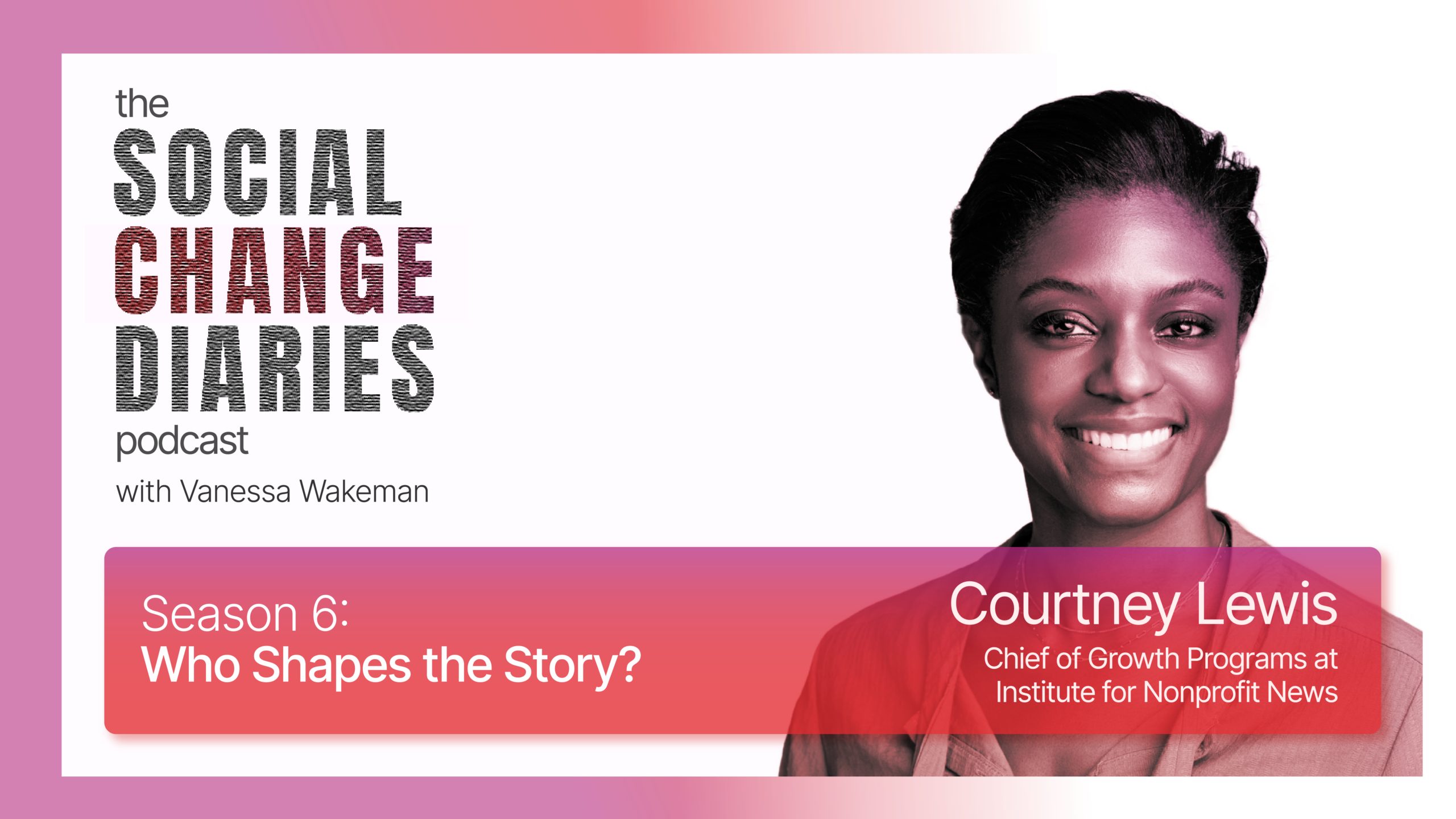
About This Episode:
In today’s episode, Vanessa sits down with Courtney Lewis, Chief of Growth Programs at the Institute for Nonprofit News (INN), an organization that works with over 500 nonprofit news organizations committed to public service. Their conversation explores why nonprofit newsrooms are different, how they center the stories audiences need, and why even conventional newsrooms are having to engage with people on a more human level.
About Courtney Lewis:
As the Chief of Growth Programs at the Institute for Nonprofit News, Courtney Lewis builds and advances programs dedicated to generating revenue and fostering diverse talent for a rapidly growing nonprofit news field. She joined INN in 2020 to lead NewsMatch, the most sophisticated collaborative fundraising campaign for journalism in the U.S. The campaign has successfully raised over $330 million for nonprofit newsrooms. Previously, she led collaborative initiatives to diversify audience and revenue for Detroit’s public radio station.
In her words…
“We see news as service, not just as information to be consumed, but as information that is in service of some greater end. And sometimes that greater end is the quality of life for the community the newsroom serves.”
“You can report on the issues of housing and how landlords aren’t doing the things they should, and are harmful to their residents. You can report on facts and now we all know what is happening, but then what? One organization produced a zine to help people navigate those situations. They created this guide—still using the journalistic skills and practices of fact checking, of resources, of identifying sources to produce the information. It just looks different than a story.”
“For success, you have to commit to allowing this newsroom to operate in a manner that is editorially independent and maybe more transparent than other areas of your work.”
“There has historically been this view of journalists as the first documenters of history, as unbiased, uninfluenced, a group of people who tell the facts and tell the truth…and were therefore trusted. And now people are responding differently, like ‘you don’t have an opinion on this? I don’t trust you.’ It’s changing.”
“We have our journalistic ethics, but what elements of those really need to remain, and what other values and ethics can we invite into our work, to be more human and more authentic?”
Questions Answered on this Episode:
- Where do you see independent news organizations really expanding right now?
- In the current climate, why do you think nonprofit news outlets are gaining popularity, given that many of the legacy organizations are still producing content?
- What conclusions can you draw from your experience with member organizations in the Institute that could be valuable for organizations to be thinking about—whether it’s through a journalistic lens concerning the kinds of content they produce, or other aspects? What lessons could be helpful to them?
- Tell me about how you see narrative power and where that sits in this conversation.
- Do you think that there is a place in the information/news ecosystem today for a point of view that considers the role of news to be in service to the audience?
- If there was one piece of advice you could give to nonprofits that are interested in starting a newsroom, but hesitant to take the first step to fully commit, what would that advice be?